 YardMate


Ampelopsis Glandulosa
Ampelopsis brevipedunculata
Easy · Beginner friendlyAbout Ampelopsis Glandulosa
Porcelain Berry is a vigorous climbing vine reaching 15-25 feet, famous for remarkable autumn fruit clusters that ripen through pastel shades of green, lilac, pink, turquoise, and deep blue on a single cluster. Beautiful but classified as invasive in much of the Mid-Atlantic, Northeast, and Southeast US, where it smothers native vegetation. Plant only where growth can be contained and monitor for escape to wild areas.
- Climbing
How to care for Ampelopsis Glandulosa
Watering
- Springevery 7 days
- Summerevery 5 days
- Fallevery 10 days
- Winterevery 21 days
Soil · Well-draining
- Top dressingPine bark mulch10%
- Main mixPotting soil + perlite 2:170%
- DrainageLECA / gravel20%
Never skip the drainage layer — standing water is the top cause of root rot.
FERTILIZER
- Springevery 30 days
At a Glance
- NativeEast Asia
- Height15–25 ft (4.6–7.6 m)
- Spread10–20 ft (3–6.1 m)
- Flower colorGreen
- Foliage colorGreen, Variegated, Red
- Fruit colorBlue, Purple
- SoilLoamy, Well-drained
- LocationsYard
Bloom time
BLOOM CYCLE
Peak bloom
Jun–Jul
Inconspicuous greenish flowers June to July
Toxicity
Humans Slight · Pets Slight
Unknown toxic principle
Slight
- Fruit
- Ingestion
EXPOSURE Eating fruit.
EFFECT Mild GI upset.
NOTE Documented concern for humans: Mild GI upset.
Slight
- Fruit
- Ingestion
EXPOSURE Eating fruit.
EFFECT Mild GI upset.
NOTE Berries not considered edible. Not on ASPCA toxic list.
Slight
- Fruit
- Ingestion
EXPOSURE Eating fruit.
EFFECT Mild GI upset.
NOTE Berries not considered edible. Not on ASPCA toxic list.
Educational information, not medical or veterinary advice. If exposure is suspected, contact a doctor or veterinarian.
DISTRIBUTION


- Native
- Introduced
- East Asia
History
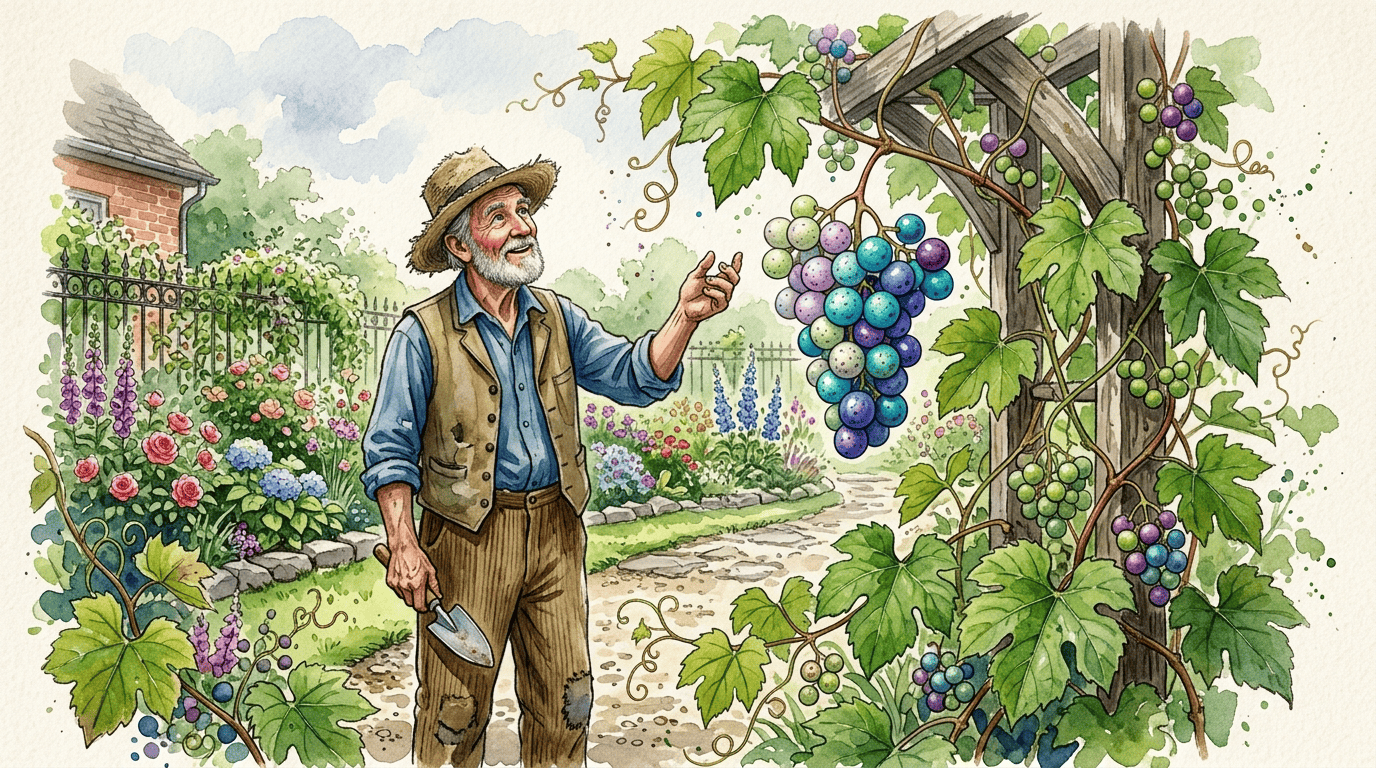
Ampelopsis brevipedunculata (now often reclassified as A. glandulosa var. brevipedunculata) is native to Japan, Korea, China, and the Russian Far East. Russian botanist Ernst Rudolph von Trautvetter described the species in 1884. The 5-10 meter deciduous woody vine superficially resembles a grape (its close relative, also in Vitaceae) with broad palmately lobed leaves and tendrils, but in autumn it produces its extraordinary display: small berries ripen through a succession of colors from pale green to yellow, lilac, turquoise, and finally deep purple—often all on the same cluster—in a unique porcelain-like speckled pattern that makes the species instantly recognizable.
Introduced to North America in the 1870s as a decorative vine, the species escaped cultivation and has become a serious invasive across the eastern United States, smothering native vegetation along riverbanks, roadsides, and woodland edges. It is listed as noxious or invasive in many northeastern and mid-Atlantic states. The variegated cultivar 'Elegans' ('Tricolor') is much less vigorous and produces far fewer viable seeds, making it a marginally safer but still discouraged option.
Introduced from East Asia to the US in the 1870s as an ornamental. Initially celebrated for its extraordinary berry colors, but by the late 20th century recognized as one of the most troublesome invasive vines in the Mid-Atlantic. Native alternatives include Parthenocissus quinquefolia and Celastrus scandens.
Symbolism & meaning
What It Symbolizes
Porcelain Berry is beauty with a warning attached — its turquoise-and-violet fruit clusters are spectacular, almost otherworldly, yet they mark it as a cautionary tale of introduced ornamentals. Sold for its glamour, it now smothers native woodland edges across much of the eastern United States. A reminder that aesthetic value alone is never reason enough to plant something far from home.
- Beauty with warning — spectacular but dangerous to ecosystems
- Caution — a cautionary tale of introduced ornamentals
Where the Name Comes From
Genus from Greek 'ampelos' (vine); 'brevipedunculata' means short-stalked.
Uses & Fun Facts
- Vigorous tendril vine cloaks fences, arbors, and walls
- Multicolored porcelain berries eaten by birds in autumn
Related plants
Plants with similar care
 Chinese AbeliaAbelia chinensis
 Fragrant AbeliaAbelia mosanensis
 Large-Flowered AbeliaAbelia uniflora
 Glossy AbeliaAbelia x grandiflora
Frequently asked questions
How often should I water Ampelopsis Glandulosa?
In summer, water about every 5 days; in winter, about every 21 days. Adjust for heat, pot size and drainage.
How much light does Ampelopsis Glandulosa need?
Full sun: 6+ hrs direct. Watch the leaves — scorching or stretching means the light needs adjusting.
Is Ampelopsis Glandulosa toxic to cats or dogs?
Pets Slight (Dogs Slight · Cats Slight) Educational information, not medical or veterinary advice. If exposure is suspected, contact a doctor or veterinarian.
Is Ampelopsis Glandulosa easy to grow?
Yes — it is considered an easy, beginner-friendly plant.
When does Ampelopsis Glandulosa bloom?
It typically blooms Jun–Jul in the Northern Hemisphere.
YardMate
Identify any plant in seconds
Snap a photo — YardMate names the plant, diagnoses problems, and reminds you when to water.
Download on the App Store