 YardMate


Spider Plant
Chlorophytum comosum
Easy · Beginner friendlyAbout Spider Plant
Chlorophytum comosum, the spider plant, is among the world's most popular and resilient houseplants. Its arching green-and-white striped leaves cascade from a central rosette, and mature plants send out long stolons bearing miniature plantlets — 'spiderettes' — that dangle like ornaments. Native to southern and tropical Africa, it adapts to nearly any indoor condition. It is a champion air purifier, famously tested in NASA's Clean Air Study. Spider plants are virtually indestructible: they store water in thick tuberous roots and bounce back from severe neglect.
- Air-purifying
- Trailing
How to care for Spider Plant
Watering
- Springevery 7 days
- Summerevery 5 days
- Fallevery 10 days
- Winterevery 14 days
Soil · Well-draining
- Top dressingPine bark mulch10%
- Main mixPotting soil + perlite 2:170%
- DrainageLECA / gravel20%
Never skip the drainage layer — standing water is the top cause of root rot.
FERTILIZER
Balanced Feed 14-14-14
An even feed covers all three needs at once, keeping leaves, roots and blooms moving together with nothing pushed out of balance.
- Nitrogen · Leaves
- Phosphorus · Roots + Blooms
- Potassium · Strength
- Springevery 30 days
- Summerevery 30 days
- Fallevery 60 days
At a Glance
- NativeAfrica
- Height1–2 ft (0.3–0.6 m)
- Spread1–2 ft (0.3–0.6 m)
- Flower colorWhite
- Foliage colorGreen, Variegated
- SoilLoamy, Well-drained
- LocationsIndoor · Balcony
Bloom time
BLOOM CYCLE
Peak bloom
Jun–Aug
Small white star-shaped flowers on stolons
Fragrance
NO FRAGRANCE
Flowers are small and not fragrant.
Toxicity
No toxicity has been reported for this plant. Still, it is wise to keep pets from chewing on any houseplant.
Educational information, not medical or veterinary advice. If exposure is suspected, contact a doctor or veterinarian.
DISTRIBUTION


- Native
- Introduced
- Africa
History

Chlorophytum comosum is native to the coastal regions of southern Africa, particularly South Africa's Cape provinces, where it grows in rocky grassland and forest edges. Introduced to Europe in the 1820s and into Victorian parlors by the 1850s, it earned its place among the handful of houseplants tough enough to survive gas-lit 19th-century rooms. Its most distinctive habit is the production of miniature plantlets at the ends of long arching stolons — a form of vegetative reproduction that makes propagation so effortless that a single plant can furnish an entire neighborhood.
NASA's 1989 Clean Air Study documented its ability to filter formaldehyde and xylene. Unusually for a common houseplant, it is confirmed non-toxic by the ASPCA to both cats and dogs, though cats are notoriously attracted to chew its leaves.
Spider plants were first documented by Swedish naturalist Carl Peter Thunberg during his 1772 expedition to South Africa. By the Victorian era, they hung in nearly every parlor window in England. In the 1970s, Swedish researchers discovered that a single spider plant could purify the air in a small sealed chamber within 24 hours, making it the poster child for green indoor living.
Symbolism & meaning
What It Symbolizes
The spider plant is pure vitality — its arching mother plant constantly throws out trailing stems hung with miniature versions of itself, generation cascading from generation in a single hanging basket. That ceaseless production of plantlets is the plant's quiet manifesto: life, given a chance, makes more life. Few houseplants make renewal so visible, or so easy to share with friends.
- Vitality — Its prolific production of offspring represents life force and renewal
Where the Name Comes From
Chlorophytum from Greek 'chloros' (green) and 'phyton' (plant). Comosum means 'tufted' or 'having a tuft of hair,' describing the plantlets.
Uses & Fun Facts
- Arching striped leaves and plantlet runners as classic hanging houseplant
Related plants
Plants with similar care
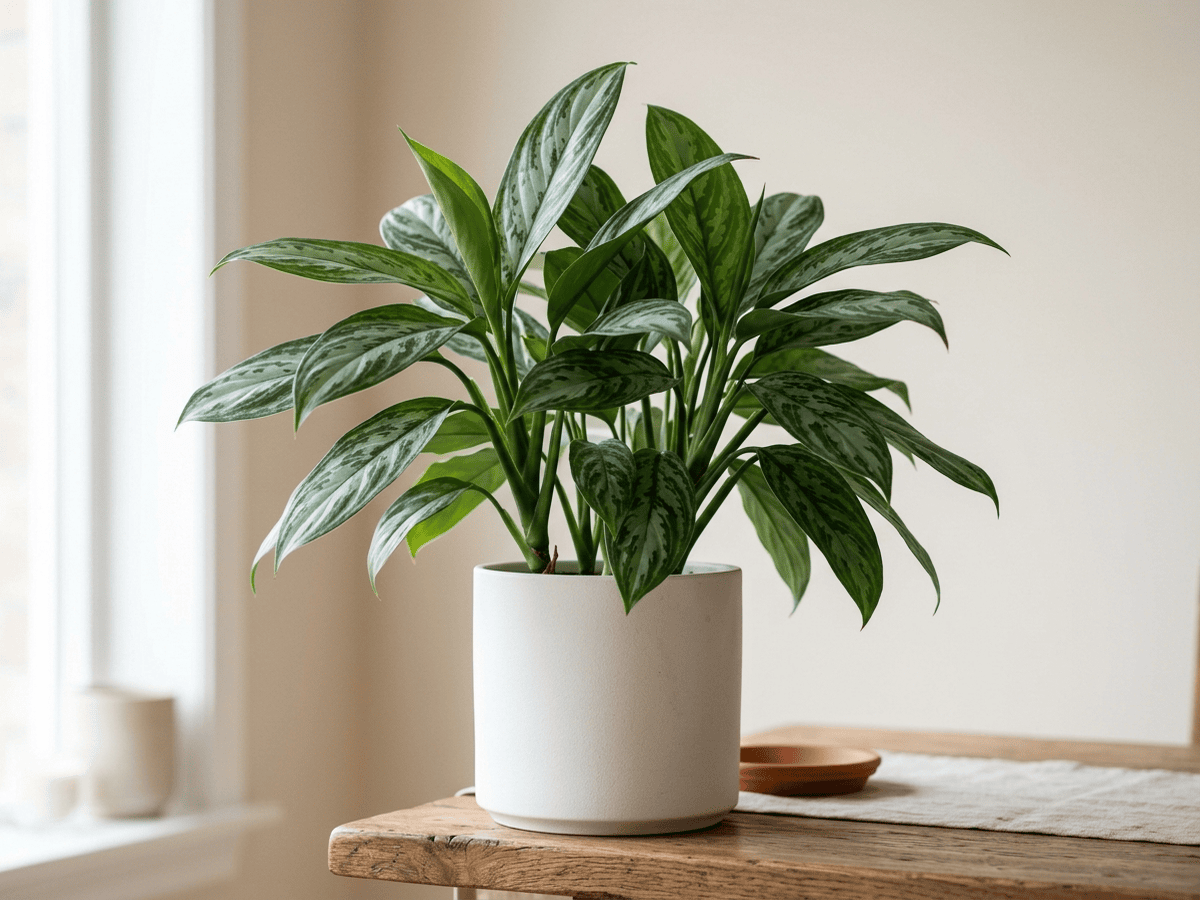 Philippine EvergreenAglaonema commutatum
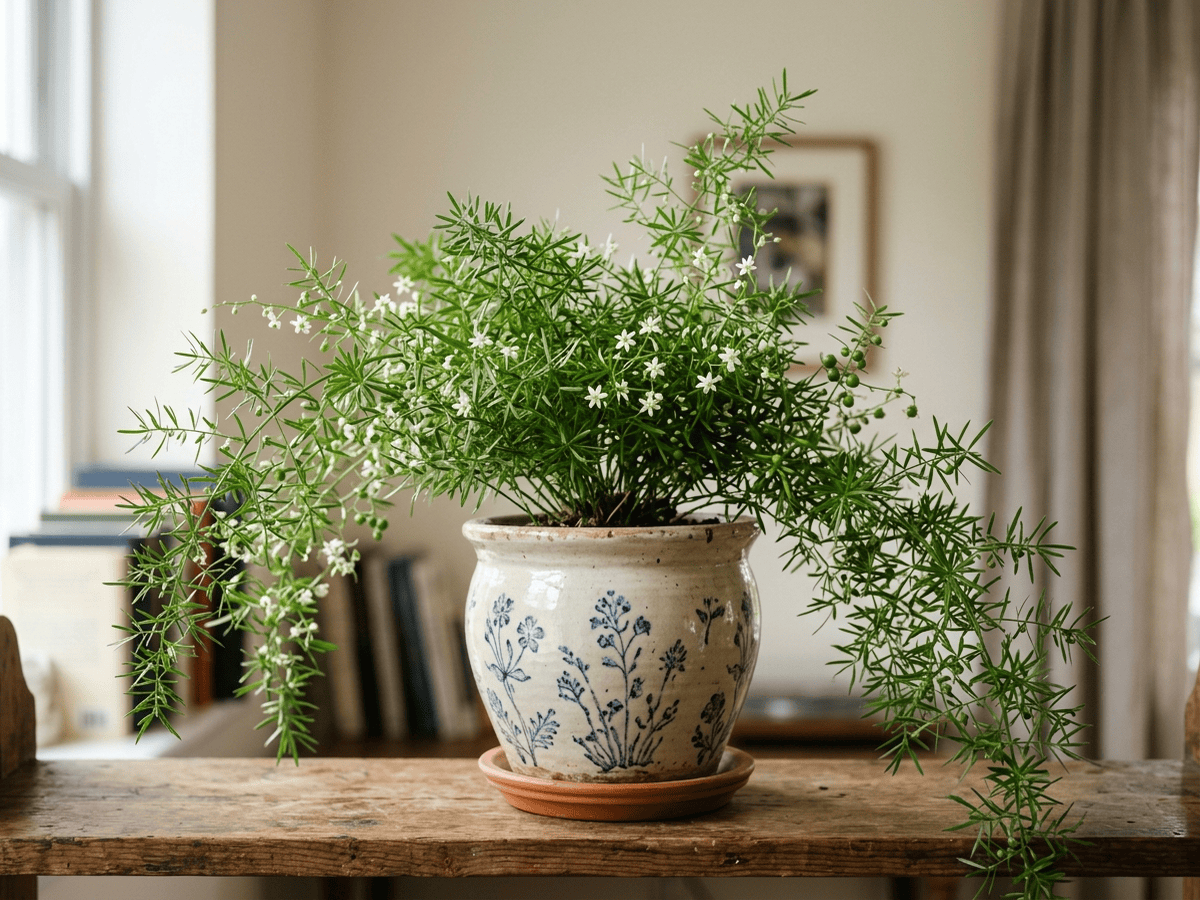 Sprenger's AsparagusAsparagus densiflorus
 Entire-Leaf False Goat’s BeardAstilbe simplicifolia
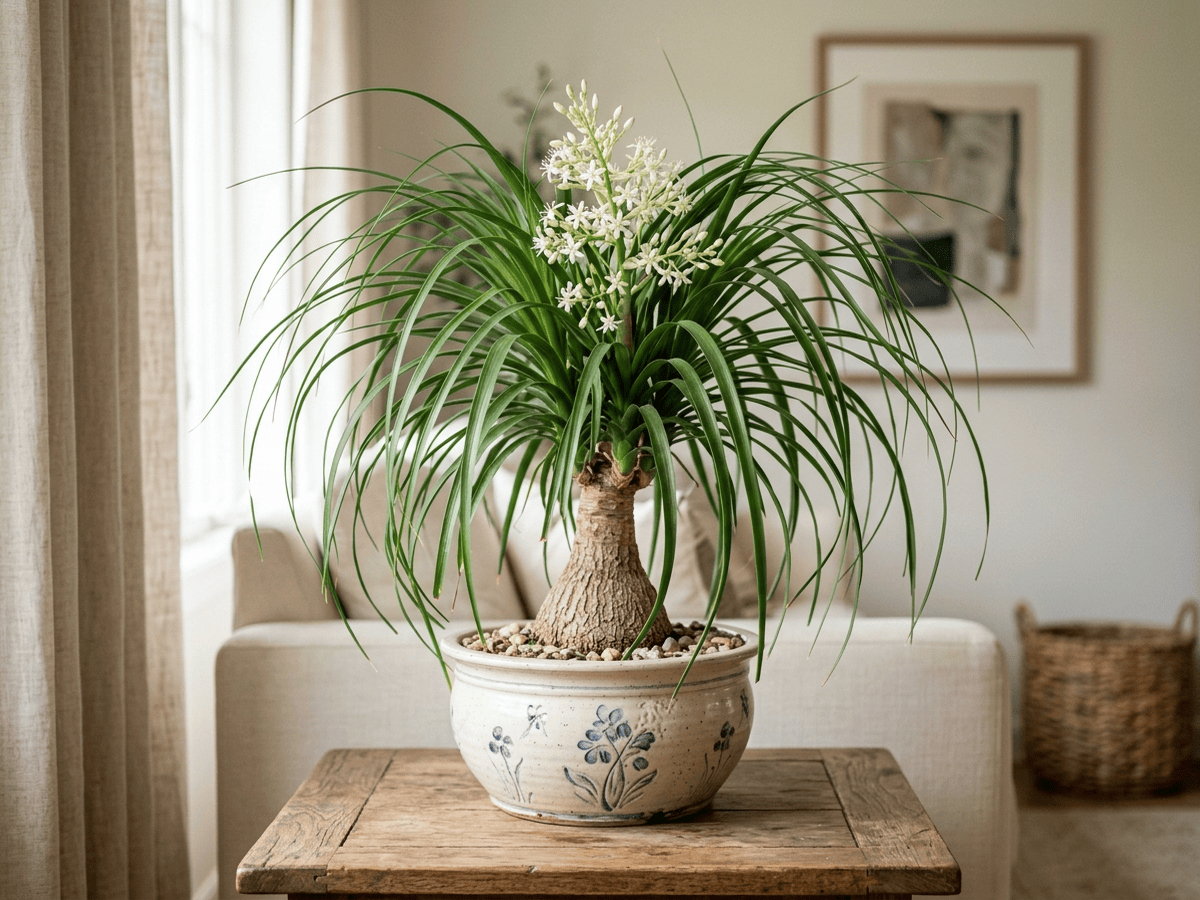 Ponytail PalmBeaucarnea recurvata
Frequently asked questions
How often should I water Spider Plant?
In summer, water about every 5 days; in winter, about every 14 days. Adjust for heat, pot size and drainage.
How much light does Spider Plant need?
Part shade: 2–4 hrs direct. Watch the leaves — scorching or stretching means the light needs adjusting.
Is Spider Plant toxic to cats or dogs?
No toxicity has been reported for this plant. Still, it is wise to keep pets from chewing on any houseplant. Educational information, not medical or veterinary advice. If exposure is suspected, contact a doctor or veterinarian.
Is Spider Plant easy to grow?
Yes — it is considered an easy, beginner-friendly plant.
Can Spider Plant be grown indoors?
Yes, it adapts well to indoor growing given the right light.
When does Spider Plant bloom?
It typically blooms Jun–Aug in the Northern Hemisphere.
YardMate
Identify any plant in seconds
Snap a photo — YardMate names the plant, diagnoses problems, and reminds you when to water.
Download on the App Store