 YardMate

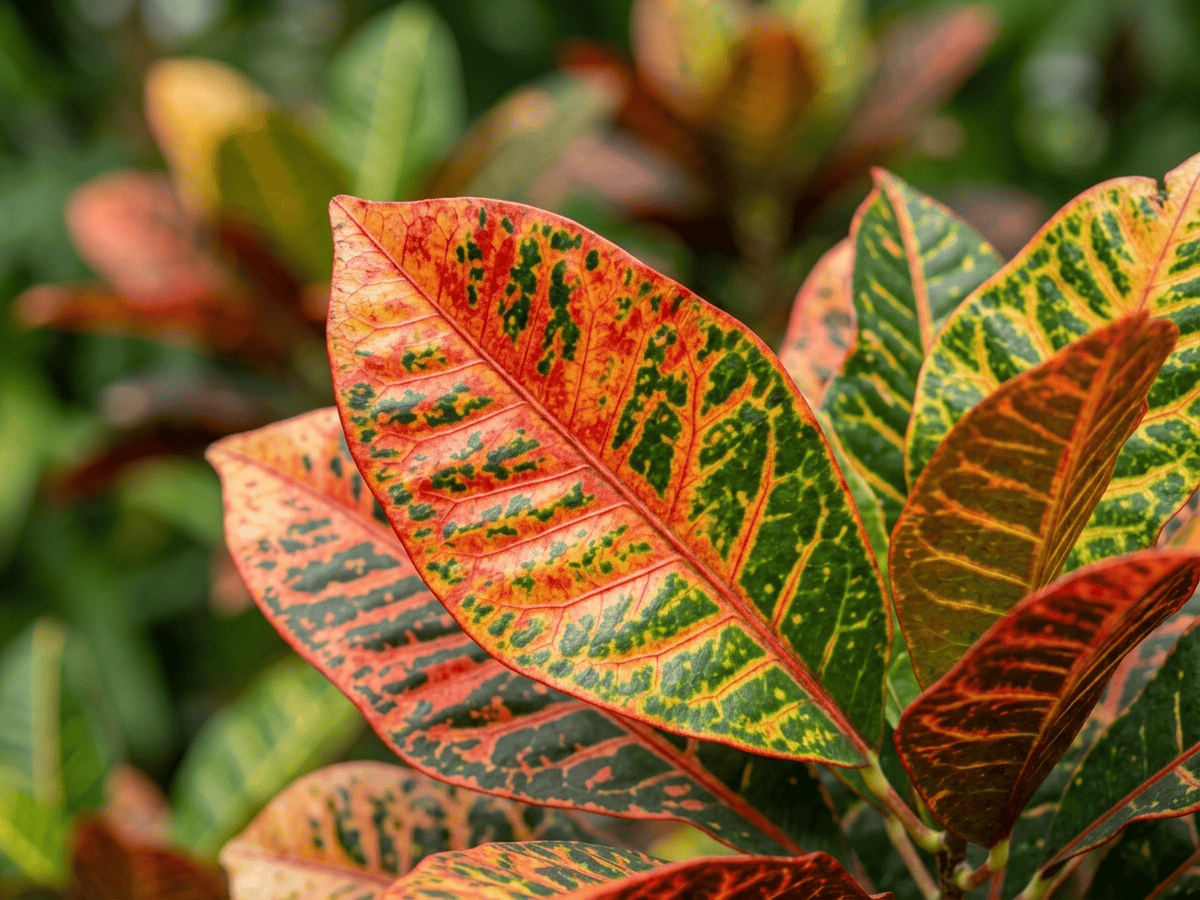


Codiaeum Variegatum
Croton variegatum
Medium · Some experienceAbout Codiaeum Variegatum
Croton variegatum (syn. Codiaeum variegatum) is a dazzling tropical shrub with leathery leaves painted in bold combinations of red, orange, yellow, green, and purple — often all on the same plant. Native to Indonesia, Malaysia, and Pacific Islands, hundreds of cultivars exist with leaves ranging from narrow and twisted to broad and oak-shaped. It demands bright light to maintain its vivid colors; in low light, new growth reverts to plain green. Crotons are notoriously dramatic about environmental changes, often dropping leaves when moved, but they recover with patience.
- Tropical
How to care for Codiaeum Variegatum
Watering
- Springevery 7 days
- Summerevery 5 days
- Fallevery 10 days
- Winterevery 14 days
Soil · Well-draining
- Top dressingPine bark mulch10%
- Main mixPotting soil + perlite 2:170%
- DrainageLECA / gravel20%
Never skip the drainage layer — standing water is the top cause of root rot.
FERTILIZER
Balanced Feed 14-14-14
An even feed covers all three needs at once, keeping leaves, roots and blooms moving together with nothing pushed out of balance.
- Nitrogen · Leaves
- Phosphorus · Roots + Blooms
- Potassium · Strength
- Springevery 30 days
- Summerevery 30 days
- Fallevery 60 days
At a Glance
- NativeSoutheast Asia, Australasia
- Height3–6 ft (0.9–1.8 m)
- Spread2–4 ft (0.6–1.2 m)
- Flower colorWhite, Yellow
- Foliage colorGreen, Yellow, Red, Bronze
- SoilLoamy, Well-drained, Rich
- LocationsIndoor · Balcony
Bloom time
BLOOM CYCLE
Peak bloom
Jun–Aug
Tiny white flowers on long racemes; insignificant
Fragrance
NO FRAGRANCE
Not fragrant.
Toxicity
Humans Slight · Pets Slight
5-deoxyingenol (diterpene ester) and latex irritants
Slight
- Leaf
- Stem
- Sap
- Contact
- Ingestion
EXPOSURE Touching leaves, stems, and sap. Eating leaves, stems, and sap.
EFFECT Skin irritation from latex sap and oral burning and GI upset if chewed.
NOTE Synonym of Codiaeum variegatum; see that record for canonical data.
Slight
- Leaf
- Stem
- Ingestion
EXPOSURE Eating leaves and stems.
EFFECT Oral irritation, vomiting, diarrhea, possible mouth and skin irritation from sap and per ASPCA listing for Codiaeum variegatum.
NOTE Synonym of Codiaeum variegatum; see that record for canonical data.
Slight
- Leaf
- Stem
- Ingestion
EXPOSURE Eating leaves and stems.
EFFECT Oral irritation, vomiting, diarrhea, possible mouth and skin irritation from sap and per ASPCA listing for Codiaeum variegatum.
NOTE Synonym of Codiaeum variegatum; see that record for canonical data.
Educational information, not medical or veterinary advice. If exposure is suspected, contact a doctor or veterinarian.
DISTRIBUTION


- Native
- Southeast Asia
- Australasia
History

'Croton variegatum' is a historical synonym — the plant was originally placed in the genus Croton by Linnaeus in 1753, but 19th-century revision moved it to Codiaeum, where it has remained. The English name 'Croton' stuck regardless, and this is probably the most persistent nomenclatural mismatch in ornamental horticulture: the true genus Croton contains entirely different plants (including the medicinal Croton tiglium, source of croton oil). The Garden Croton itself is native to Malaysia, Indonesia, the western Pacific islands, and northern Australia, where it grows as an evergreen shrub in coastal forest.
It has been intensively bred for leaf color and shape; hundreds of cultivars exist. The plant is mildly toxic from its milky latex. Crotons have been cultivated in Southeast Asian gardens for centuries, revered for their supernatural color range.
In Malay and Indonesian cultures, they are planted around temples and home entrances as protective plants — the fiery leaf colors are believed to ward off evil spirits. European plant collectors brought them to Victorian hothouses in the 1860s, sparking a 'croton craze' that rivaled orchid mania. The Victorians bred hundreds of cultivars, many of which survive today. Crotons are also significant in traditional Pacific Island medicine, where leaf poultices treat headaches and skin conditions.
Symbolism & meaning
What It Symbolizes
Codiaeum Variegatum is boldness made foliage, its leaves splashed in pigments so unapologetic they look almost printed. From tropical doorways to bright sunrooms, it celebrates courage and self-expression — a plant that refuses any quiet color palette. To live with croton is to keep a daily argument for vivid, fearless personal style.
- Boldness — Its unapologetically vivid colors celebrate courage and self-expression
Where the Name Comes From
Codiaeum derives from the Malay name 'kodiho.' Variegatum means 'variegated,' referring to the multicolored leaves. The common name 'croton' is from Greek 'kroton' (tick), originally applied to a different genus.
Uses & Fun Facts
- Multicolor leathery leaves bring vivid tropical garden accents
- Bold houseplant adds bright indoor color near sunny windows
Related plants
Plants with similar care
 Desert RoseAdenium obesum
 Tree AeoniumAeonium arboreum
 Queen Victoria AgaveAgave victoriae-reginae
 Lemon VerbenaAloysia citriodora
Frequently asked questions
How often should I water Codiaeum Variegatum?
In summer, water about every 5 days; in winter, about every 14 days. Adjust for heat, pot size and drainage.
How much light does Codiaeum Variegatum need?
Full sun: 6+ hrs direct. Watch the leaves — scorching or stretching means the light needs adjusting.
Is Codiaeum Variegatum toxic to cats or dogs?
Pets Slight (Dogs Slight · Cats Slight) Educational information, not medical or veterinary advice. If exposure is suspected, contact a doctor or veterinarian.
Is Codiaeum Variegatum easy to grow?
It is moderately demanding: a good choice once you have a little experience.
Can Codiaeum Variegatum be grown indoors?
Yes, it adapts well to indoor growing given the right light.
When does Codiaeum Variegatum bloom?
It typically blooms Jun–Aug in the Northern Hemisphere.
YardMate
Identify any plant in seconds
Snap a photo — YardMate names the plant, diagnoses problems, and reminds you when to water.
Download on the App Store