 YardMate


Deerhorn Cholla
Cylindropuntia versicolor
Easy · Beginner friendlyAbout Deerhorn Cholla
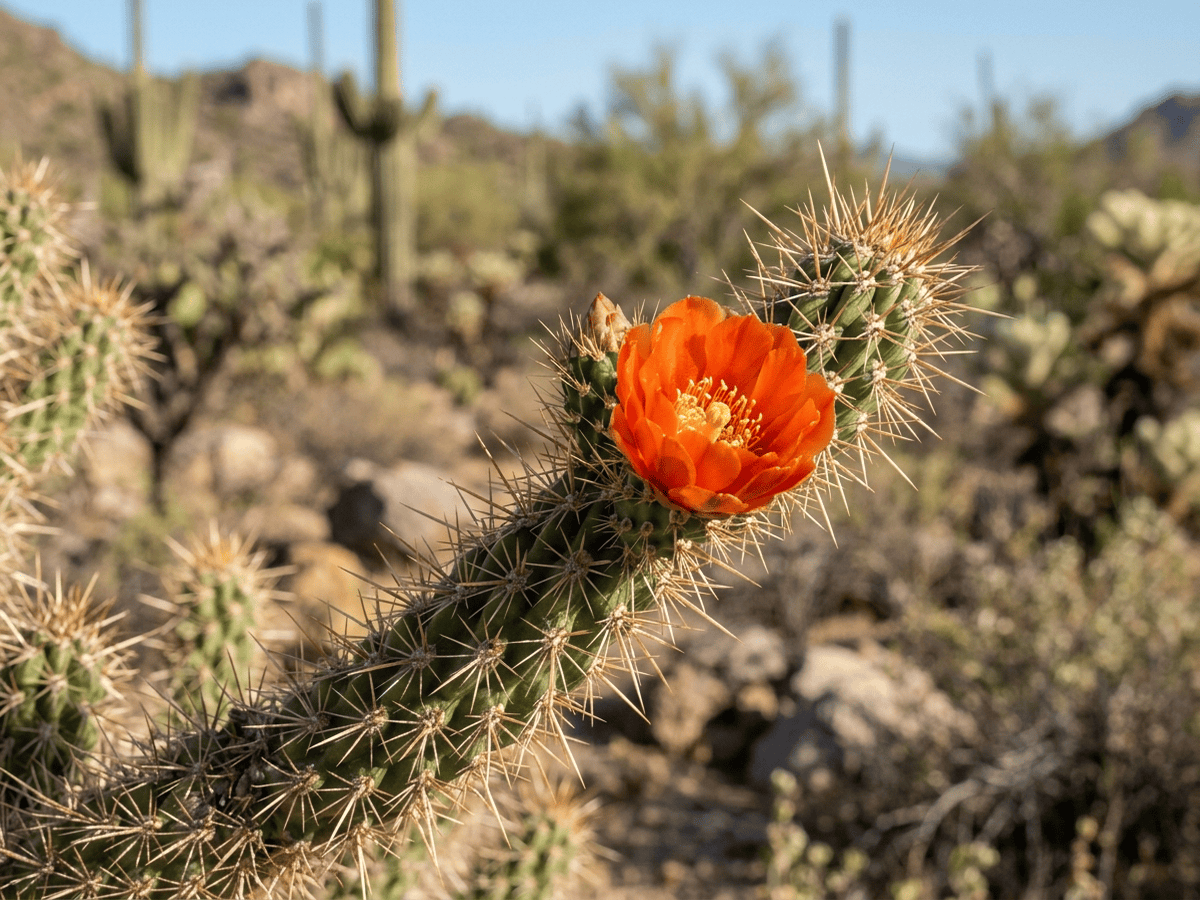
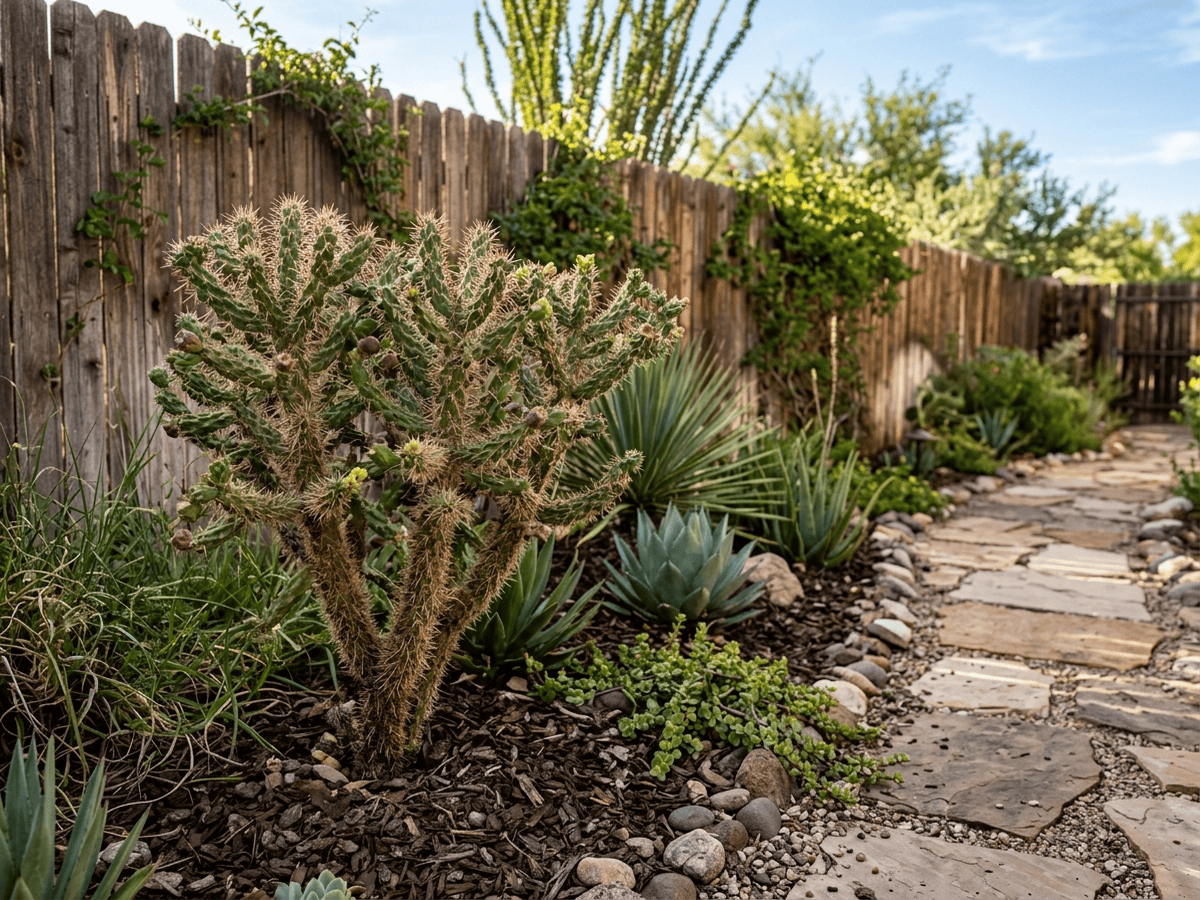
Staghorn Cholla is a Sonoran Desert cactus from Arizona and Sonora, forming branched shrub-form plants 4-8 feet tall with cylindrical jointed stems. Its flowers come in a remarkable range of colors—red, orange, yellow, pink, bronze, and green—often on the same plant, hence 'versicolor'. The branching antler-like form provides important wildlife habitat for cactus wrens and curve-billed thrashers. A signature plant of authentic Sonoran landscape design.
- Drought-tolerant
- Evergreen
- Native
How to care for Deerhorn Cholla
Watering
- Springevery 21 days
- Summerevery 21 days
- Fallevery 30 days
- Winterevery 60 days
Soil · Fast-draining
- Main mixSand + pumice + soil 1:1:150%
- DrainagePumice / gravel50%
Keep grit at half the mix or more — this soil is meant to dry out fast.
FERTILIZER
- Springevery 60 days
At a Glance
- Height4–8 ft (1.2–2.4 m)
- Spread3–6 ft (0.9–1.8 m)
- Flower colorYellow, Orange, Red, Purple
- Foliage colorGreen
- Fruit colorYellow, Green
- SoilSandy, Well-drained
- LocationsYard
Bloom time
BLOOM CYCLE
Peak bloom
Mar–May
Multicolored red, yellow, orange, bronze flowers in spring
Toxicity
Humans Slight · Pets Slight
Unknown toxic principle
Slight
- Stem
- Contact
EXPOSURE Touching stems.
EFFECT Puncture wounds.
NOTE Not chemically toxic; sheathed barbed spines are highly injurious on contact.
Slight
- Stem
- Contact
EXPOSURE Touching stems.
EFFECT Puncture wounds.
NOTE Not chemically toxic; sheathed barbed spines are highly injurious on contact.
Slight
- Stem
- Contact
EXPOSURE Touching stems.
EFFECT Puncture wounds.
NOTE Not chemically toxic; sheathed barbed spines are highly injurious on contact.
Educational information, not medical or veterinary advice. If exposure is suspected, contact a doctor or veterinarian.
DISTRIBUTION


- Native
History

Cylindropuntia versicolor, commonly called staghorn cholla, is a branching cylindrical cactus native to the eastern Sonoran Desert of southern Arizona, particularly the area around Tucson, and adjacent Sonora, Mexico, at 600-1200 meters elevation. German-American botanist George Engelmann documented the species, and American botanist John Merle Coulter validly published the name in 1896 based on Engelmann's unpublished manuscript. The epithet versicolor means variously-colored and refers to the remarkable diversity of flower colors within single populations—individual plants may bear flowers in yellow, bronze, orange, red, pink, magenta, or deep purple-brown, a range unusual for any cactus species.
Plants form 1-2 meter tall openly branching shrubs with slender cylindrical green stems 1.5-2 cm thick, bearing scattered spine clusters with 5-12 sheathed yellow spines. Flowers 2-3 cm across appear at stem tips in late spring, followed by proliferating chains of small green fruit that rarely mature seed—the plant propagates primarily by dropped segments.
Larval host for several Sonoran moths. Long recognized as a critical nesting site for cactus wrens and as a habitat plant by the Tohono O'odham. Now valued in restoration plantings and authentic Sonoran-style landscape design throughout Tucson, Phoenix, and the Southwest.
Symbolism & meaning
What It Symbolizes
Deerhorn Cholla celebrates diversity, often bearing several flower colors — red, yellow, peach, magenta — on a single sculptural plant. Beyond its bloom, it offers shelter, providing essential nesting habitat for cactus wrens and other desert birds within its prickly architecture. In the Sonoran Desert, this thorny cactus is both gallery and apartment block, beauty and refuge in one.
- Diversity — many flower colors on a single plant
- Shelter — essential nesting habitat for desert birds
Where the Name Comes From
'Cylindropuntia' refers to the cylindrical jointed stems; 'versicolor' means various-colored, for the multicolored flowers.
Uses & Fun Facts
- Spiny stems shelter cactus wrens and desert birds
- Sculptural cholla as Sonoran-desert garden focal cactus
- Multicolor flower forms for native xeriscape plantings
Related plants
Plants with similar care
 Chinese AbeliaAbelia chinensis
 Fragrant AbeliaAbelia mosanensis
 Large-Flowered AbeliaAbelia uniflora
 Glossy AbeliaAbelia x grandiflora
Frequently asked questions
How often should I water Deerhorn Cholla?
In summer, water about every 21 days; in winter, about every 60 days. Adjust for heat, pot size and drainage.
How much light does Deerhorn Cholla need?
Full sun: 6+ hrs direct. Watch the leaves — scorching or stretching means the light needs adjusting.
Is Deerhorn Cholla toxic to cats or dogs?
Pets Slight (Dogs Slight · Cats Slight) Educational information, not medical or veterinary advice. If exposure is suspected, contact a doctor or veterinarian.
Is Deerhorn Cholla easy to grow?
Yes — it is considered an easy, beginner-friendly plant.
When does Deerhorn Cholla bloom?
It typically blooms Mar–May in the Northern Hemisphere.
YardMate
Identify any plant in seconds
Snap a photo — YardMate names the plant, diagnoses problems, and reminds you when to water.
Download on the App Store