 YardMate


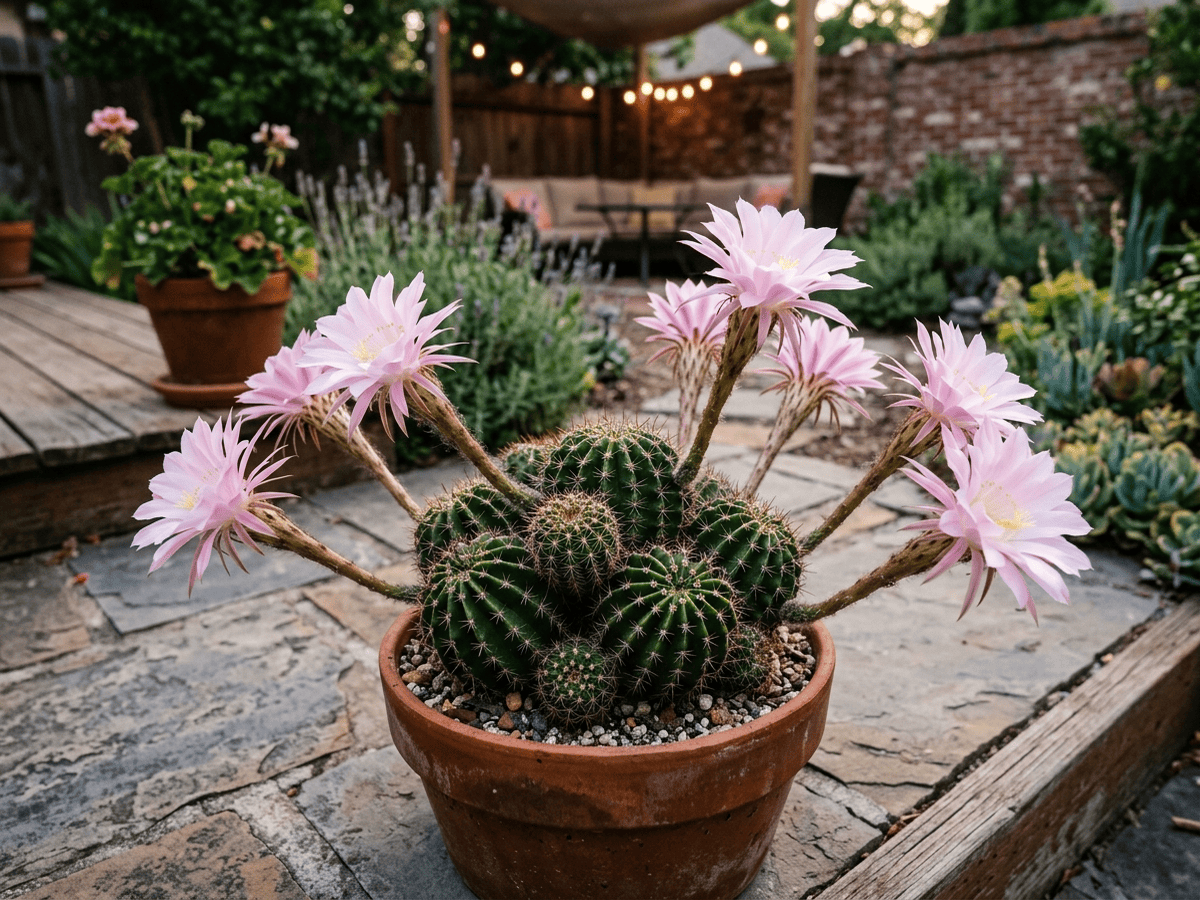
Easter Lily Cactus
Echinopsis oxygona
Easy · Beginner friendlyAbout Easter Lily Cactus
Easter Lily Cactus is a South American globular-to-columnar cactus from southern Brazil and Uruguay, forming clusters 4-12 inches tall with prominent ribs and short spines. It is most famous for its enormous nocturnal trumpet flowers—pink, white, or pale lavender blooms up to 8 inches across that open at dusk and last only one night. A classic windowsill cactus across America for its reliability and breathtaking blooms on small plants.
- Drought-tolerant
- Container-friendly
- Evergreen
How to care for Easter Lily Cactus
Watering
- Springevery 14 days
- Summerevery 14 days
- Fallevery 30 days
- Winterevery 45 days
Soil · Fast-draining
- Main mixSand + pumice + soil 1:1:150%
- DrainagePumice / gravel50%
Keep grit at half the mix or more — this soil is meant to dry out fast.
FERTILIZER
Balanced Feed 14-14-14
An even feed covers all three needs at once, keeping leaves, roots and blooms moving together with nothing pushed out of balance.
- Nitrogen · Leaves
- Phosphorus · Roots + Blooms
- Potassium · Strength
- Springevery 60 days
- Summerevery 60 days
At a Glance
- NativeSouth America
- Height0.5–2 ft (0.2–0.6 m)
- Spread1–2 ft (0.3–0.6 m)
- Flower colorPink, White, Purple
- Foliage colorGreen
- Fruit colorGreen
- SoilSandy, Well-drained
- LocationsIndoor · Balcony · Yard
Bloom time
BLOOM CYCLE
Peak bloom
Jun–Aug
Huge fragrant pink-white trumpet flowers open at night in summer
Fragrance
STRONG FRAGRANCE
Strong sweet fragrance from night-blooming flowers.
Toxicity
Pets Slight
Unknown toxic principle
Not reported
EXPOSURE No exposure route is reported.
EFFECT No toxic effect is reported.
NOTE No human toxicity is reported in this catalog; avoid eating ornamental plants unless confirmed edible.
Slight
- Stem
- Contact
EXPOSURE Touching stems.
EFFECT Puncture wounds from spines.
NOTE ASPCA/NC State treat this cactus as non-toxic. Spines are a mechanical injury hazard, not chemical toxicity.
Slight
- Stem
- Contact
EXPOSURE Touching stems.
EFFECT Puncture wounds from spines.
NOTE ASPCA/NC State treat this cactus as non-toxic. Spines are a mechanical injury hazard, not chemical toxicity.
Educational information, not medical or veterinary advice. If exposure is suspected, contact a doctor or veterinarian.
DISTRIBUTION


- Native
- Introduced
- South America
History

Echinopsis oxygona, Easter lily cactus or pink Easter lily cactus, is a clumping globose to short-cylindric cactus native to subtropical South America from southern Brazil, Uruguay, Paraguay, and northeastern Argentina. Prussian botanist Johann Heinrich Friedrich Link originally described it as Cereus oxygonus in 1827; German botanist Joseph Gerhard Zuccarini transferred it to Echinopsis in 1837 when he erected the genus. The species has long been cultivated and is widely represented in older collections under numerous synonyms (E. multiplex, E. eyriesii, etc.).
Plants form offsetting clumps of bright green globose to short-cylindrical stems 10-25 cm tall with 13-15 sharp ribs bearing woolly areoles and short brown spines. The showy feature is the enormous 15-20 cm long funnel-shaped flowers in pink, white, or pale lavender that open at night and remain through the following day, emitting a strong sweet fragrance. Each flower lasts only about 24 hours but plants typically produce several flushes per summer.
Hybridizers have developed many colorful modern cultivars. Introduced to European cultivation in the 19th century and widely propagated for its dramatic flowers. The genus Echinopsis has been widely hybridized in the US and Europe, producing thousands of named cultivars with flowers in every color.
Symbolism & meaning
What It Symbolizes
The Easter lily cactus traffics in surprise. By day it is a modest spiny ball, easy to overlook on a windowsill; by night, in midsummer, it produces flowers astonishingly large — sometimes longer than the plant itself. The wonder is amplified by their habit: they open only after dark, lasting a single night. Few garden events feel as much like a private magic show.
- Surprise — small plant produces astonishingly large flowers
- Wonder — nocturnal blooming is a magical garden event
Where the Name Comes From
The name Easter Lily Cactus describes its cactus-like form. 'Echinopsis' from Greek 'echinos' (hedgehog) and 'opsis' (resembling); 'oxygona' means sharp-angled, referring to ribs.
Uses & Fun Facts
- Globular cactus grown in pots for spectacular night-opening flowers
- Huge pink trumpet blooms appear briefly on a small spiny body
Related plants
Plants with similar care
 Chinese AbeliaAbelia chinensis
 Fragrant AbeliaAbelia mosanensis
 Large-Flowered AbeliaAbelia uniflora
 Glossy AbeliaAbelia x grandiflora
Frequently asked questions
How often should I water Easter Lily Cactus?
In summer, water about every 14 days; in winter, about every 45 days. Adjust for heat, pot size and drainage.
How much light does Easter Lily Cactus need?
Full sun: 6+ hrs direct. Watch the leaves — scorching or stretching means the light needs adjusting.
Is Easter Lily Cactus toxic to cats or dogs?
Pets Slight (Dogs Slight · Cats Slight) Educational information, not medical or veterinary advice. If exposure is suspected, contact a doctor or veterinarian.
Is Easter Lily Cactus easy to grow?
Yes — it is considered an easy, beginner-friendly plant.
Can Easter Lily Cactus be grown indoors?
Yes, it adapts well to indoor growing given the right light.
When does Easter Lily Cactus bloom?
It typically blooms Jun–Aug in the Northern Hemisphere.
YardMate
Identify any plant in seconds
Snap a photo — YardMate names the plant, diagnoses problems, and reminds you when to water.
Download on the App Store