 YardMate


Kleinkaroo Kammetjie
Freesia refracta
Medium · Some experienceAbout Kleinkaroo Kammetjie
Freesia refracta is a South African bulb producing one-sided racemes of intensely fragrant, funnel-shaped flowers in yellow, white, pink, red, orange, blue, and purple. The fragrance — sweet, fresh, and slightly spicy — is one of the most popular in perfumery and is consistently rated among the world's favorite scents. Native to the Western Cape, freesias bloom in spring from corms planted in autumn. The stems characteristically bend at a right angle ('refract'), presenting the flowers in a neat row. They are important cut flowers and excellent for cool greenhouse cultivation and containers.
- Fragrant
- Cut-flower
How to care for Kleinkaroo Kammetjie
Watering
- Springevery 5 days
- Summerevery 3 days
- Fallevery 7 days
- Winterpause watering
Soil · Well-draining
- Main mixLoam + coarse sand 3:175%
- DrainageGravel25%
Sharp drainage matters most — bulbs rot in wet soil while dormant.
FERTILIZER
Bulb Feed 3-5-3
With bulbs, when matters more than what. One dose goes in the hole at planting, the second when shoots break ground.
- Nitrogen · Leaves
- Phosphorus · Roots + Blooms
- Potassium · Strength
- Springevery 21 days
- Summerevery 21 days
At a Glance
- NativeAfrica
- Height1–1.5 ft (0.3–0.5 m)
- Spread0.3–0.5 ft (0.1–0.2 m)
- Flower colorWhite, Yellow, Pink, Red
- Foliage colorGreen
- SoilSandy, Well-drained
- LocationsIndoor · Balcony
Bloom time
BLOOM CYCLE
Peak bloom
Mar–May
Plant corms in autumn; needs cool temps; stems bend at right angle
Fragrance
STRONG FRAGRANCE
Famously sweet fruity fragrance with citrus notes; white and yellow cultivars usually most fragrant.
Toxicity
No toxicity has been reported for this plant. Still, it is wise to keep pets from chewing on any houseplant.
Educational information, not medical or veterinary advice. If exposure is suspected, contact a doctor or veterinarian.
DISTRIBUTION


- Native
- Introduced
- Africa
History
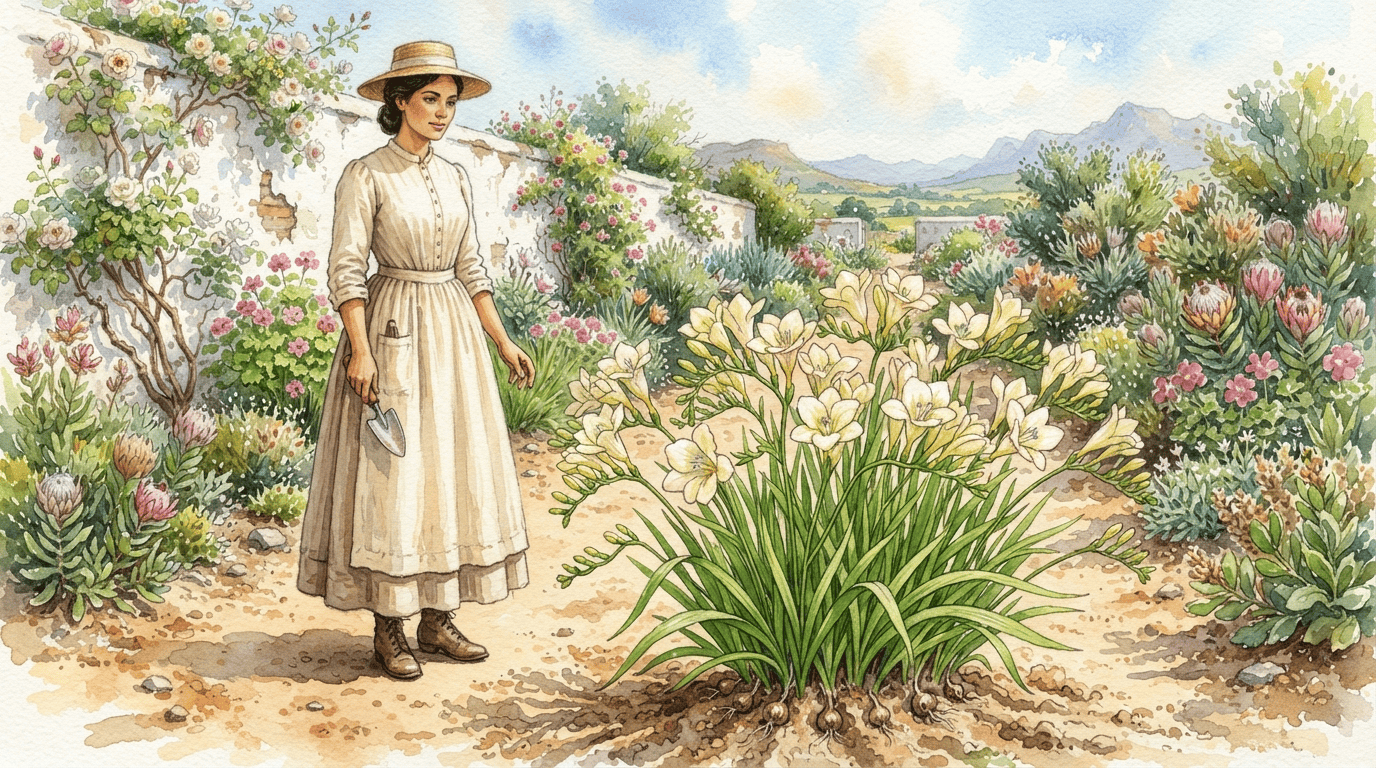
Freesia refracta is native to South Africa's Cape Province, where it grows from small corms in sandy coastal flats. The genus was named in 1866 by botanist Christian Friedrich Ecklon in honor of his German medical colleague Friedrich Heinrich Theodor Freese. Wild freesia flowers were famous in Cape colonial gardens for their exceptionally sweet fragrance, and European breeders began crossing the wild species in the late 19th century.
Modern commercial freesias are complex hybrids, and freesia is among the top ten globally traded cut flowers by volume. Japan became a major producer in the 20th century — Shimane Prefecture still runs an annual freesia festival — and the Netherlands remains the dominant European producer. Freesia is also a standard source of perfumery note names, though most 'freesia' fragrances are synthetic reconstructions.
Non-toxic to pets. The freesia's distinctive bent stem evolved to present its flowers horizontally to attract the long-tongued insect pollinators of the South African fynbos ecosystem. Dutch and Japanese breeders have expanded the color range far beyond the original yellow, with blue and double-flowered varieties now available.
Symbolism & meaning
What It Symbolizes
Kleinkaroo Kammetjie, the wild South African freesia, can symbolize innocence through its pure, sweet fragrance and gentle, slightly drooping form. Its scent is the kind that children remember without being told, simple and clean, evoking a childlike trust in the world. In the language of cut flowers, freesia has long been the bridal whisper, the flower offered when the message is one of openheartedness rather than passion, of beginnings rather than declarations.
- Innocence — Its pure, sweet fragrance and gentle form represent childlike purity and trust
Where the Name Comes From
Freesia honors Friedrich Freese, German physician. Refracta means 'bent back,' for the characteristic right-angle bend in the stem.
Uses & Fun Facts
- Funnel flowers carry intense citrus-honey perfume
- Arched stems are florist favorites for spring vases
- Bulbs forced indoors for fragrant winter pots
Related plants
Plants with similar care
 Desert RoseAdenium obesum
 Tree AeoniumAeonium arboreum
 Queen Victoria AgaveAgave victoriae-reginae
 Lemon VerbenaAloysia citriodora
Frequently asked questions
How often should I water Kleinkaroo Kammetjie?
Water about every 5 days during the growing season, and always let excess water drain away.
How much light does Kleinkaroo Kammetjie need?
Full sun: 6+ hrs direct. Watch the leaves — scorching or stretching means the light needs adjusting.
Is Kleinkaroo Kammetjie toxic to cats or dogs?
No toxicity has been reported for this plant. Still, it is wise to keep pets from chewing on any houseplant. Educational information, not medical or veterinary advice. If exposure is suspected, contact a doctor or veterinarian.
Is Kleinkaroo Kammetjie easy to grow?
It is moderately demanding: a good choice once you have a little experience.
Can Kleinkaroo Kammetjie be grown indoors?
Yes, it adapts well to indoor growing given the right light.
When does Kleinkaroo Kammetjie bloom?
It typically blooms Mar–May in the Northern Hemisphere.
YardMate
Identify any plant in seconds
Snap a photo — YardMate names the plant, diagnoses problems, and reminds you when to water.
Download on the App Store