 YardMate


Barberton Daisy
Gerbera jamesonii
Medium · Some experienceAbout Barberton Daisy
Gerbera jamesonii, the Barberton daisy, is one of the world's top five cut flowers, producing large, perfectly symmetrical daisy-like blooms up to 12 cm across in vivid red, orange, yellow, pink, white, and cream. Native to South Africa's Mpumalanga province, it was discovered near the town of Barberton in 1884. Modern hybrids range from single to fully double flowers. As a garden plant, it forms a rosette of lobed leaves with long-stemmed flowers rising above. It prefers full sun and well-drained soil. In containers and beds, it provides cheerful, long-lasting color.
- Cut-flower
- Air-purifying
How to care for Barberton Daisy
Watering
- Springevery 5 days
- Summerevery 3 days
- Fallevery 7 days
- Winterevery 10 days
Soil · Well-draining
- Top dressingPine bark mulch10%
- Main mixPotting soil + perlite 2:170%
- DrainageLECA / gravel20%
Never skip the drainage layer — standing water is the top cause of root rot.
FERTILIZER
Bloom Booster 10-52-10
A phosphorus-forward feed fuels abundant blooms, with just enough nitrogen and potassium to keep foliage and roots steady.
- Nitrogen · Leaves
- Phosphorus · Roots + Blooms
- Potassium · Strength
- Springevery 21 days
- Summerevery 21 days
- Fallevery 30 days
At a Glance
- NativeAfrica
- Height1–1.5 ft (0.3–0.5 m)
- Spread1–1.5 ft (0.3–0.5 m)
- Flower colorRed, Pink, Orange, Yellow
- Foliage colorGreen
- SoilLoamy, Well-drained, Rich
- LocationsYard · Balcony
Bloom time
BLOOM CYCLE
Peak bloom
Jan–Dec
Large daisy blooms year-round in warm climates; avoid wetting crown
Fragrance
NO FRAGRANCE
Not fragrant.
Toxicity
No toxicity has been reported for this plant. Still, it is wise to keep pets from chewing on any houseplant.
Educational information, not medical or veterinary advice. If exposure is suspected, contact a doctor or veterinarian.
DISTRIBUTION


- Native
- Introduced
- Africa
History
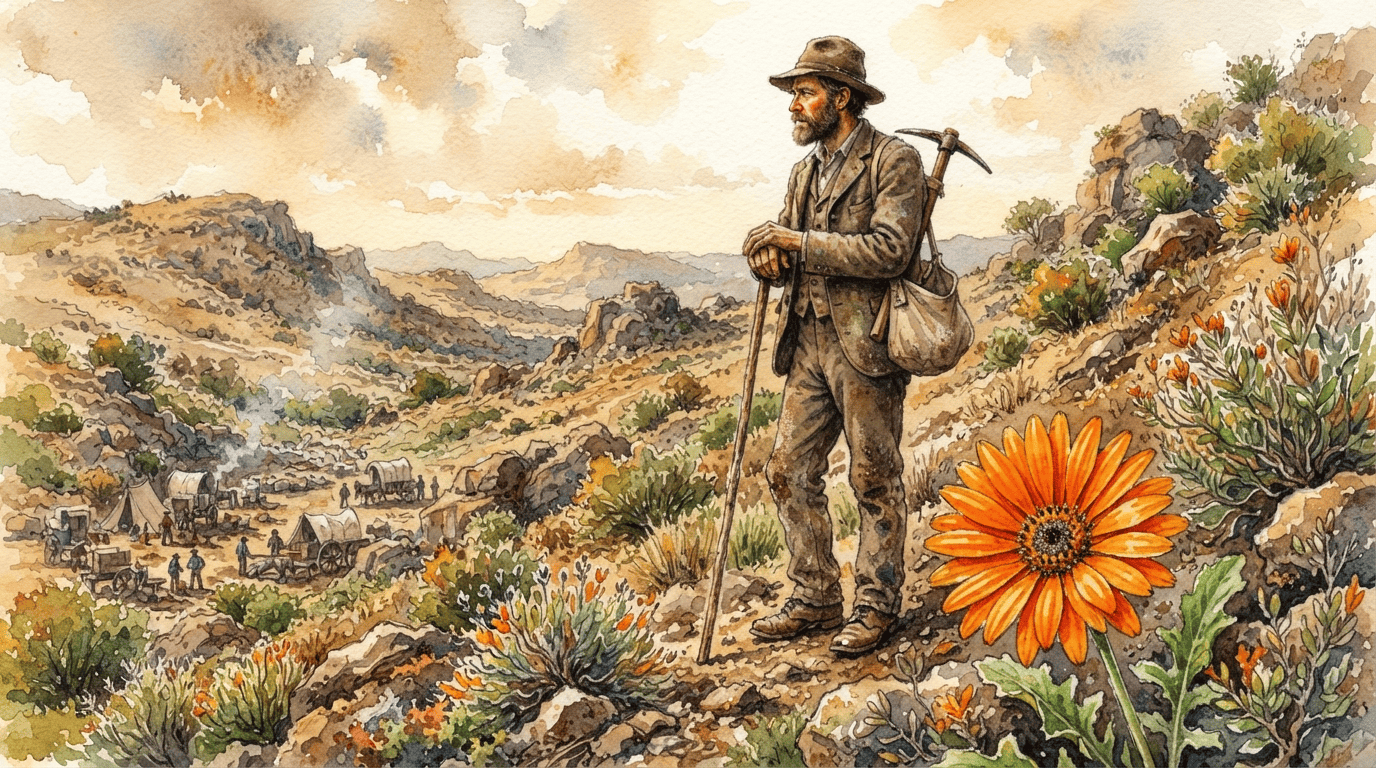
Gerbera jamesonii is native to a narrow area of South Africa's Mpumalanga (formerly eastern Transvaal) province, where Scottish gold prospector Robert Jameson discovered it in 1884 and sent specimens to the Durban Botanic Gardens. The genus was named after German naturalist Traugott Gerber, but the species honors its discoverer. British breeder Richard Lynch of Cambridge University Botanic Garden began hybridizing it with G. viridifolia in 1890, and the resulting G. × hybrida is the basis of the entire modern commercial crop.
It ranks consistently among the top five cut flowers in global trade by volume, with the Netherlands, Colombia, and Ecuador as the dominant producers. Its large bright composite flower and generous vase life make it a staple of mass-market bouquets and wedding flowers. Non-toxic to pets.
Gerbera jamesonii was discovered in 1884 by Robert Jameson near Barberton, South Africa, during the gold rush era. Dutch and Danish breeders transformed it into a commercial powerhouse — today, gerberas are the fifth most traded cut flower globally, with over 2 billion stems produced annually. NASA's Clean Air Study found gerberas effective at removing benzene and trichloroethylene from indoor air. The perfectly symmetrical flower follows the Fibonacci spiral — the florets are arranged in mathematical spirals of 21 and 34, creating the mesmerizing pattern.
Symbolism & meaning
What It Symbolizes
Barberton Daisy embodies cheerfulness, its bright, perfectly symmetrical face radiating happiness and optimistic energy as if it were drawn by a child given only the most hopeful crayons. Few flowers say 'thinking of you' quite as openly. A South African native turned global florist staple, it offers a clear, uncomplicated form of joy in every bloom.
- Cheerfulness — Its bright, symmetrical face radiates happiness and optimistic energy
Where the Name Comes From
Gerbera honors Traugott Gerber (1710–1743), German naturalist. Jamesonii honors Robert Jameson, who discovered it near Barberton, South Africa.
Uses & Fun Facts
- Bold daisy blooms in florist palettes and bridal bouquets
- Compact rosette grown in patio pots and window boxes
- Vivid daisies for sunny annual and perennial bedding
Related plants
Plants with similar care
 Mexican AbeliaAbelia floribunda
 Fraser FirAbies fraseri
 Paperbark MapleAcer griseum
 Sugar MapleAcer saccharum
Frequently asked questions
How often should I water Barberton Daisy?
In summer, water about every 3 days; in winter, about every 10 days. Adjust for heat, pot size and drainage.
How much light does Barberton Daisy need?
Full sun: 6+ hrs direct. Watch the leaves — scorching or stretching means the light needs adjusting.
Is Barberton Daisy toxic to cats or dogs?
No toxicity has been reported for this plant. Still, it is wise to keep pets from chewing on any houseplant. Educational information, not medical or veterinary advice. If exposure is suspected, contact a doctor or veterinarian.
Is Barberton Daisy easy to grow?
It is moderately demanding: a good choice once you have a little experience.
When does Barberton Daisy bloom?
It typically blooms Jan–Dec in the Northern Hemisphere.
YardMate
Identify any plant in seconds
Snap a photo — YardMate names the plant, diagnoses problems, and reminds you when to water.
Download on the App Store