 YardMate


Ginkgo
Ginkgo biloba
Easy · Beginner friendlyAbout Ginkgo
The Ginkgo is a living fossil — the sole survivor of an ancient plant family that thrived alongside dinosaurs 270 million years ago. Its unique fan-shaped leaves turn brilliant gold in autumn before dropping all at once, carpeting the ground in a spectacular golden shower. Incredibly resilient, six ginkgo trees survived the Hiroshima atomic bombing and are still alive today. Slow-growing but extremely long-lived, some specimens in China exceed 2,500 years.
- Low-maintenance
- Deer-resistant
How to care for Ginkgo
Watering
- Springevery 7 days
- Summerevery 5 days
- Fallevery 14 days
- Winterevery 30 days
Soil · Well-draining
- Top dressingPine bark mulch10%
- Main mixPotting soil + perlite 2:170%
- DrainageLECA / gravel20%
Never skip the drainage layer — standing water is the top cause of root rot.
FERTILIZER
Balanced Feed 14-14-14
An even feed covers all three needs at once, keeping leaves, roots and blooms moving together with nothing pushed out of balance.
- Nitrogen · Leaves
- Phosphorus · Roots + Blooms
- Potassium · Strength
- Springevery 60 days
At a Glance
- NativeEast Asia
- Height50–80 ft (15.2–24.4 m)
- Spread25–40 ft (7.6–12.2 m)
- Flower colorYellow, Green
- Foliage colorGreen, Yellow
- Fruit colorYellow
- SoilLoamy, Well-drained
- LocationsYard
Bloom time
BLOOM CYCLE
Dioecious; inconspicuous catkin-like male strobili in spring; female trees produce malodorous fleshy seeds
Fragrance
STRONG FRAGRANCE
Fleshy seed coat of female trees has a strong rancid-butter / vomit smell when ripe — the main reason only male trees are planted in streets.
Toxicity
Humans Moderate · Pets Moderate
ginkgotoxin (MPN), ginkgolic acids, ginkgolides, and bilobalide
Moderate
- Seed
- Fruit
- Ingestion
- Contact
EXPOSURE Eating seeds and fruit. Touching seeds and fruit.
EFFECT Raw seeds contain MPN (4-O-methylpyridoxine) causing vitamin B6 deficiency and seizures if many are eaten and fleshy seed coat contains urushiol-like ginkgolic acids causing contact dermatitis.
NOTE Leaves used in standardized extract (EGb 761) for memory support. Seeds (ginkgo nuts, a traditional Japanese ingredient) should be cooked and consumed in limited quantity. Handling the fleshy seed coat can cause severe contact dermatitis.
Moderate
- Seed
- Ingestion
EXPOSURE Eating seeds.
EFFECT Seeds potentially toxic and whole-plant leaf material generally low concern.
NOTE Leaves used in standardized extract (EGb 761) for memory support. Seeds (ginkgo nuts, a traditional Japanese ingredient) should be cooked and consumed in limited quantity. Handling the fleshy seed coat can cause severe contact dermatitis.
Moderate
- Seed
- Ingestion
EXPOSURE Eating seeds.
EFFECT Seeds potentially toxic.
NOTE Leaves used in standardized extract (EGb 761) for memory support. Seeds (ginkgo nuts, a traditional Japanese ingredient) should be cooked and consumed in limited quantity. Handling the fleshy seed coat can cause severe contact dermatitis.
Educational information, not medical or veterinary advice. If exposure is suspected, contact a doctor or veterinarian.
DISTRIBUTION

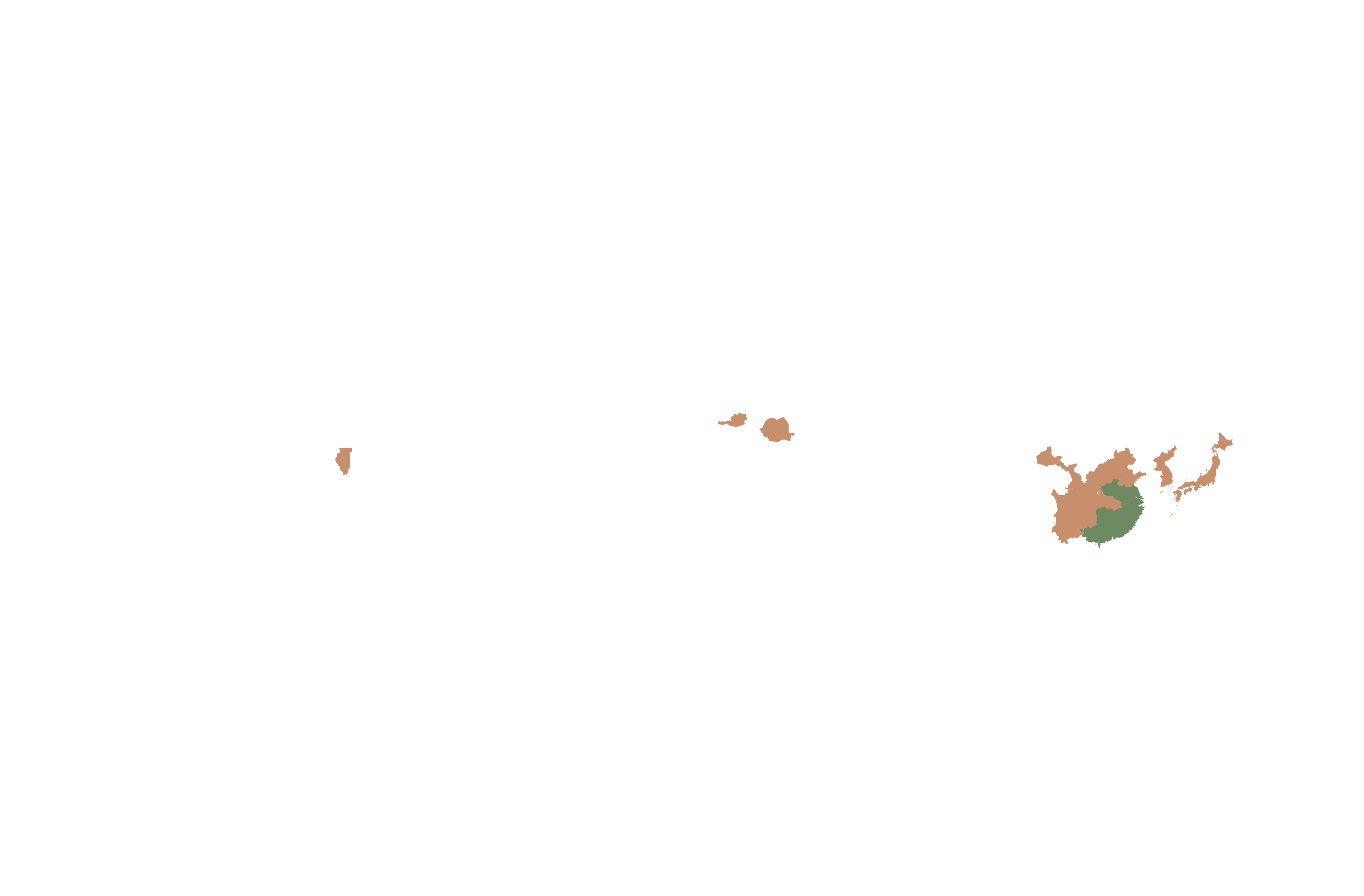
- Native
- Introduced
- East Asia
History
Ginkgo biloba is the sole surviving species of the order Ginkgoales, a lineage of gymnosperms that diversified in the Permian (about 270 million years ago), peaked in the Jurassic and early Cretaceous, and declined to near-extinction by the late Pliocene. It survived the Cretaceous-Paleogene extinction that killed the non-avian dinosaurs, making it a true "living fossil" whose leaves are essentially identical to those of Jurassic fossils. The species was preserved in a handful of isolated populations in southwestern and eastern China (the current debate is whether any population is truly "wild" or whether all survived only in Buddhist and Taoist monastery plantings), from where it was carried to Japan and Korea by Buddhist monks — hence its frequent occurrence in temple courtyards. German physician Engelbert Kaempfer observed ginkgos at Japanese temples in 1691 and named the tree in European literature; living specimens reached Utrecht around 1730.
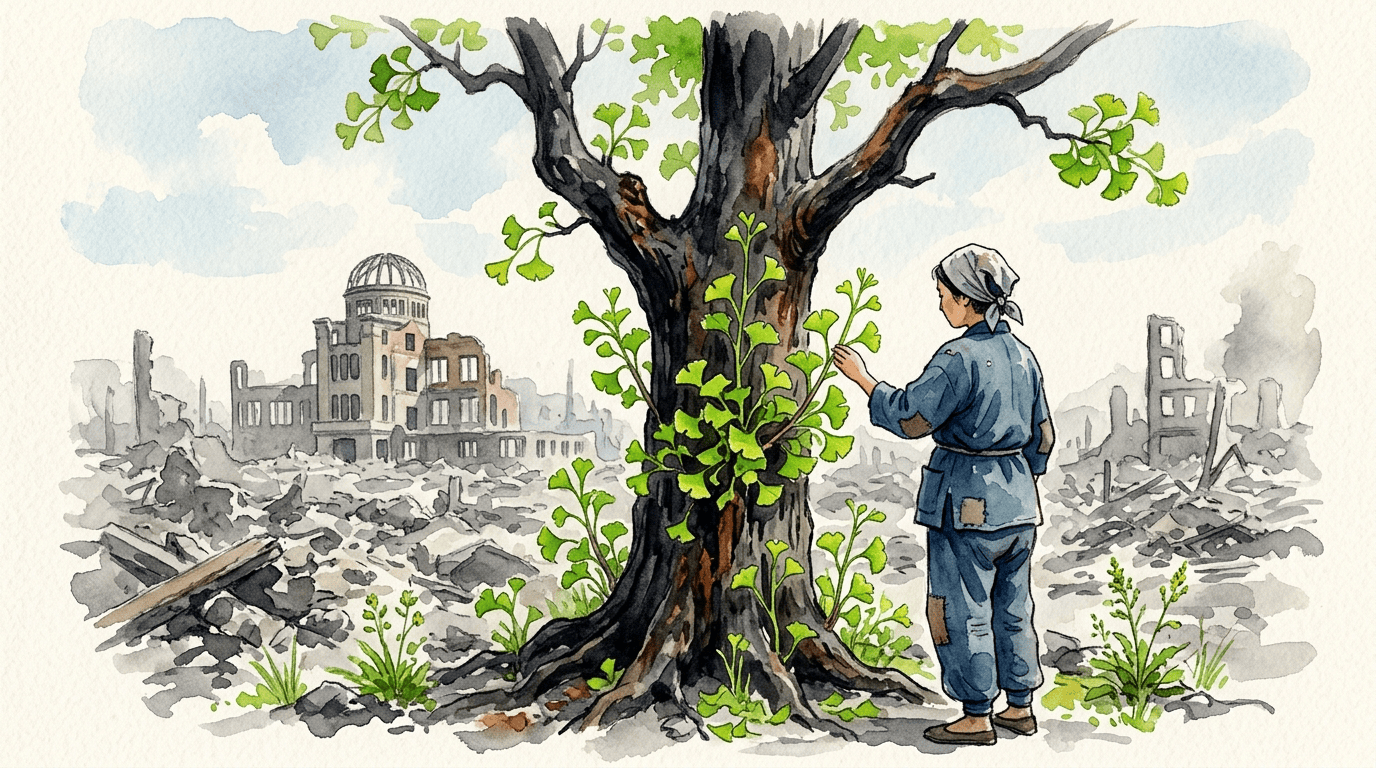
Six ginkgo trees grew within 1-2 km of ground zero of the Hiroshima atomic bombing on 6 August 1945 and survived the blast, resprouting the following spring while almost all surrounding vegetation was destroyed; all six remain alive today and are designated "hibaku jumoku" (A-bombed trees). The brilliant clear-yellow autumn color and unique fan-shaped bilobed leaves make ginkgo an iconic urban tree; only male trees are typically planted because female trees produce foul-smelling seeds. The Ginkgo survived every mass extinction for 270 million years, making it the oldest living tree species.
In China, ginkgo trees in Buddhist temples are said to be over 2,500 years old. Goethe wrote a famous love poem about the ginkgo's bilobed leaf in 1815, comparing it to two souls becoming one.
Symbolism & meaning
What It Symbolizes
The Ginkgo can symbolize hope, and there is no symbol more concrete than the small grove that survived the Hiroshima blast and grew on. Its lineage stretches back two hundred and seventy million years, the ultimate longevity, an ancient survivor older than most modern plant families. Goethe, gazing at its bilobed leaf, saw two souls becoming one, lending ginkgo a third meaning of unity. To plant a ginkgo is to plant deep time, devotion and quiet defiance all at once.
- Hope — survived Hiroshima — symbol of endurance against all odds
- Longevity — 270 million years old, the ultimate survivor
- Unity — Goethe's poem saw its bilobed leaf as two souls merging
Where the Name Comes From
'Ginkgo' from the Japanese 'gin' (silver) + 'kyo' (apricot), describing the silvery fruit. 'Biloba' means two-lobed, referring to the split in the fan-shaped leaf.
Uses & Fun Facts
- Leaf extracts long used in Chinese medicine for circulation
- Fan-shaped leaves turn brilliant gold in autumn
- Tough urban shade tree tolerant of pollution
- Roasted Ginkgo nuts eaten in East Asian cuisine
Related plants
Plants with similar care
 Chinese AbeliaAbelia chinensis
 Fragrant AbeliaAbelia mosanensis
 Large-Flowered AbeliaAbelia uniflora
 Glossy AbeliaAbelia x grandiflora
Frequently asked questions
How often should I water Ginkgo?
In summer, water about every 5 days; in winter, about every 30 days. Adjust for heat, pot size and drainage.
How much light does Ginkgo need?
Full sun: 6+ hrs direct. Watch the leaves — scorching or stretching means the light needs adjusting.
Is Ginkgo toxic to cats or dogs?
Pets Moderate (Dogs Moderate · Cats Moderate) Educational information, not medical or veterinary advice. If exposure is suspected, contact a doctor or veterinarian.
Is Ginkgo easy to grow?
Yes — it is considered an easy, beginner-friendly plant.
YardMate
Identify any plant in seconds
Snap a photo — YardMate names the plant, diagnoses problems, and reminds you when to water.
Download on the App Store