 YardMate


Beauty Bush
Kolkwitzia amabilis
Easy · Beginner friendlyAbout Beauty Bush
Beauty Bush is a Chinese deciduous shrub growing 6 to 10 feet tall with arching fountain-like form, producing masses of pink bell-shaped flowers with yellow throats in late spring. Exfoliating brown bark adds winter interest. A beloved old-fashioned American shrub since its 1901 introduction, ranked among the top spring-blooming heritage shrubs in Midwest and Northeast gardens.
- Deer-resistant
- Cold-hardy
- Pollinator-friendly
How to care for Beauty Bush
Watering
- Springevery 5 days
- Summerevery 3 days
- Fallevery 7 days
- Winterevery 14 days
Soil · Rich & loamy
- Top dressingBark mulch15%
- Main mixRich loam + compost 3:170%
- DrainageGravel15%
Use fully finished compost — fresh compost burns roots.
FERTILIZER
Balanced Feed 14-14-14
An even feed covers all three needs at once, keeping leaves, roots and blooms moving together with nothing pushed out of balance.
- Nitrogen · Leaves
- Phosphorus · Roots + Blooms
- Potassium · Strength
- Springevery 45 days
- Summerevery 60 days
At a Glance
- NativeEast Asia
- Height6–10 ft (1.8–3 m)
- Spread5–8 ft (1.5–2.4 m)
- Flower colorPink
- Foliage colorGreen, Yellow
- SoilWell-drained, Loamy, Neutral
- LocationsYard
Bloom time
BLOOM CYCLE
Peak bloom
Mar–May
Pink bells with yellow throats cover arching stems in late spring
Fragrance
LIGHT FRAGRANCE
The flowers have a lightly sweet-scented scent.
Toxicity
No toxicity has been reported for this plant. Still, it is wise to keep pets from chewing on any houseplant.
Educational information, not medical or veterinary advice. If exposure is suspected, contact a doctor or veterinarian.
DISTRIBUTION


- Native
- Introduced
- East Asia
History
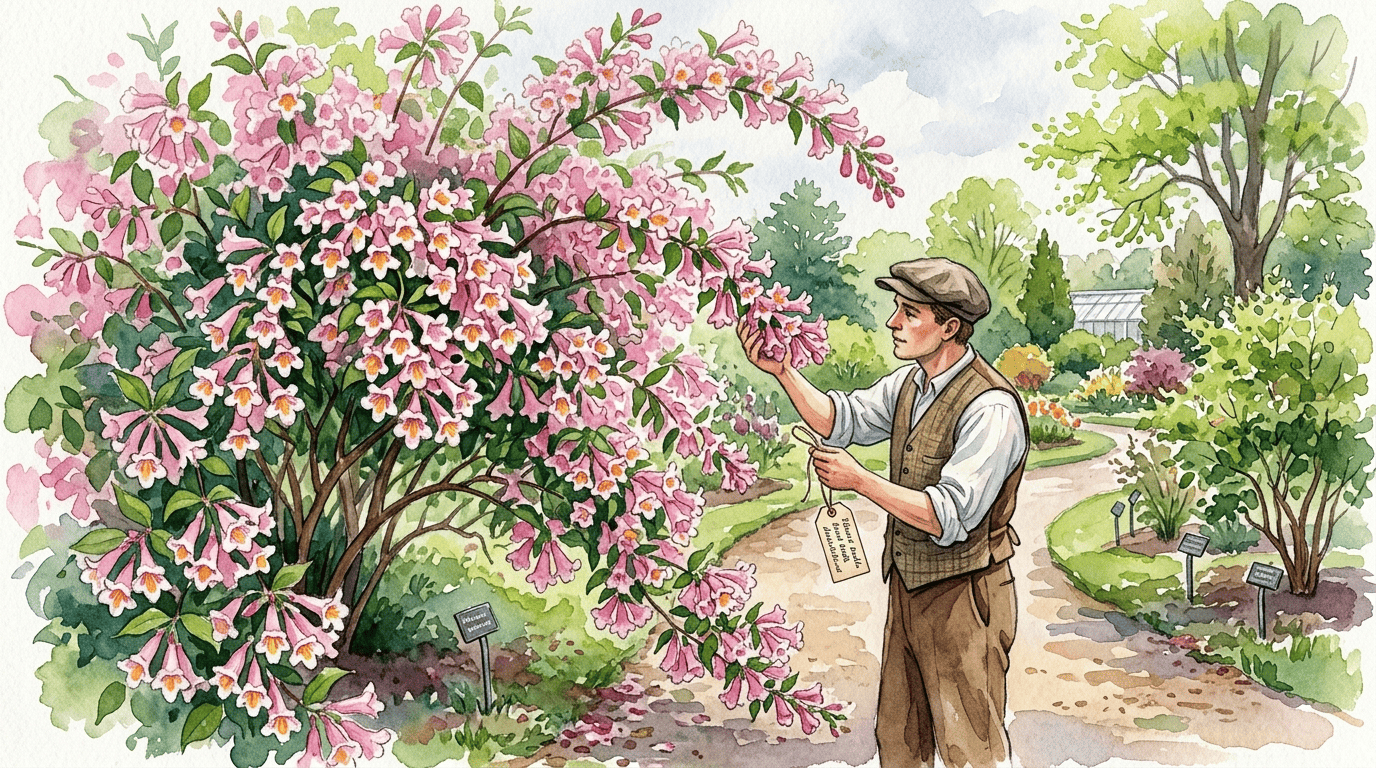
Kolkwitzia amabilis grows wild on rocky slopes in the Qinling and Daba mountains of central China. The German botanist Carl Graebner described the monotypic genus in 1901, honoring Richard Kolkwitz, professor of botany at Berlin. Ernest Henry 'Chinese' Wilson collected seeds in 1901 for the Veitch Nursery of England and sent further material to the Arnold Arboretum in 1907, where the first Western flowering occurred in 1910.
The species became a signature plant of Harvard's Arnold Arboretum and earned the common name 'beauty bush' in the US. It spread slowly through horticulture until the cultivar 'Pink Cloud' was selected at Wisley in 1946 and given the RHS Award of Garden Merit.
'Dream Catcher' (Proven Winners, 2007) with gold foliage extended modern interest. Molecular studies in 2013 moved it into Linnaea. Discovered in central China by E.H. The 'Pink Cloud' cultivar introduced in 1946 became the American standard, planted at countless mid-century suburban homes for its showy spring display.
Symbolism & meaning
What It Symbolizes
The Beauty Bush wears its meaning openly — amabilis literally means 'lovable,' so its symbolism of Beloved beauty is woven into its botanical name. As a Mid-century classic, it became a signature shrub of 1950s American suburbs, arching pink-flowered branches over countless front lawns. A plant that quite literally asks to be admired.
- Beloved beauty — literal translation of botanical name
- Mid-century classic — signature 1950s American suburban shrub
Where the Name Comes From
'Kolkwitzia' honors Richard Kolkwitz (1873-1956), German botanist; 'amabilis' from Latin means lovely or lovable.
Uses & Fun Facts
- Arching branches drip with pink bell flowers in late spring
- Profuse blooms attract bees and butterflies
- Beautybush is striking standalone shrub feature
Related plants
Plants with similar care
 Chinese AbeliaAbelia chinensis
 Fragrant AbeliaAbelia mosanensis
 Large-Flowered AbeliaAbelia uniflora
 Glossy AbeliaAbelia x grandiflora
Frequently asked questions
How often should I water Beauty Bush?
In summer, water about every 3 days; in winter, about every 14 days. Adjust for heat, pot size and drainage.
How much light does Beauty Bush need?
Full sun: 6+ hrs direct. Watch the leaves — scorching or stretching means the light needs adjusting.
Is Beauty Bush toxic to cats or dogs?
No toxicity has been reported for this plant. Still, it is wise to keep pets from chewing on any houseplant. Educational information, not medical or veterinary advice. If exposure is suspected, contact a doctor or veterinarian.
Is Beauty Bush easy to grow?
Yes — it is considered an easy, beginner-friendly plant.
When does Beauty Bush bloom?
It typically blooms Mar–May in the Northern Hemisphere.
YardMate
Identify any plant in seconds
Snap a photo — YardMate names the plant, diagnoses problems, and reminds you when to water.
Download on the App Store