 YardMate


Trailing Ice Plant
Lampranthus spectabilis
Easy · Beginner friendlyAbout Trailing Ice Plant
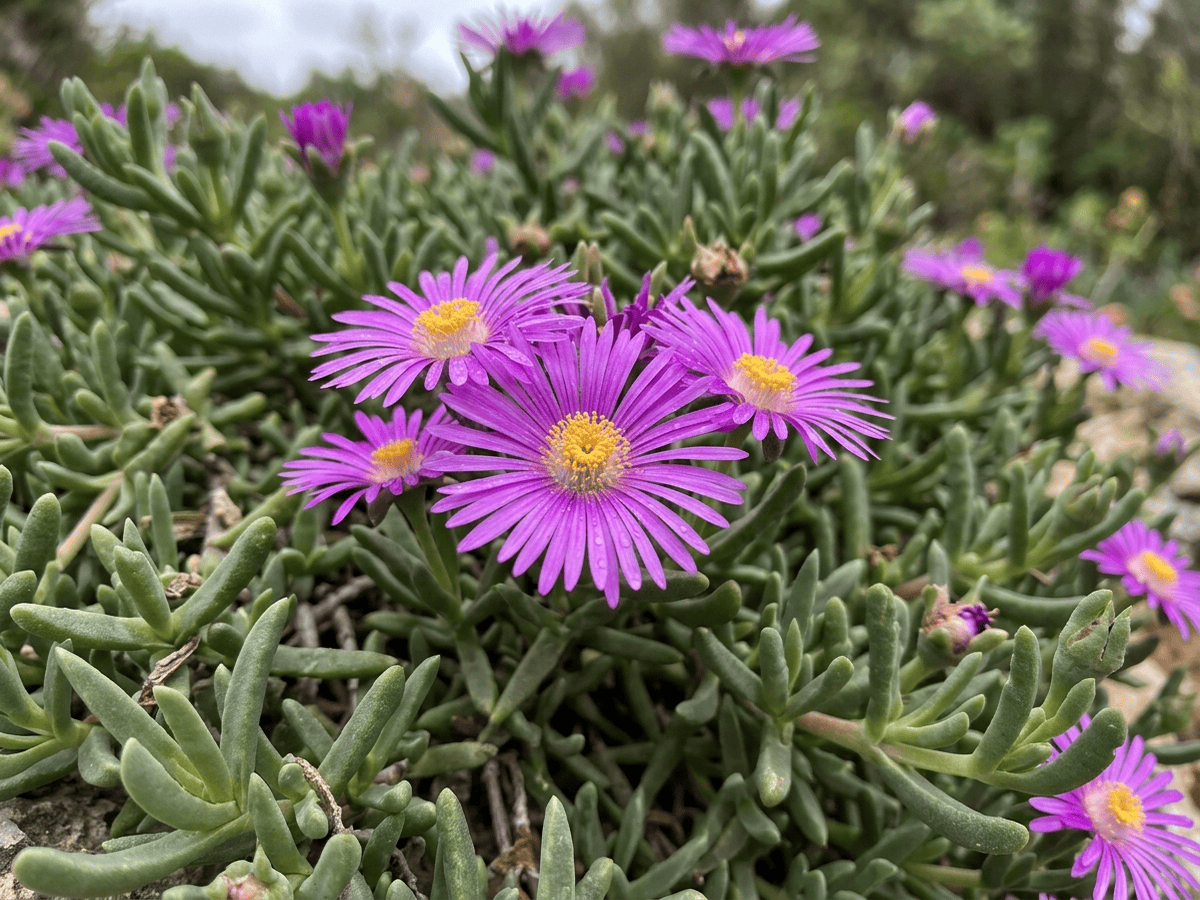
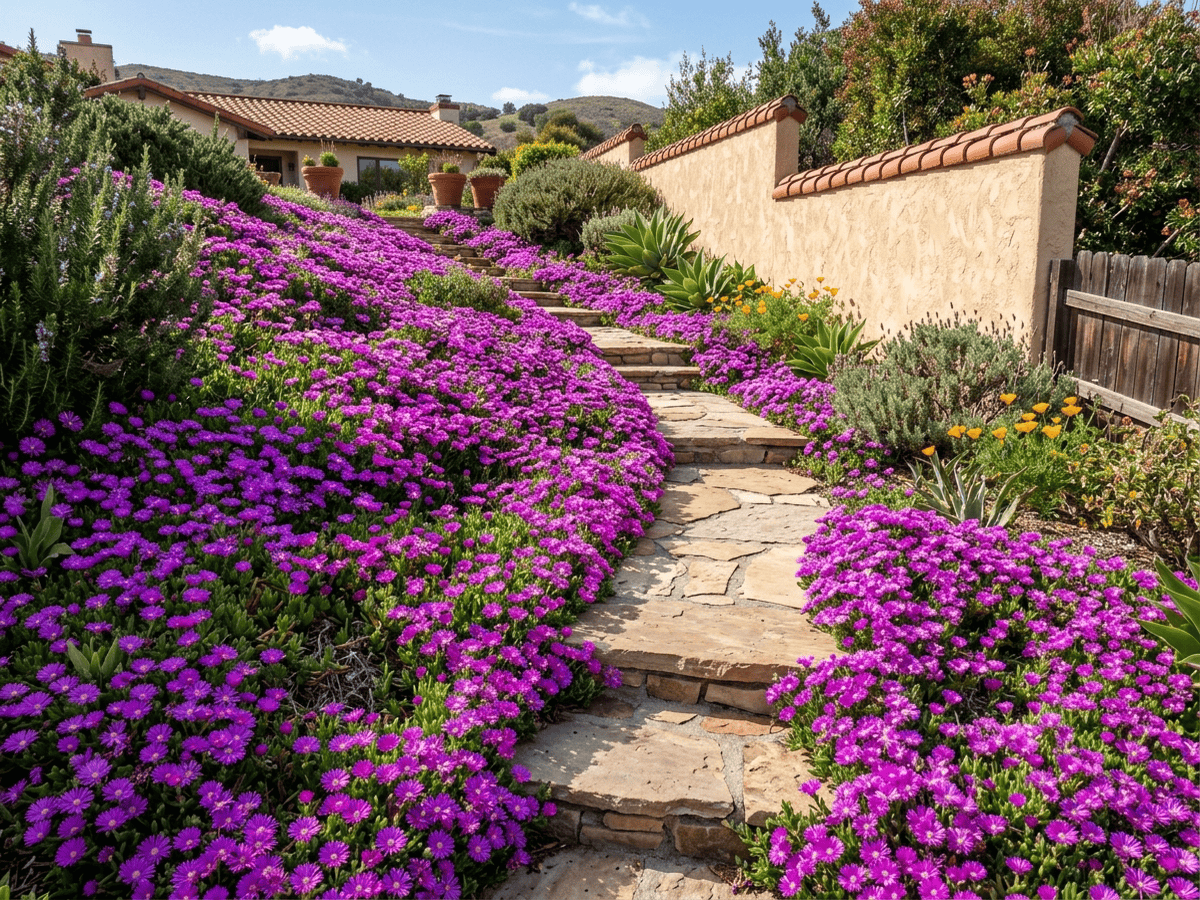
Trailing Ice Plant is a South African succulent ground cover celebrated for its spectacular spring floral display. Dense mats of fleshy three-sided gray-green leaves are smothered in brilliant purple to magenta daisy-like flowers from March through May. Fast-spreading and extremely drought-tolerant, it is widely planted along California highways, hillsides, and home gardens for erosion control and ornamental effect.
- Drought-tolerant
- Groundcover
How to care for Trailing Ice Plant
Watering
- Springevery 14 days
- Summerevery 14 days
- Fallevery 21 days
- Winterevery 30 days
Soil · Fast-draining
- Main mixSand + pumice + soil 1:1:150%
- DrainagePumice / gravel50%
Keep grit at half the mix or more — this soil is meant to dry out fast.
FERTILIZER
Balanced Feed 14-14-14
An even feed covers all three needs at once, keeping leaves, roots and blooms moving together with nothing pushed out of balance.
- Nitrogen · Leaves
- Phosphorus · Roots + Blooms
- Potassium · Strength
This plant needs little to no feeding.
At a Glance
- NativeAfrica
- Height0.5–1 ft (0.2–0.3 m)
- Spread1–2 ft (0.3–0.6 m)
- Flower colorPurple, Pink
- Foliage colorGreen
- SoilSandy, Well-drained
- LocationsYard
Bloom time
BLOOM CYCLE
Peak bloom
Jun–Aug
Blooms close at night; full display requires several hours of direct sun daily
Toxicity
Humans Safe · Pets Safe
None reported
Safe
EXPOSURE No exposure route is reported.
EFFECT No toxic effect is reported.
NOTE Listed as non-toxic for humans; avoid eating ornamental plants unless confirmed edible.
Safe
EXPOSURE No exposure route is reported.
EFFECT No toxic effect is reported.
NOTE Listed as non-toxic for dogs; avoid eating ornamental plants unless confirmed edible.
Safe
EXPOSURE No exposure route is reported.
EFFECT No toxic effect is reported.
NOTE Listed as non-toxic for cats; avoid eating ornamental plants unless confirmed edible.
Educational information, not medical or veterinary advice. If exposure is suspected, contact a doctor or veterinarian.
DISTRIBUTION


- Native
- Introduced
- Africa
History
Lampranthus spectabilis, trailing ice plant, is a mat-forming succulent in the Aizoaceae family native to rocky Cape fynbos of the Western Cape Province of South Africa. The plant forms dense low carpets of finger-like gray-green succulent leaves, and from late winter through spring the mats become so completely covered with brilliant magenta daisy-like flowers that the foliage disappears beneath a solid sheet of color. Each flower is about six centimeters across with an iridescent satin sheen.
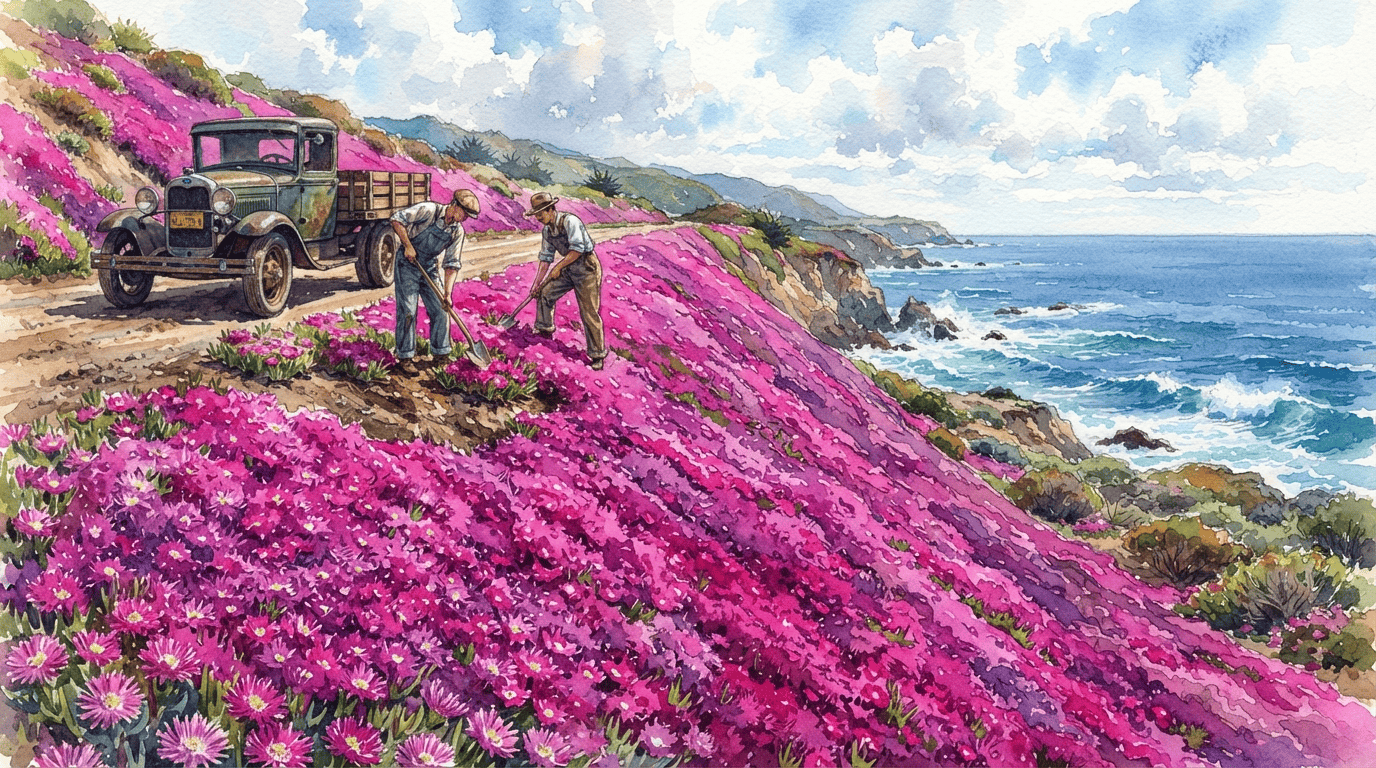
California and Mediterranean horticulturists adopted the species in the early twentieth century for freeway embankments, coastal slopes, and dry ornamental gardens, where it tolerates drought, salt spray, and heat. Like other South African ice plants it is now listed as moderately invasive along the California coast where it competes with native coastal flora, but it remains widely grown. The genus Lampranthus, from the Greek lampros (bright) and anthos (flower), was established by N.E. Brown in 1930 after reclassification from the sprawling Mesembryanthemum group.
It was introduced to California in the early 20th century, where the Mediterranean climate proved ideal. By the 1930s the California Department of Transportation had adopted it as a primary highway embankment plant for erosion control, and today it lines thousands of miles of California freeways. Its spring bloom transforms entire hillsides into carpets of vivid purple.
Symbolism & meaning
What It Symbolizes
Trailing Ice Plant is abundance and resilience pouring down a sunny slope, smothering itself each spring in thousands of dazzling blooms. Adapted to dry, rocky South African coasts, it asks for almost nothing and gives back a tide of color that stops traffic. In its succulent generosity lies the proof that toughness and beauty can be the very same trait.
- Abundance — smothers itself in thousands of blooms each spring
- Resilience — thrives on rocky slopes with minimal water
Where the Name Comes From
The name Trailing Ice Plant describes its trailing stems. Lampranthus comes from the Greek lampros (bright, shining) and anthos (flower), describing the luminous quality of its blooms. Spectabilis is Latin for 'remarkable', referencing its spectacular floral display.
Uses & Fun Facts
- Dense succulent mat covers freeway slopes and coastal banks
- Brilliant magenta spring carpet glows in low-water gardens
- Fire-resistant planting protects structures in dry-climate landscapes
Related plants
Plants with similar care
 Chinese AbeliaAbelia chinensis
 Fragrant AbeliaAbelia mosanensis
 Large-Flowered AbeliaAbelia uniflora
 Glossy AbeliaAbelia x grandiflora
Frequently asked questions
How often should I water Trailing Ice Plant?
In summer, water about every 14 days; in winter, about every 30 days. Adjust for heat, pot size and drainage.
How much light does Trailing Ice Plant need?
Full sun: 6+ hrs direct. Watch the leaves — scorching or stretching means the light needs adjusting.
Is Trailing Ice Plant toxic to cats or dogs?
Pets Safe (Dogs Safe · Cats Safe) Educational information, not medical or veterinary advice. If exposure is suspected, contact a doctor or veterinarian.
Is Trailing Ice Plant easy to grow?
Yes — it is considered an easy, beginner-friendly plant.
When does Trailing Ice Plant bloom?
It typically blooms Jun–Aug in the Northern Hemisphere.
YardMate
Identify any plant in seconds
Snap a photo — YardMate names the plant, diagnoses problems, and reminds you when to water.
Download on the App Store