 YardMate

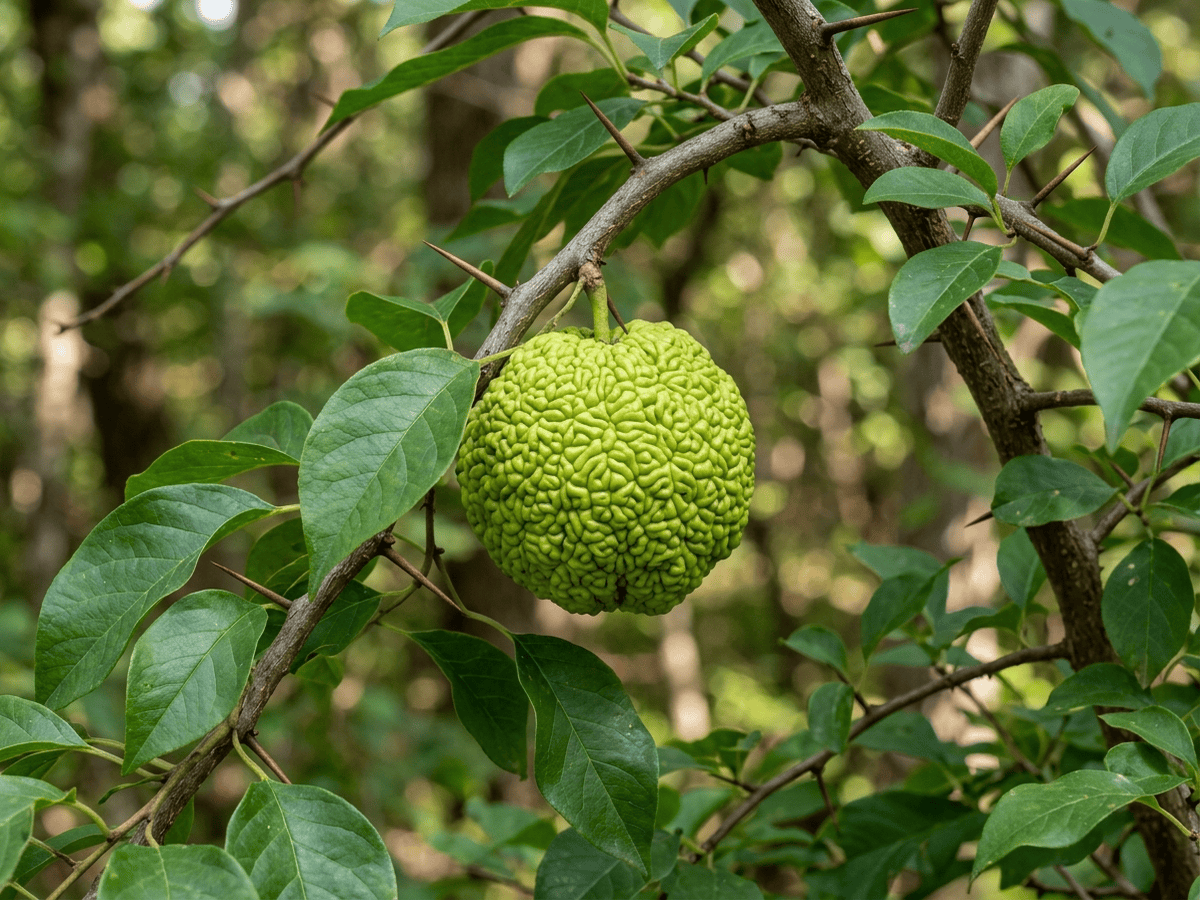


Osage Orange
Maclura pomifera
Easy · Beginner friendlyAbout Osage Orange
Maclura pomifera, Osage orange (also called hedge apple or bodark), is a medium-sized thorny deciduous tree native to the south-central United States — originally restricted to the Red River drainage of Texas, Oklahoma, and Arkansas. Before barbed wire, it was the premier living fence of the American Midwest.
Osage orange bears massive chartreuse bumpy grapefruit-sized fruits in autumn that are functionally useless today but were likely dispersed by now-extinct Pleistocene megafauna — mastodons, ground sloths, and giant armadillos. The fruit is not eaten by any living American mammal.
The dense orange-yellow wood is the strongest and most rot-resistant American native timber, historically used by the Osage Nation for bow-making (giving French traders the name 'bois d'arc' or 'bodark'), later as fence posts lasting a century or more. The species was planted across millions of miles of Midwestern farmland as hedge fencing in the 1850s-1880s before barbed wire replaced it.
- Drought-tolerant
- Native
How to care for Osage Orange
Watering
- Springevery 14 days
- Summerevery 14 days
- Fallevery 21 days
- Winterpause watering
Soil · Well-draining
- Top dressingPine bark mulch10%
- Main mixPotting soil + perlite 2:170%
- DrainageLECA / gravel20%
Never skip the drainage layer — standing water is the top cause of root rot.
FERTILIZER
Balanced Feed 14-14-14
An even feed covers all three needs at once, keeping leaves, roots and blooms moving together with nothing pushed out of balance.
- Nitrogen · Leaves
- Phosphorus · Roots + Blooms
- Potassium · Strength
This plant needs little to no feeding.
At a Glance
- NativeNorth America
- Height30–50 ft (9.1–15.2 m)
- Spread25–40 ft (7.6–12.2 m)
- Flower colorGreen
- Foliage colorGreen, Yellow
- Fruit colorGreen, Yellow
- SoilLoamy, Well-drained
- LocationsYard
Bloom time
BLOOM CYCLE
Peak bloom
Apr–May
Inconspicuous green flowers in spring; large chartreuse fruits develop on female trees in fall.
Fragrance
LIGHT FRAGRANCE
Fruit has mild citrus-like scent when cut.
Toxicity
Humans Slight · Pets Slight
latex
Slight
- Sap
- Contact
EXPOSURE Touching sap.
EFFECT Milky sap can cause skin irritation.
NOTE Milky sap is a skin irritant. Fruit is essentially inedible to all living mammals.
Slight
- Fruit
- Ingestion
EXPOSURE Eating fruit.
EFFECT GI upset and fruit rarely eaten due to inedibility.
NOTE Milky sap is a skin irritant. Fruit is essentially inedible to all living mammals.
Slight
- Fruit
- Ingestion
EXPOSURE Eating fruit.
EFFECT GI upset.
NOTE Milky sap is a skin irritant. Fruit is essentially inedible to all living mammals.
Educational information, not medical or veterinary advice. If exposure is suspected, contact a doctor or veterinarian.
DISTRIBUTION


- Native
- Introduced
- North America
History
Maclura pomifera is native to a small region of the south-central United States, chiefly the Red River drainage of Texas, Oklahoma, and Arkansas. The Osage, Caddo, and other southern Plains nations prized the dense springy wood for bow-making; French traders called it bois d'arc, "wood of the bow," the source of the Texan name bodark.
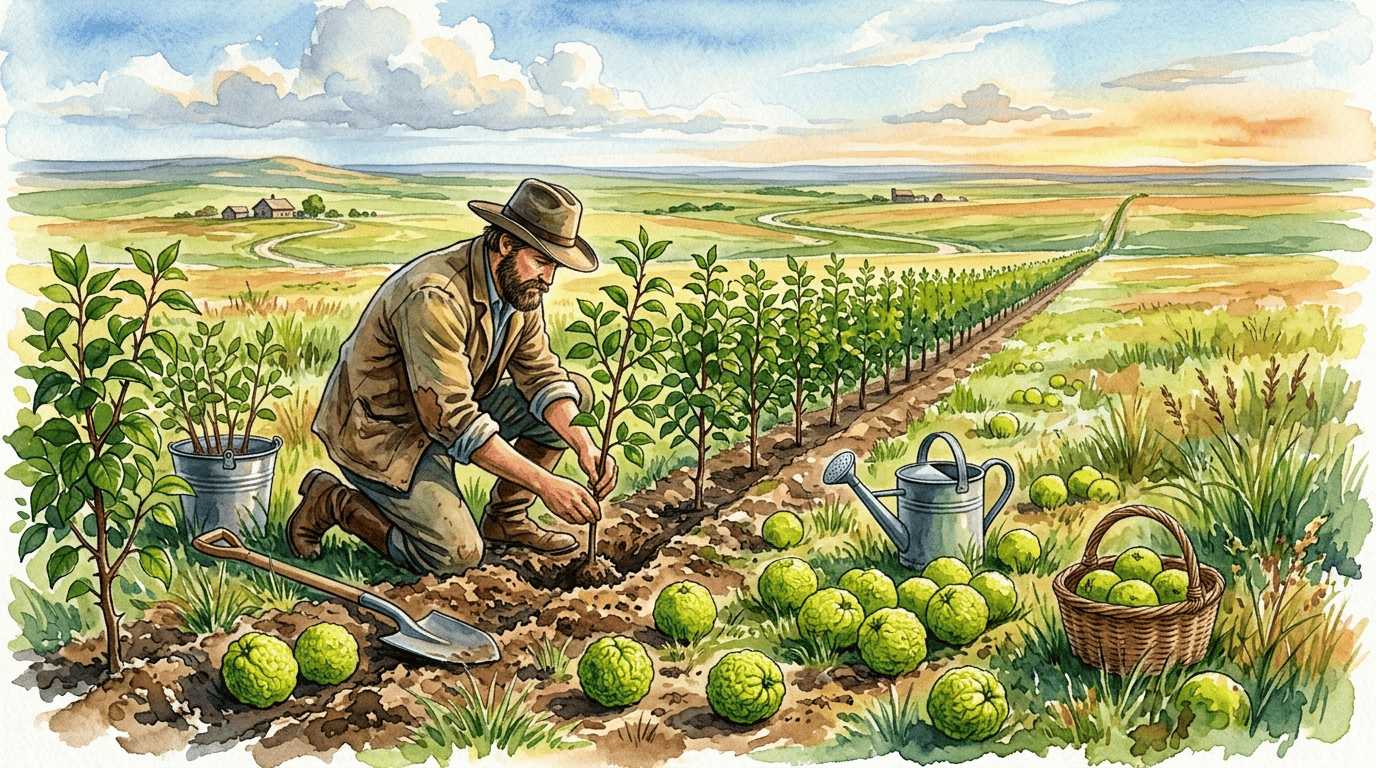
In the 1830s, Illinois professor Jonathan Baldwin Turner promoted Osage orange as a living hedge for the Midwestern prairie, where wood and stone for traditional fencing were scarce. Between 1850 and 1880, thousands of miles of hedge were planted across Illinois, Iowa, Kansas, and Nebraska before barbed wire replaced it within a generation.
The enormous inedible fruit is a famous evolutionary puzzle, often interpreted as an anachronism shaped by extinct large mammals. The wood remains one of the strongest, densest, and most rot-resistant native American timbers, with fence posts known to last for generations.
Symbolism & meaning
What It Symbolizes
Osage Orange expresses endurance — its wood is so rot-proof that posts cut from it have stood for a century, and its hedgerows once fenced much of the American Midwest before barbed wire arrived. Its strange green fruit evokes a lost world, evolved to be eaten by mastodons and ground sloths that never returned. A living evolutionary ghost still carrying yesterday's seeds.
- Endurance — Wood so rot-proof posts last a century; fences the Midwest
- Lost World — Its fruit waits for mastodons that never return — an evolutionary ghost
Where the Name Comes From
'Osage Orange' refers to the Osage people, whose homeland lay near the tree's native range; 'orange' points to the large yellow-green, citrus-scented fruit. Maclura honors American geologist William Maclure (1763-1840); 'pomifera' means fruit-bearing.
Uses & Fun Facts
- Thorny historic Plains hedgerow predating barbed-wire fencing
- Dense rot-resistant wood prized for fence posts and bows
- Dense thorny canopy shelters nesting songbirds and small mammals
Related plants
Plants with similar care
 Chinese AbeliaAbelia chinensis
 Fragrant AbeliaAbelia mosanensis
 Large-Flowered AbeliaAbelia uniflora
 Glossy AbeliaAbelia x grandiflora
Frequently asked questions
How often should I water Osage Orange?
Water about every 14 days during the growing season, and always let excess water drain away.
How much light does Osage Orange need?
Full sun: 6+ hrs direct. Watch the leaves — scorching or stretching means the light needs adjusting.
Is Osage Orange toxic to cats or dogs?
Pets Slight (Dogs Slight · Cats Slight) Educational information, not medical or veterinary advice. If exposure is suspected, contact a doctor or veterinarian.
Is Osage Orange easy to grow?
Yes — it is considered an easy, beginner-friendly plant.
When does Osage Orange bloom?
It typically blooms Apr–May in the Northern Hemisphere.
YardMate
Identify any plant in seconds
Snap a photo — YardMate names the plant, diagnoses problems, and reminds you when to water.
Download on the App Store