 YardMate

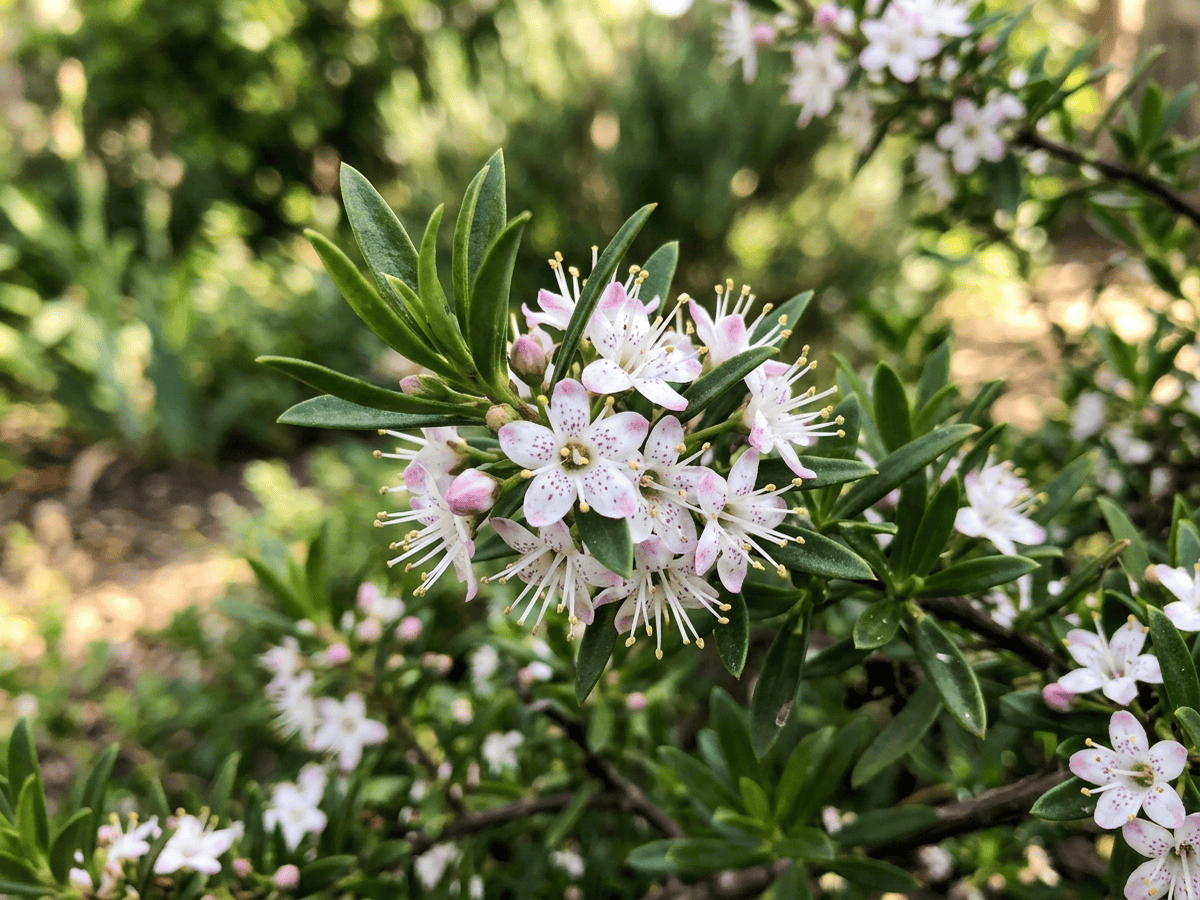


Creeping Myoporum
Myoporum parvifolium
Easy · Beginner friendlyAbout Creeping Myoporum
Creeping Myoporum is an Australian evergreen groundcover reaching 3-6 inches tall and spreading 6-10 feet, with small narrow glossy green leaves and tiny white star-shaped flowers in summer. Extremely drought-tolerant and vigorous once established, it is widely used in Southern California commercial landscapes as a low-water freeway and slope groundcover, though it can be aggressive in small spaces.
- Drought-tolerant
- Evergreen
- Groundcover
How to care for Creeping Myoporum
Watering
- Springevery 14 days
- Summerevery 21 days
- Fallevery 21 days
- Winterevery 30 days
Soil · Well-draining
- Top dressingPine bark mulch10%
- Main mixPotting soil + perlite 2:170%
- DrainageLECA / gravel20%
Never skip the drainage layer — standing water is the top cause of root rot.
FERTILIZER
This plant needs little to no feeding.
At a Glance
- NativeAustralasia
- Height0.3–1 ft (0.1–0.3 m)
- Spread6–9 ft (1.8–2.7 m)
- Flower colorWhite, Pink
- Foliage colorGreen
- Fruit colorPurple
- SoilSandy, Well-drained, Loamy
- LocationsYard
Bloom time
BLOOM CYCLE
Peak bloom
May–Jul
Small white star flowers May to July
Toxicity
Humans Moderate · Pets Moderate
furanosesquiterpenes (ngaione)
Moderate
- Leaf
- Fruit
- Ingestion
EXPOSURE Eating leaves and fruit.
EFFECT Gastrointestinal upset and liver irritation.
NOTE Myoporum species contain ngaione, hepatotoxic to livestock; caution advised around pets.
Moderate
- Leaf
- Fruit
- Ingestion
EXPOSURE Eating leaves and fruit.
EFFECT Gastrointestinal upset.
NOTE Myoporum species contain ngaione, hepatotoxic to livestock; caution advised around pets.
Moderate
- Leaf
- Fruit
- Ingestion
EXPOSURE Eating leaves and fruit.
EFFECT Gastrointestinal upset.
NOTE Myoporum species contain ngaione, hepatotoxic to livestock; caution advised around pets.
Educational information, not medical or veterinary advice. If exposure is suspected, contact a doctor or veterinarian.
DISTRIBUTION


- Native
- Introduced
- Australasia
History

Myoporum parvifolium, commonly called creeping boobialla or creeping myoporum, is a prostrate evergreen shrub native to inland southern Australia from Western Australia through South Australia, Victoria, and New South Wales, growing on sandy soils and along seasonal watercourses. Scottish botanist Robert Brown described the species in his landmark Prodromus Florae Novae Hollandiae in 1810, based on specimens collected during Matthew Flinders's circumnavigation expedition. The epithet parvifolium means small-leaved.
The plant forms dense 10-30 cm tall mats spreading 2-3 meters wide, with small narrow bright green succulent-like leaves and clusters of small white or pink-tinged five-petaled star-shaped flowers mainly in spring and summer followed by purple-tinged berries. Since the 1960s it has been a workhorse groundcover in California, Arizona, and Mediterranean-climate landscapes for dry slopes, erosion control, and freeway plantings, valued for fast coverage and drought tolerance.
Family placement recently moved from Myoporaceae into Scrophulariaceae sensu lato. Introduced to California horticulture in the mid-20th century and widely adopted for highway and commercial slope plantings. Use has declined somewhat in recent decades as native alternatives gain preference, but remains a workhorse drought-tolerant groundcover.
Symbolism & meaning
What It Symbolizes
Creeping Myoporum is coastal cover — a flat, dense carpet that holds California and Australian slopes against erosion while flowering quietly white through much of the year. It is utilitarian beauty, the workhorse of commercial groundcovers, the plant freeway maintenance crews and parking-lot designers reach for. It is proof that the unglamorous job of holding the soil down can still be done with grace.
- Coastal cover — carpets sunny slopes year-round
- Utilitarian beauty — the workhorse of commercial groundcovers
Where the Name Comes From
'Myoporum' from Greek 'myein' (to close) and 'poros' (pore); 'parvifolium' means small-leaved.
Uses & Fun Facts
- Spreads ten feet wide covering dry slopes and median strips
- Evergreen mat for low-water California commercial landscapes
Related plants
Plants with similar care
 Chinese AbeliaAbelia chinensis
 Fragrant AbeliaAbelia mosanensis
 Large-Flowered AbeliaAbelia uniflora
 Glossy AbeliaAbelia x grandiflora
Frequently asked questions
How often should I water Creeping Myoporum?
In summer, water about every 21 days; in winter, about every 30 days. Adjust for heat, pot size and drainage.
How much light does Creeping Myoporum need?
Full sun: 6+ hrs direct. Watch the leaves — scorching or stretching means the light needs adjusting.
Is Creeping Myoporum toxic to cats or dogs?
Pets Moderate (Dogs Moderate · Cats Moderate) Educational information, not medical or veterinary advice. If exposure is suspected, contact a doctor or veterinarian.
Is Creeping Myoporum easy to grow?
Yes — it is considered an easy, beginner-friendly plant.
When does Creeping Myoporum bloom?
It typically blooms May–Jul in the Northern Hemisphere.
YardMate
Identify any plant in seconds
Snap a photo — YardMate names the plant, diagnoses problems, and reminds you when to water.
Download on the App Store