 YardMate

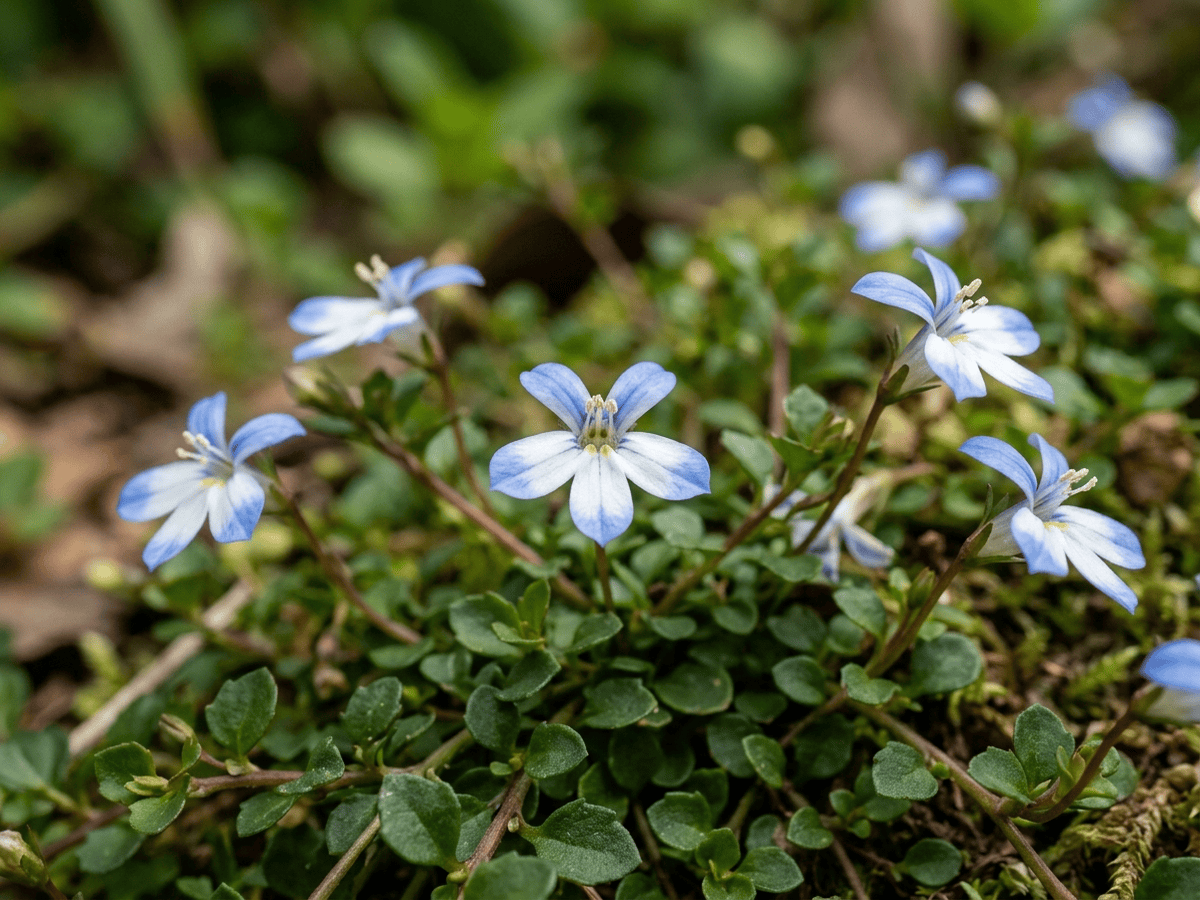


Matted Pratia
Pratia pedunculata
Easy · Beginner friendlyAbout Matted Pratia
Blue Star Creeper is a fine-textured creeping perennial groundcover reaching 1-2 inches tall, forming a tight mat of tiny leaves studded with small pale blue star-shaped flowers from spring into fall. Walkable and dense, it is a superb lawn substitute for low-traffic areas and an ideal filler between stepping stones. Native to Australia and New Zealand, it performs well in mild US climates including the West Coast and Gulf states.
- Groundcover
- Long-blooming
- Pollinator-friendly
How to care for Matted Pratia
Watering
- Springevery 7 days
- Summerevery 7 days
- Fallevery 10 days
- Winterevery 21 days
Soil · Well-draining
- Top dressingPine bark mulch10%
- Main mixPotting soil + perlite 2:170%
- DrainageLECA / gravel20%
Never skip the drainage layer — standing water is the top cause of root rot.
FERTILIZER
Balanced Feed 14-14-14
An even feed covers all three needs at once, keeping leaves, roots and blooms moving together with nothing pushed out of balance.
- Nitrogen · Leaves
- Phosphorus · Roots + Blooms
- Potassium · Strength
- Springevery 45 days
- Summerevery 45 days
At a Glance
- NativeAustralasia
- Height0.1–0.25 ft (0–0.1 m)
- Spread1–2 ft (0.3–0.6 m)
- Flower colorBlue, White
- Foliage colorGreen
- SoilLoamy, Moisture-retentive
- LocationsYard
Bloom time
BLOOM CYCLE
Peak bloom
Apr–Oct
Pale blue star flowers April to October
Toxicity
Humans Slight · Pets Slight
lobeline alkaloids
Slight
- Leaf
- Stem
- Ingestion
EXPOSURE Eating leaves and stems.
EFFECT Gastrointestinal upset.
NOTE Documented concern for humans: Gastrointestinal upset.
Slight
- Leaf
- Ingestion
EXPOSURE Eating leaves.
EFFECT Vomiting.
NOTE Lobelia alkaloids are mildly toxic. Not on ASPCA toxic list but Lobelia genus generally cautioned.
Slight
- Leaf
- Ingestion
EXPOSURE Eating leaves.
EFFECT Vomiting.
NOTE Lobelia alkaloids are mildly toxic. Not on ASPCA toxic list but Lobelia genus generally cautioned.
Educational information, not medical or veterinary advice. If exposure is suspected, contact a doctor or veterinarian.
DISTRIBUTION


- Native
- Introduced
- Australasia
History

Pratia pedunculata, now reclassified as Lobelia pedunculata by modern molecular phylogenies, is a very low prostrate perennial in the bellflower family (Campanulaceae, Lobelioideae) native to moist meadows and stream banks of eastern Australia from Queensland through New South Wales, Victoria, and Tasmania. Scottish botanist Robert Brown first described it as Lobelia pedunculata in 1810 based on Tasmanian specimens; George Bentham transferred it to Pratia in 1868. Recent molecular studies (2003-2010) dissolved Pratia back into Lobelia, but horticultural trade persistently uses Pratia pedunculata.
The plant forms flat 2-5 cm mats of tiny rounded leaves on rooting stolons, with solitary 1 cm pale sky-blue (or white) five-petaled flowers held just above the foliage on slender stems from spring through fall. Widely sold in North American and European nurseries as 'blue star creeper' for use as a lawn substitute, between pavers, and in fairy garden scale plantings.
Sometimes classified as Isotoma fluviatilis. Introduced to Western horticulture from Australia in the 20th century, it has become a favorite lawn alternative in Pacific Coast US gardens where cool nights and moist soils allow it to thrive year-round.
Symbolism & meaning
What It Symbolizes
Matted Pratia carries starry delight, its tiny blue flowers scattered across a low green carpet like a fragment of summer sky pressed into the lawn. Its invitation is to tread lightly, walkable but only softly so, gentle enough to bear footsteps yet delicate enough to ask for kindness. It is often read as a flower of careful underfoot beauty, a groundcover whose meaning is the tender attention we give to small things we are allowed to step on but choose not to crush.
- Starry delight — tiny blue stars scattered on green carpet
- Tread lightly — walkable but softly so
Where the Name Comes From
'Pratia' honors French naval officer Charles Louis Prat-Bernon; 'pedunculata' refers to flower stalks.
Uses & Fun Facts
- Walkable mat fills paver gaps as lawn substitute
- Tiny blue stars dot creeping foliage spring through fall
Related plants
Plants with similar care
 Chinese AbeliaAbelia chinensis
 Fragrant AbeliaAbelia mosanensis
 Large-Flowered AbeliaAbelia uniflora
 Glossy AbeliaAbelia x grandiflora
Frequently asked questions
How often should I water Matted Pratia?
In summer, water about every 7 days; in winter, about every 21 days. Adjust for heat, pot size and drainage.
How much light does Matted Pratia need?
Full sun: 6+ hrs direct. Watch the leaves — scorching or stretching means the light needs adjusting.
Is Matted Pratia toxic to cats or dogs?
Pets Slight (Dogs Slight · Cats Slight) Educational information, not medical or veterinary advice. If exposure is suspected, contact a doctor or veterinarian.
Is Matted Pratia easy to grow?
Yes — it is considered an easy, beginner-friendly plant.
When does Matted Pratia bloom?
It typically blooms Apr–Oct in the Northern Hemisphere.
YardMate
Identify any plant in seconds
Snap a photo — YardMate names the plant, diagnoses problems, and reminds you when to water.
Download on the App Store