 YardMate


Mexican Creeping Zinnia
Sanvitalia procumbens
Easy · Beginner friendlyAbout Mexican Creeping Zinnia
Creeping Zinnia is a low, mat-forming annual from Mexico and the US Southwest, 4–8 inches tall and spreading 12–18 inches, with tiny dark-eyed yellow or orange daisy flowers covering the plant from early summer to frost. Heat- and drought-tolerant, self-cleaning, and an excellent groundcover or hanging-basket plant. A favorite in American cottage and xeric gardens for its prolific bloom and easy care.
- Heat-tolerant
- Drought-tolerant
- Groundcover
- Pollinator-friendly
How to care for Mexican Creeping Zinnia
Watering
- Springevery 5 days
- Summerevery 4 days
- Fallevery 10 days
- Winterpause watering
Soil · Well-draining
- Top dressingPine bark mulch10%
- Main mixPotting soil + perlite 2:170%
- DrainageLECA / gravel20%
Never skip the drainage layer — standing water is the top cause of root rot.
FERTILIZER
Balanced Feed 14-14-14
An even feed covers all three needs at once, keeping leaves, roots and blooms moving together with nothing pushed out of balance.
- Nitrogen · Leaves
- Phosphorus · Roots + Blooms
- Potassium · Strength
- Springevery 21 days
- Summerevery 21 days
At a Glance
- NativeNorth America
- Height0.4–0.8 ft (0.1–0.2 m)
- Spread1–1.5 ft (0.3–0.5 m)
- Flower colorYellow, Orange
- Foliage colorGreen
- SoilLoamy, Well-drained, Sandy
- LocationsYard · Balcony
Bloom time
BLOOM CYCLE
Peak bloom
Jun–Nov
Dark-eyed yellow daisies early summer to frost
Fragrance
NO FRAGRANCE
No notable fragrance.
Toxicity
No toxicity has been reported for this plant. Still, it is wise to keep pets from chewing on any houseplant.
Educational information, not medical or veterinary advice. If exposure is suspected, contact a doctor or veterinarian.
DISTRIBUTION


- Native
- Introduced
- North America
History
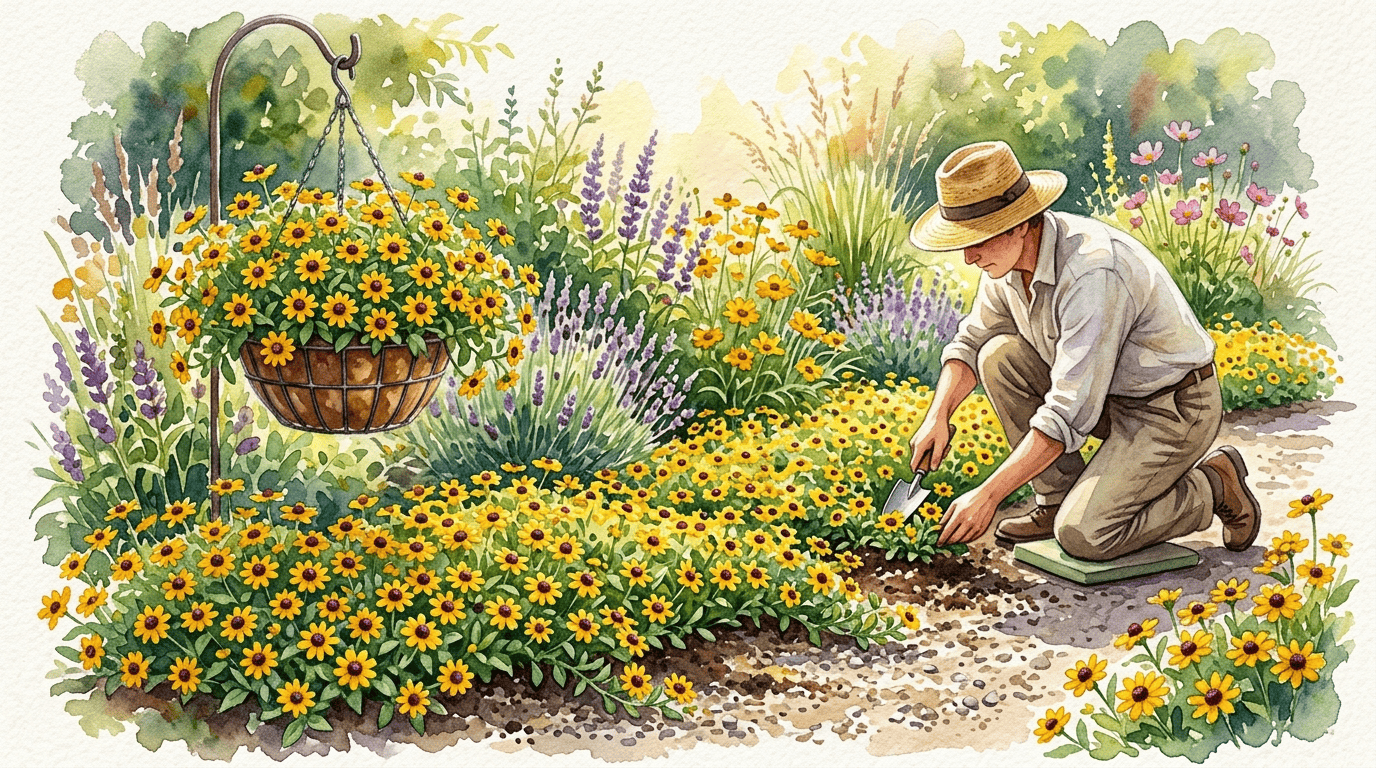
Sanvitalia procumbens is native to Mexico and adjacent southwestern United States (southern Arizona and New Mexico), growing in disturbed open ground, grassland edges, and roadsides. The genus was named for the noble Italian Sanvitali family (of Parma). Despite its common name "creeping zinnia," the plant is not a true zinnia (Zinnia) but a related small daisy-form annual in the same Asteraceae family. It is a low-spreading prostrate annual 10-15 cm tall with 30-40 cm lateral spread, growing as a tight mounding groundcover rather than climbing or trailing significantly.
From early summer through autumn it produces near-continuous small 1.5-2 cm flowers with bright golden-yellow ray petals surrounding a prominent dark chocolate-purple or black disk — the strong color contrast between yellow rays and dark disks gives the plant its characteristic ornamental signature. The wild type is the classic yellow-with-dark-center form; modern cultivars include "Million Suns" (bright yellow with green center, somewhat more compact), "Mandarin Orange," and "Sanvi Lemon Dream" (pale lemon-yellow). The plant is primarily used as an edging plant at the front of sunny summer borders, as a filler in mixed containers, or as a summer groundcover in drought-tolerant bedding schemes.
Heat-tolerant, drought-tolerant once established, and self-seeds modestly in favorable conditions. Introduced from Mexico and the southwestern US deserts in the 19th century. The modern 'Sunbini' and 'Million Suns' series from American and European breeders have made sanvitalia a staple of US garden-center hanging baskets and patio containers.
Symbolism & meaning
What It Symbolizes
Mexican Creeping Zinnia is brightness made carpet — sunny golden flowers that glow even on cloudy days, refusing to read the room. It brings joy to edges and containers, a small daily defiance of overcast weather. It is the annual planted to keep summer cheerful when summer itself forgets, a bright golden mat that will not let the season feel gray.
- Brightness — sunny flowers glow even on cloudy days
- Joy — carpet of cheerful golden blooms
Where the Name Comes From
The name Mexican Creeping Zinnia describes its low, spreading habit. Genus honors Italian noble Sanvitali family; 'procumbens' means 'prostrate'.
Uses & Fun Facts
- Self-cleaning mat-forming annual covers hot dry edging
- Trailing yellow daisies spill from hanging baskets all summer
- Tiny dark-eyed daisies feed native bees and butterflies
Related plants
Plants with similar care
 Chinese AbeliaAbelia chinensis
 Fragrant AbeliaAbelia mosanensis
 Large-Flowered AbeliaAbelia uniflora
 Glossy AbeliaAbelia x grandiflora
Frequently asked questions
How often should I water Mexican Creeping Zinnia?
Water about every 5 days during the growing season, and always let excess water drain away.
How much light does Mexican Creeping Zinnia need?
Full sun: 6+ hrs direct. Watch the leaves — scorching or stretching means the light needs adjusting.
Is Mexican Creeping Zinnia toxic to cats or dogs?
No toxicity has been reported for this plant. Still, it is wise to keep pets from chewing on any houseplant. Educational information, not medical or veterinary advice. If exposure is suspected, contact a doctor or veterinarian.
Is Mexican Creeping Zinnia easy to grow?
Yes — it is considered an easy, beginner-friendly plant.
When does Mexican Creeping Zinnia bloom?
It typically blooms Jun–Nov in the Northern Hemisphere.
YardMate
Identify any plant in seconds
Snap a photo — YardMate names the plant, diagnoses problems, and reminds you when to water.
Download on the App Store