 YardMate


White Fanflower
Scaevola albida
Easy · Beginner friendlyAbout White Fanflower
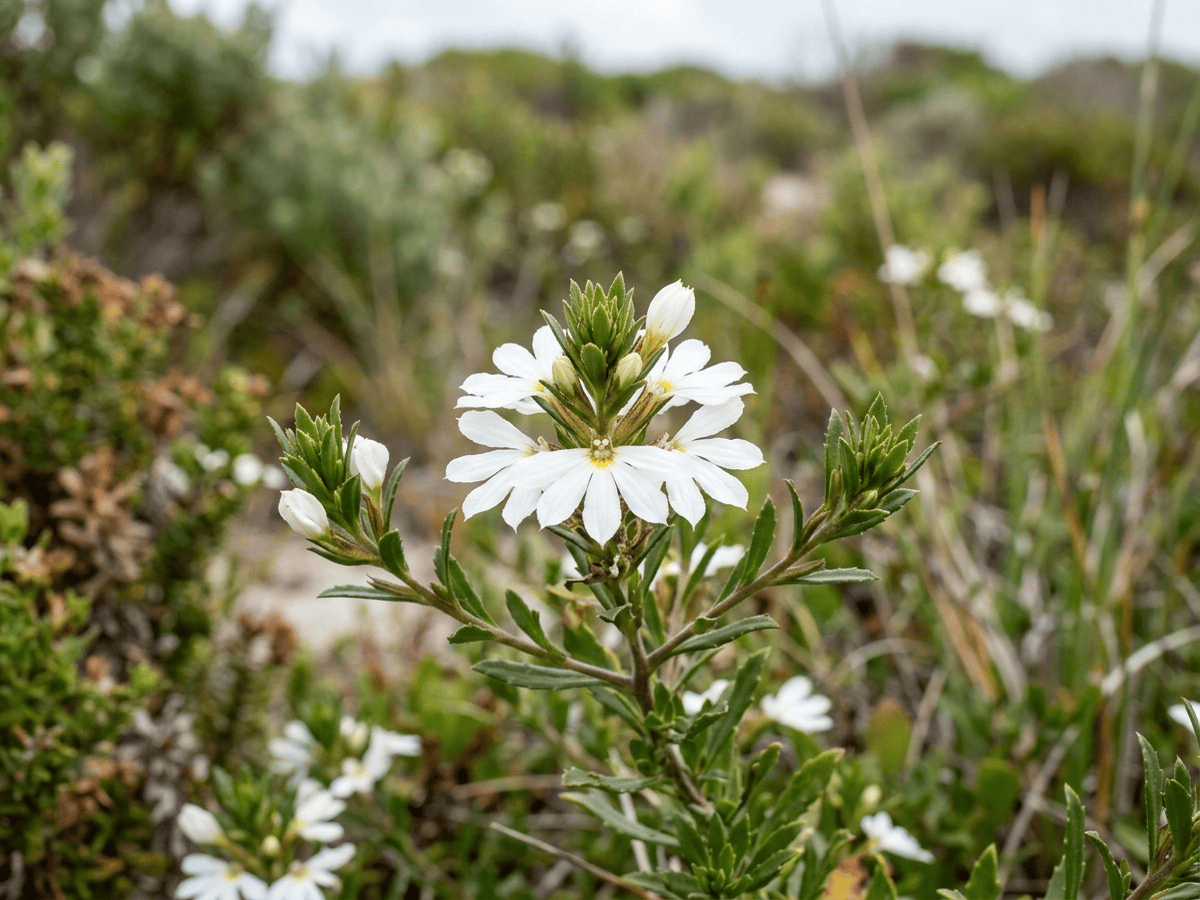
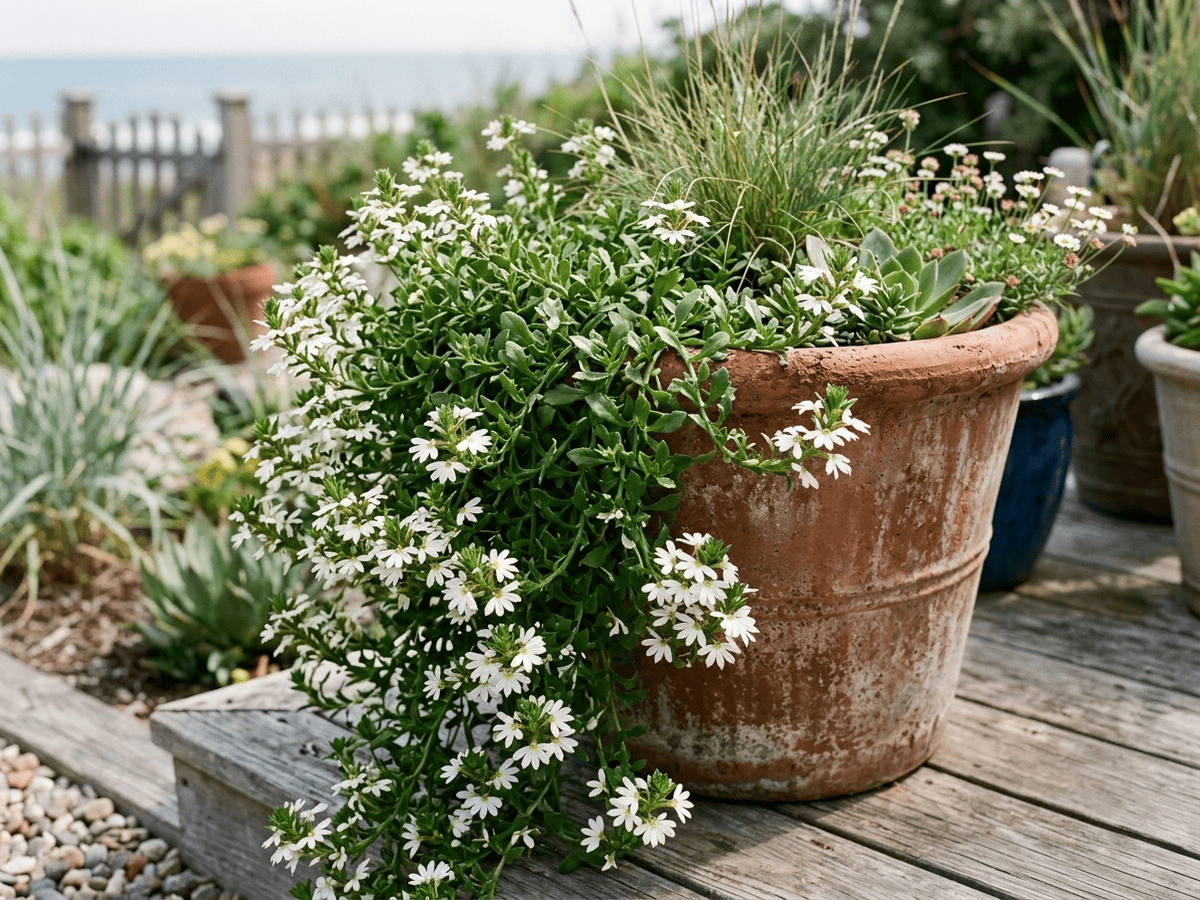
White Fan Flower is an Australian trailing tender perennial grown as an annual in American containers, producing distinctive fan-shaped flowers with five petals arranged on one side of the bloom like a spread hand. Growing 4 to 8 inches tall and trailing 18 to 36 inches, the white-to-pale-blue flowers bloom continuously from spring through frost in hot sunny conditions. A heat-tolerant alternative to the more common Scaevola aemula.
- Heat-tolerant
- Drought-tolerant
- Trailing
- Container-friendly
How to care for White Fanflower
Watering
- Springevery 4 days
- Summerevery 3 days
- Fallevery 5 days
- Winterevery 7 days
Soil · Well-draining
- Top dressingPine bark mulch10%
- Main mixPotting soil + perlite 2:170%
- DrainageLECA / gravel20%
Never skip the drainage layer — standing water is the top cause of root rot.
FERTILIZER
Balanced Feed 14-14-14
An even feed covers all three needs at once, keeping leaves, roots and blooms moving together with nothing pushed out of balance.
- Nitrogen · Leaves
- Phosphorus · Roots + Blooms
- Potassium · Strength
- Springevery 21 days
- Summerevery 21 days
- Fallevery 30 days
At a Glance
- NativeAustralasia
- Height0.5–1 ft (0.2–0.3 m)
- Spread2–4 ft (0.6–1.2 m)
- Flower colorBlue, Purple, White, Pink
- Foliage colorGreen
- SoilSandy, Well-drained
- LocationsBalcony · Yard
Bloom time
BLOOM CYCLE
Peak bloom
Jun–Nov
Fan-shaped white flowers summer to frost
Toxicity
Toxicity unknown
None reported
Unknown
EXPOSURE Unspecified plant material.
EFFECT Toxic effects are not specified.
NOTE Toxicity for humans is not well documented; use caution until verified.
Unknown
EXPOSURE Unspecified plant material.
EFFECT Toxic effects are not specified.
NOTE Toxicity for dogs is not well documented; use caution until verified.
Unknown
EXPOSURE Unspecified plant material.
EFFECT Toxic effects are not specified.
NOTE Toxicity for cats is not well documented; use caution until verified.
Educational information, not medical or veterinary advice. If exposure is suspected, contact a doctor or veterinarian.
DISTRIBUTION


- Native
- Australasia
History

Scaevola albida, commonly called fan flower or pale fanflower, is a prostrate evergreen perennial native to coastal sands, heathlands, and open forests of eastern and southern Australia. German botanist Ernst Gottlieb von Steudel described the species in 1840. Scaevola refers to Gaius Mucius Scaevola, a Roman legend who burned his right hand; the genus name evokes the hand-shaped one-sided fan of petals arranged as if the other half has been torn away.
Aboriginal Australian Dreamtime tradition holds a similar story of an angry ancestor. The plant produces masses of fan-shaped blue, violet, or white flowers over long seasons and tolerates heat, humidity, and salt spray.
Proven Winners, Plant Haven, and Suntory introduced the Surdiva, Bombay, and Whirlwind series, making Scaevola a top-selling trailing bedding annual worldwide. Native to Australia's coastal regions, introduced to American horticulture in the 1990s alongside its sister species Scaevola aemula. Proven Winners' Whirlwind series popularized white fan flower as a modern heat-tolerant trailing annual staple.
Symbolism & meaning
What It Symbolizes
White Fanflower expresses the open hand, each bloom shaped like a spread palm offered freely to bees and gardeners alike. Its meaning of generosity is reinforced by continuous summer flowering, an unbroken giving that asks for nothing but warmth and a little water. This is the patron annual of giving without reservation — a small Australian native that holds its open palm out, week after week, all season long.
- Open hand — flowers shaped like a spread palm
- Generosity — continuous free bloom
Where the Name Comes From
The common name highlights its white coloring. 'Scaevola' from Latin for 'left-handed,' after the Roman hero Gaius Mucius Scaevola; refers to one-sided fan-shaped flowers; 'albida' means whitish.
Uses & Fun Facts
- Fan-shaped flowers trail neatly from baskets and heat-tough summer pots
Related plants
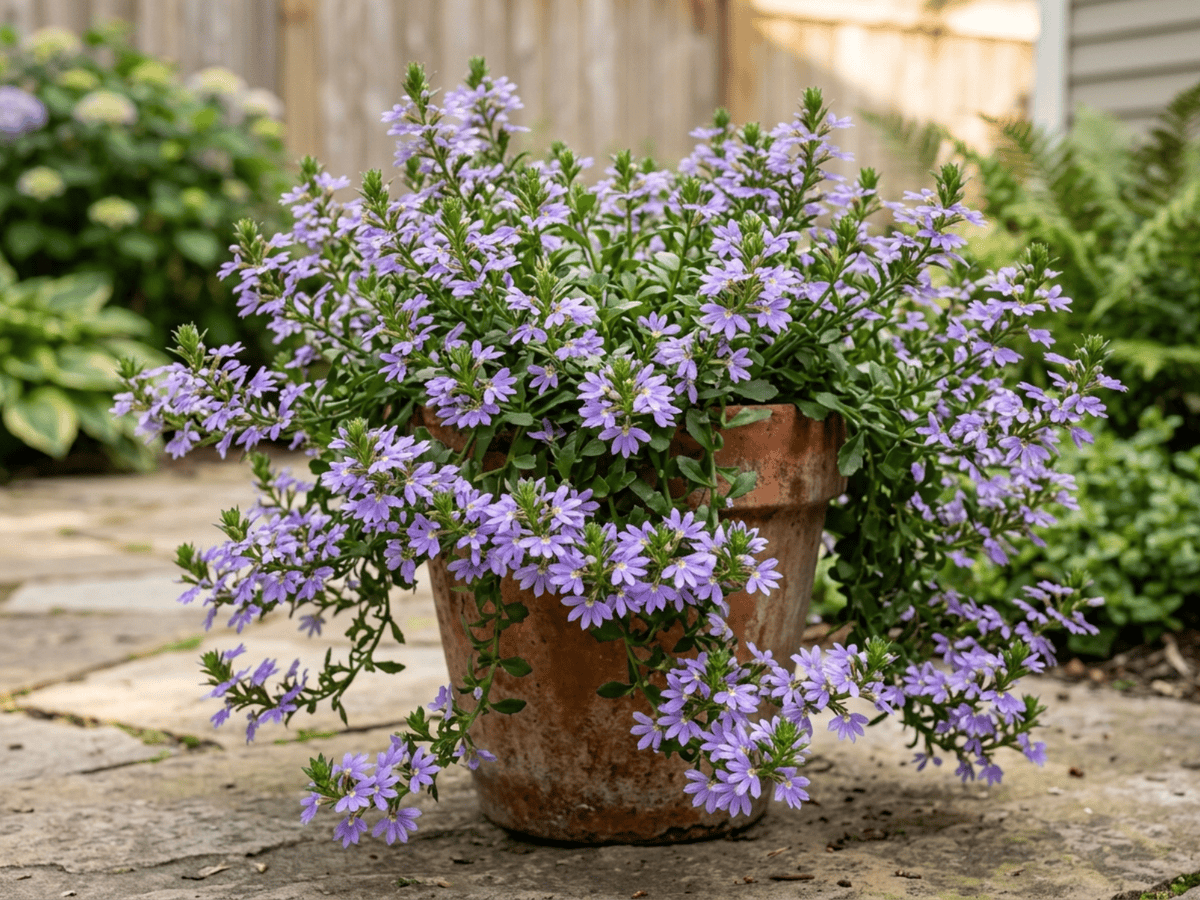
More Scaevola plants
Plants with similar care
 Chinese AbeliaAbelia chinensis
 Fragrant AbeliaAbelia mosanensis
 Large-Flowered AbeliaAbelia uniflora
 Glossy AbeliaAbelia x grandiflora
Frequently asked questions
How often should I water White Fanflower?
In summer, water about every 3 days; in winter, about every 7 days. Adjust for heat, pot size and drainage.
How much light does White Fanflower need?
Full sun: 6+ hrs direct. Watch the leaves — scorching or stretching means the light needs adjusting.
Is White Fanflower toxic to cats or dogs?
Pets Unknown (Dogs Unknown · Cats Unknown) Educational information, not medical or veterinary advice. If exposure is suspected, contact a doctor or veterinarian.
Is White Fanflower easy to grow?
Yes — it is considered an easy, beginner-friendly plant.
When does White Fanflower bloom?
It typically blooms Jun–Nov in the Northern Hemisphere.
YardMate
Identify any plant in seconds
Snap a photo — YardMate names the plant, diagnoses problems, and reminds you when to water.
Download on the App Store