 YardMate


Golden Chalice Vine
Solandra maxima
Medium · Some experienceAbout Golden Chalice Vine
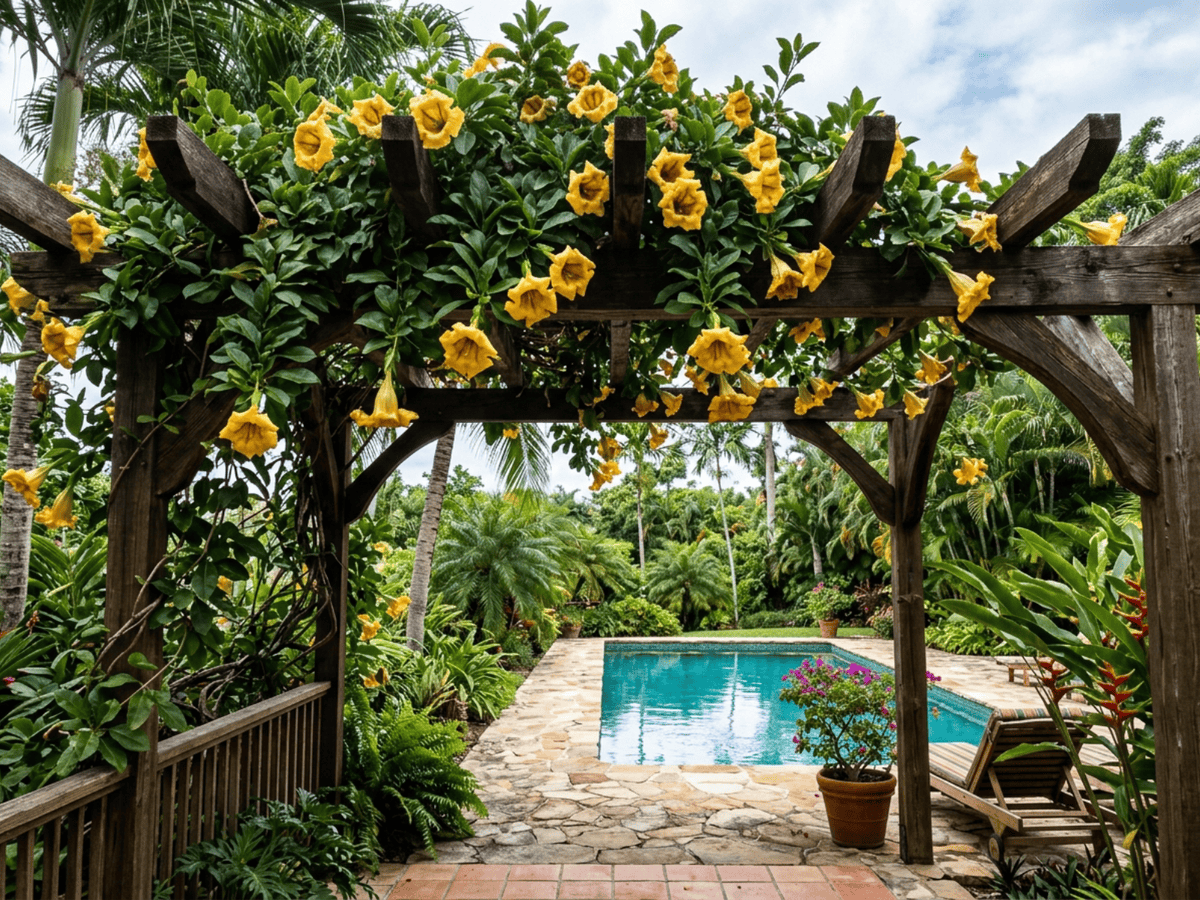
Cup of Gold is a vigorous, woody tropical vine native to Mexico and Central America, producing some of the largest flowers of any climbing plant. The enormous golden-yellow trumpet flowers can reach 10 inches across and 8 inches long, with a rich, coconut-like fragrance that intensifies at night. Each flower opens pale yellow and deepens to golden amber over several days, with distinctive purple striping inside the throat. The plant is a powerful climber, reaching 40 feet or more with thick, glossy, dark green foliage. In frost-free climates it blooms intermittently throughout the year, with peak flowering in winter and spring. Cup of Gold requires strong support and full sun with regular water for best flowering. As a member of the Solanaceae (nightshade) family, all parts contain tropane alkaloids and are toxic if ingested, though significantly less dangerous than Brugmansia or Datura. The plant was sacred to the Aztecs, who used it ceremonially. It makes an unforgettable spectacle draped over walls, arbors, and large structures in tropical gardens.
- Fragrant
- Climbing
- Tropical
How to care for Golden Chalice Vine
Watering
- Springevery 3 days
- Summerevery 2 days
- Fallevery 5 days
- Winterevery 14 days
Soil · Well-draining
- Top dressingPine bark mulch10%
- Main mixPotting soil + perlite 2:170%
- DrainageLECA / gravel20%
Never skip the drainage layer — standing water is the top cause of root rot.
FERTILIZER
Bloom Booster 10-52-10
A phosphorus-forward feed fuels abundant blooms, with just enough nitrogen and potassium to keep foliage and roots steady.
- Nitrogen · Leaves
- Phosphorus · Roots + Blooms
- Potassium · Strength
- Springevery 30 days
- Summerevery 30 days
- Fallevery 30 days
At a Glance
- NativeNorth America, Central America
- Height20–40 ft (6.1–12.2 m)
- Spread15–30 ft (4.6–9.1 m)
- Flower colorYellow, Cream
- Foliage colorGreen
- SoilLoamy, Well-drained, Rich
- LocationsYard
Bloom time
BLOOM CYCLE
Peak bloom
Jun–Aug
Enormous golden trumpets up to 10 inches; coconut-scented, strongest at night
Fragrance
STRONG FRAGRANCE
Sweet coconut-vanilla-honey scent in evening.
Toxicity
Humans Toxic · Pets Toxic
scopolamine, hyoscyamine, and atropine
Toxic
- All
- Ingestion
EXPOSURE Eating any part of the plant.
EFFECT Tropane alkaloid poisoning: hallucinations, tachycardia, hyperthermia, seizures and potentially fatal.
NOTE Highly toxic — treat with same caution as Brugmansia and Datura.
Toxic
- All
- Ingestion
EXPOSURE Eating any part of the plant.
EFFECT Same tropane toxicity: agitation, mydriasis, tachycardia.
NOTE Highly toxic — treat with same caution as Brugmansia and Datura.
Toxic
- All
- Ingestion
EXPOSURE Eating any part of the plant.
EFFECT Same as dogs.
NOTE Highly toxic — treat with same caution as Brugmansia and Datura.
Educational information, not medical or veterinary advice. If exposure is suspected, contact a doctor or veterinarian.
DISTRIBUTION


- Native
- Introduced
- North America
- Central America
History
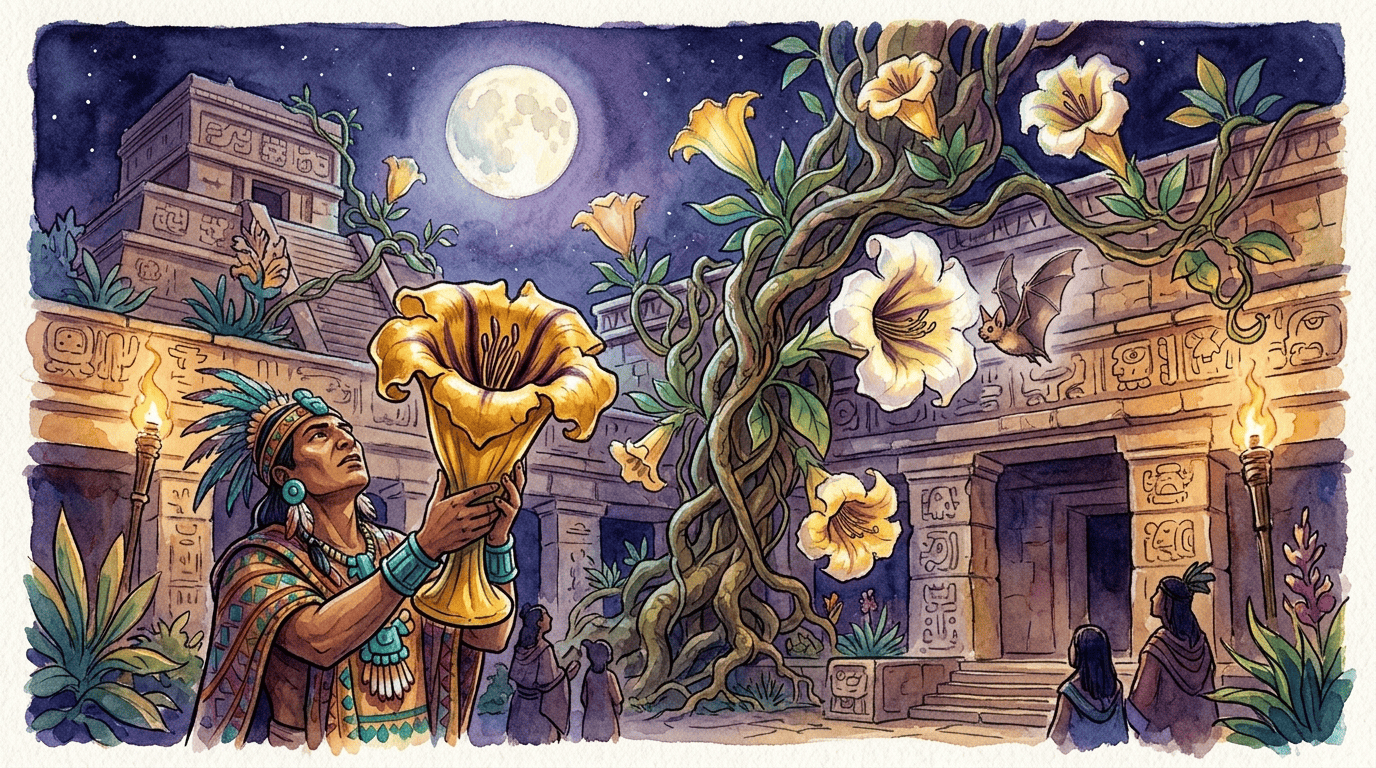
Solandra maxima is native to the rainforests of Mexico and Central America (Guatemala, Honduras, Nicaragua, Costa Rica). It is an enormous woody vine — capable of climbing 10-15 meters into rainforest canopy in its native habitat and of overwhelming trellises and pergolas in cultivation — producing spectacular goblet-shaped flowers 15-25 cm long and wide, pale yellow aging through gold to deep orange-brown, with prominent dark purple stripes along the petal interior. The flowers are intensely fragrant in the evening, producing a sweet coconut-vanilla-honey scent, and are pollinated in the wild by nectar-feeding bats. The plant is a signature ornamental of tropical and subtropical resort and hotel landscaping — Hawaii, Florida, the Caribbean, coastal California, and Mediterranean gardens — where its dramatic scale and fragrance can anchor entire pergola and entrance installations.
Like other members of the Solanaceae family (which includes Brugmansia, Datura, and henbane), Solandra contains tropane alkaloids (scopolamine, hyoscyamine, atropine) in all parts of the plant, making it highly toxic if ingested. Indigenous Mexican Huichol (Wixárika) peoples traditionally used Solandra in ceremonial contexts as part of their complex ritual pharmacopoeia. Solandra maxima was revered by the Aztecs, who called it 'tecomaxochitl' (cup flower) and used it in religious ceremonies.
The genus was named by Swedish botanist Olof Swartz in honor of Daniel Solander, the Swedish naturalist who accompanied Captain James Cook on his first Pacific voyage. The plant was introduced to European gardens in the late 18th century and became a prized conservatory climber in Victorian England.
Symbolism & meaning
What It Symbolizes
Golden Chalice Vine is triumph in chalice form — enormous gold trumpets the size of tea bowls cupping the morning air, the bold cup of victory and achievement raised toward the sky. Its ambition shows in growth: a vigorous tropical climber reaching enormous heights when given a wall and a warm climate. It is the vine planted by gardeners who believe a flower can be a trophy.
- Triumph — the bold golden chalice-like flowers represent victory and achievement
- Ambition — the vigorous climbing growth reaching great heights symbolizes aspiration
Where the Name Comes From
The name Golden Chalice Vine describes its vining or arching growth. 'Solandra' honors Daniel Carl Solander (1733-1782), a Swedish botanist and pupil of Linnaeus who sailed with Captain Cook. 'Maxima' means largest, referring to the enormous flowers.
Uses & Fun Facts
- Ten-inch golden trumpets release coconut scent intensifying at night
- Vigorous tropical vine clothes large pergolas and walls
Related plants
Plants with similar care
 Mexican AbeliaAbelia floribunda
 Fraser FirAbies fraseri
 Paperbark MapleAcer griseum
 Sugar MapleAcer saccharum
Frequently asked questions
How often should I water Golden Chalice Vine?
In summer, water about every 2 days; in winter, about every 14 days. Adjust for heat, pot size and drainage.
How much light does Golden Chalice Vine need?
Full sun: 6+ hrs direct. Watch the leaves — scorching or stretching means the light needs adjusting.
Is Golden Chalice Vine toxic to cats or dogs?
Pets Toxic (Dogs Toxic · Cats Toxic) Educational information, not medical or veterinary advice. If exposure is suspected, contact a doctor or veterinarian.
Is Golden Chalice Vine easy to grow?
It is moderately demanding: a good choice once you have a little experience.
When does Golden Chalice Vine bloom?
It typically blooms Jun–Aug in the Northern Hemisphere.
YardMate
Identify any plant in seconds
Snap a photo — YardMate names the plant, diagnoses problems, and reminds you when to water.
Download on the App Store