 YardMate
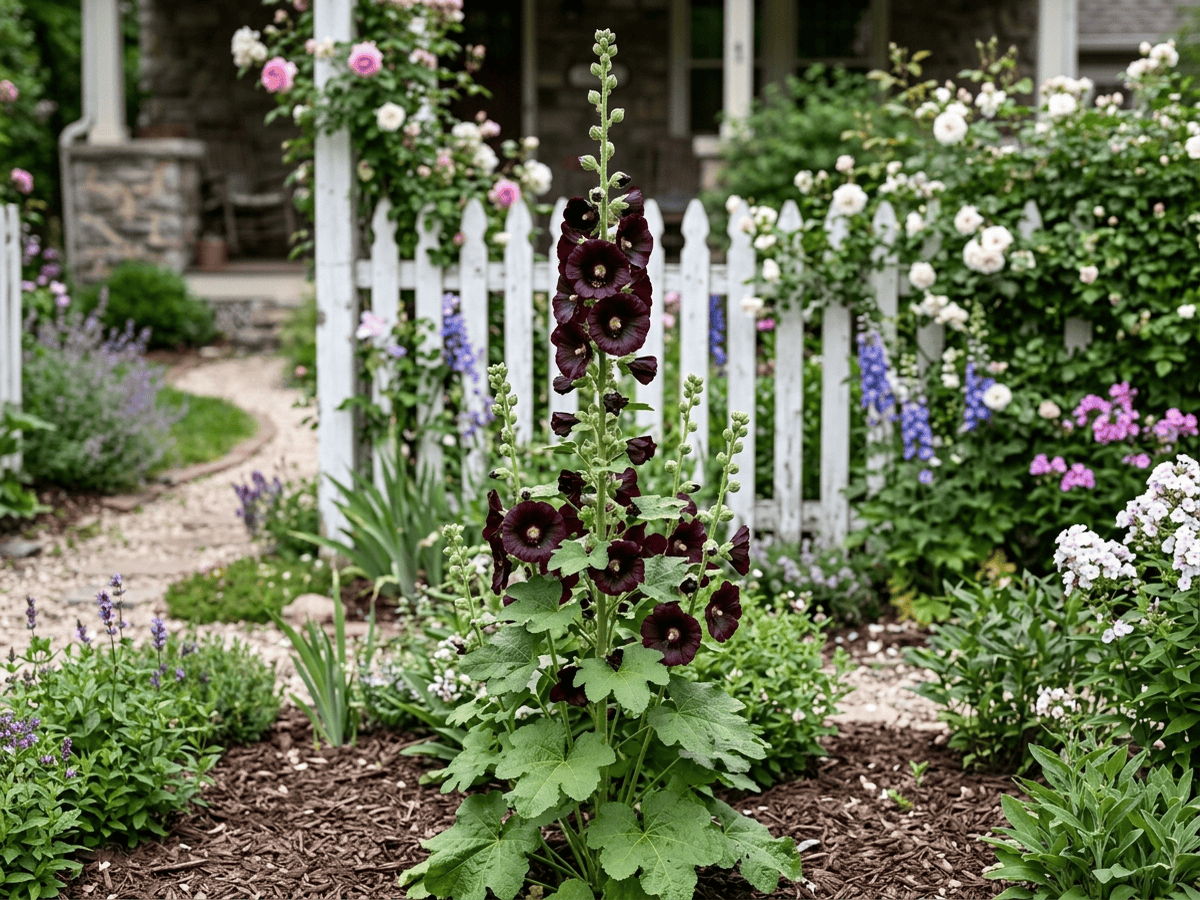


Black Hollyhock
Alcea rosea 'Nigra'
Medium · Some experienceAbout Black Hollyhock
Alcea rosea 'Nigra' is the historic black hollyhock, a biennial or short-lived perennial that has been grown in European gardens since the 16th century. Its tall flowering spires — up to 2 meters — carry large single chocolate-maroon to near-black flowers that contrast stunningly with the coarse gray-green lobed foliage.
Alcea 'Nigra' is the oldest named hollyhock cultivar still in commerce. It was grown by Thomas Jefferson at Monticello, recorded in European herbals from the 1600s, and treasured by generations of cottage-garden enthusiasts. Plants flower their second year, set abundant seed, and often colonize a garden naturally.
Like most hollyhocks, 'Nigra' struggles with hollyhock rust, a fungal disease that disfigures foliage. Tolerating leaf damage is the tradeoff for those dramatic black flower spires. Best in full sun with good air circulation and lean, well-drained soil.
- Pollinator-friendly
- Cut-flower
- Architectural
- Long-blooming
How to care for Black Hollyhock
Watering
- Springevery 5 days
- Summerevery 3 days
- Fallevery 7 days
- Winterevery 14 days
Soil · Well-draining
- Top dressingPine bark mulch10%
- Main mixPotting soil + perlite 2:170%
- DrainageLECA / gravel20%
Never skip the drainage layer — standing water is the top cause of root rot.
FERTILIZER
Balanced Feed 14-14-14
An even feed covers all three needs at once, keeping leaves, roots and blooms moving together with nothing pushed out of balance.
- Nitrogen · Leaves
- Phosphorus · Roots + Blooms
- Potassium · Strength
- Springevery 30 days
- Summerevery 45 days
At a Glance
- NativeWestern Asia, East Asia
- Height6–8 ft (1.8–2.4 m)
- Spread1–2 ft (0.3–0.6 m)
- Flower colorBurgundy, Purple
- Foliage colorGreen
- SoilLoamy, Well-drained
- LocationsYard
Bloom time
BLOOM CYCLE
Peak bloom
Jun–Aug
Single chocolate-black flowers open up the spire from bottom to top in mid-summer.
Fragrance
LIGHT FRAGRANCE
The flowers have a very light sweet scent.
Toxicity
No toxicity has been reported for this plant. Still, it is wise to keep pets from chewing on any houseplant.
Educational information, not medical or veterinary advice. If exposure is suspected, contact a doctor or veterinarian.
DISTRIBUTION

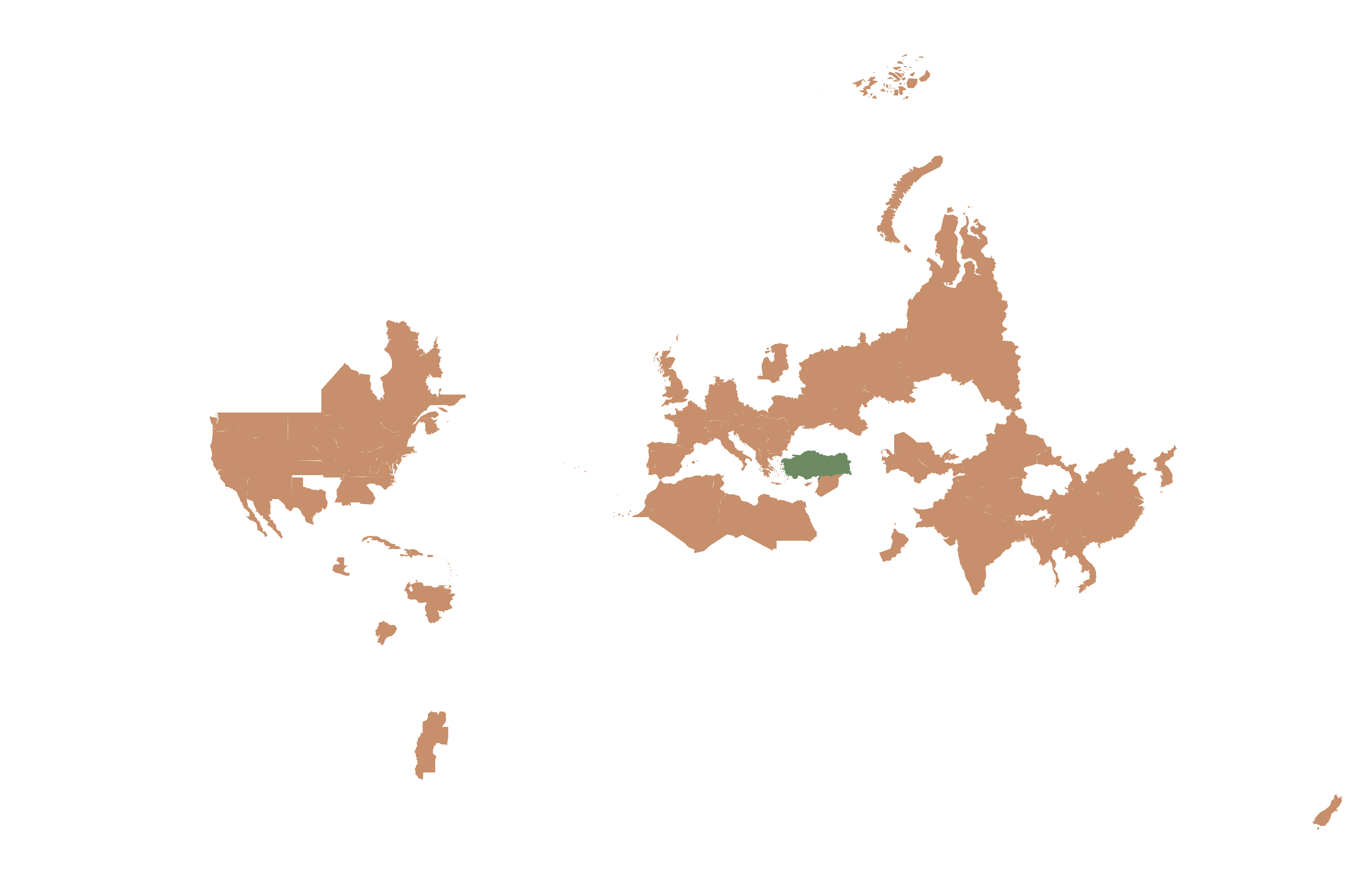
- Native
- Introduced
- Western Asia
- East Asia
History

Alcea rosea 'Nigra' was first recorded in European herbals in the 1600s, making it among the oldest named hollyhock cultivars still grown today. Thomas Jefferson documented growing black hollyhocks at Monticello in the 1790s. The cultivar has persisted not through commercial propagation but through amateur seed-saving — generations of cottage gardeners preserving it by collecting seed each autumn and replanting.
The Alcea rosea species itself was introduced to Europe from Asia (likely Turkey or western China) in the late Middle Ages and rapidly became a mainstay of monastery and cottage gardens, where it was used both ornamentally and medicinally (leaves were boiled in milk for skin complaints). 'Nigra' blooms in chocolate-maroon that reads as near-black against foliage, especially in strong sunlight. It remains susceptible to hollyhock rust — a small tradeoff for those gothic flower spires.
Symbolism & meaning
What It Symbolizes
Black Hollyhock expresses ambition, its towering spires reaching skyward like dark velvet ladders to the clouds. Yet it is also a living link to heritage, carrying the soul of 17th-century cottage gardens where it grew against whitewashed walls. Its near-black blooms whisper of old places, old aspirations — beauty that climbs not toward novelty, but toward something deeply remembered.
- Ambition — Towering spires reach skyward, symbolic of aspiration
- Heritage — Living link to 17th-century cottage gardens
Where the Name Comes From
Alcea from Greek 'alkaia' (a mallow); 'rosea' means rose-colored; 'Nigra' means black in Latin.
Uses & Fun Facts
- Tall near-black blooms striking in cottage-garden bouquets
- Open dark blooms attract bumblebees and large butterflies
- Dramatic chocolate-maroon spires for back of cottage borders
Related plants
More Alcea plants

Plants with similar care
 Mexican AbeliaAbelia floribunda
 Fraser FirAbies fraseri
 Paperbark MapleAcer griseum
 Sugar MapleAcer saccharum
Frequently asked questions
How often should I water Black Hollyhock?
In summer, water about every 3 days; in winter, about every 14 days. Adjust for heat, pot size and drainage.
How much light does Black Hollyhock need?
Full sun: 6+ hrs direct. Watch the leaves — scorching or stretching means the light needs adjusting.
Is Black Hollyhock toxic to cats or dogs?
No toxicity has been reported for this plant. Still, it is wise to keep pets from chewing on any houseplant. Educational information, not medical or veterinary advice. If exposure is suspected, contact a doctor or veterinarian.
Is Black Hollyhock easy to grow?
It is moderately demanding: a good choice once you have a little experience.
When does Black Hollyhock bloom?
It typically blooms Jun–Aug in the Northern Hemisphere.
YardMate
Identify any plant in seconds
Snap a photo — YardMate names the plant, diagnoses problems, and reminds you when to water.
Download on the App Store