 YardMate
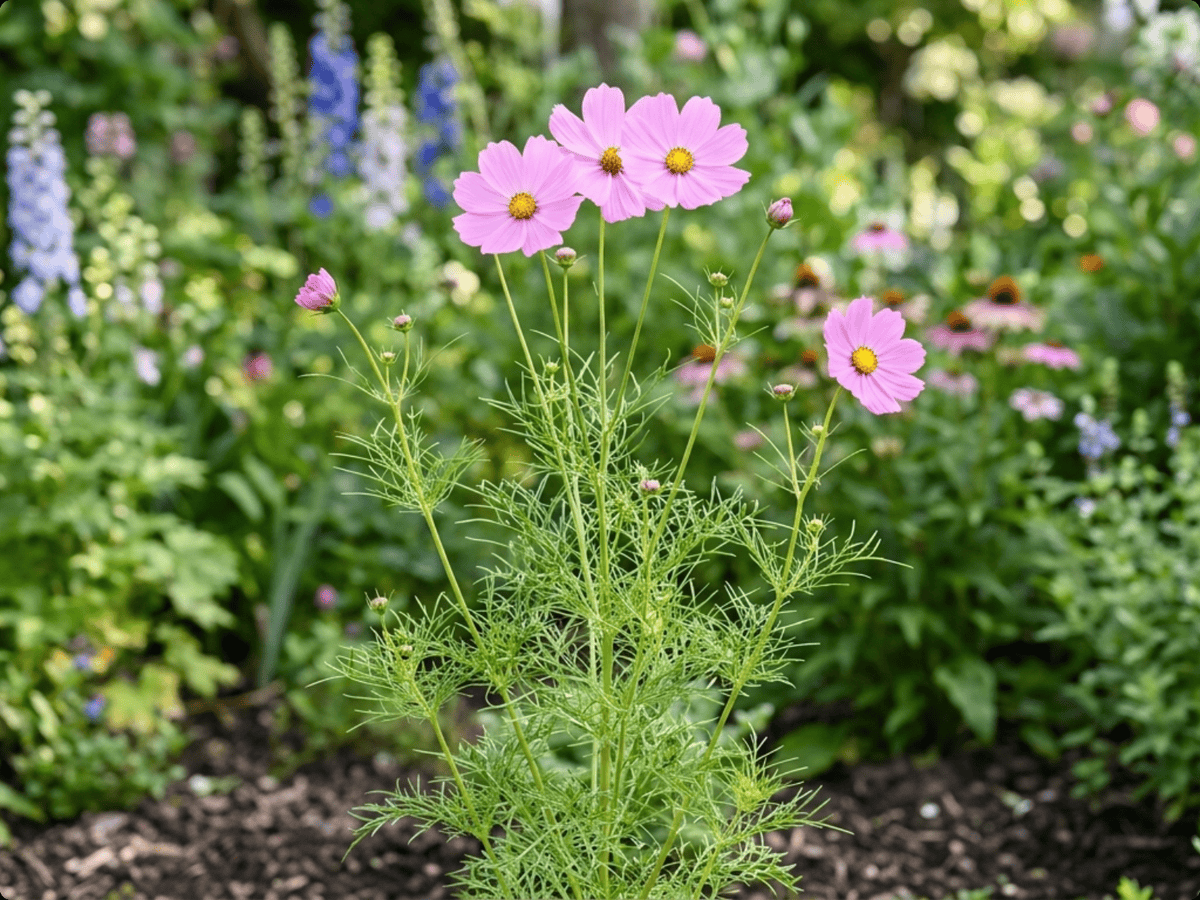


Garden Cosmos
Cosmos bipinnatus
Easy · Beginner friendlyAbout Garden Cosmos
Cosmos bipinnatus, the garden cosmos, produces graceful, daisy-like flowers on tall, airy stems above delicate, feathery foliage. Colors include white, pink, magenta, and crimson, often with contrasting centers. Native to Mexico, it grows rapidly to 1–1.5 meters, blooming profusely from midsummer to frost. The open, simple flower form is especially valuable for pollinators. It thrives in poor soil — rich soil produces more foliage and fewer flowers. Direct-sown seeds bloom within 60 days, making it one of the fastest annuals from seed. The wispy, transparent habit creates beautiful meadow effects.
- Fast-growing
- Pollinator-friendly
How to care for Garden Cosmos
Watering
- Springevery 7 days
- Summerevery 5 days
- Fallevery 10 days
- Winterpause watering
Soil · Well-draining
- Top dressingPine bark mulch10%
- Main mixPotting soil + perlite 2:170%
- DrainageLECA / gravel20%
Never skip the drainage layer — standing water is the top cause of root rot.
FERTILIZER
Balanced Feed 14-14-14
An even feed covers all three needs at once, keeping leaves, roots and blooms moving together with nothing pushed out of balance.
- Nitrogen · Leaves
- Phosphorus · Roots + Blooms
- Potassium · Strength
- Springevery 30 days
At a Glance
- NativeNorth America
- Height3–6 ft (0.9–1.8 m)
- Spread1.5–2.5 ft (0.5–0.8 m)
- Flower colorPink, White, Red, Purple
- Foliage colorGreen
- SoilWell-drained, Loamy
- LocationsYard
Bloom time
BLOOM CYCLE
Peak bloom
Jun–Sep
Direct sow; prefers lean soil; blooms in 60 days; self-seeds freely
Fragrance
NO FRAGRANCE
Not fragrant.
Toxicity
No toxicity has been reported for this plant. Still, it is wise to keep pets from chewing on any houseplant.
Educational information, not medical or veterinary advice. If exposure is suspected, contact a doctor or veterinarian.
DISTRIBUTION


- Native
- Introduced
- North America
History

Cosmos bipinnatus is native to Mexico, particularly the Sierra Madre, where it blooms in late summer meadows. Spanish missionary priests in 16th-century colonial Mexico gave it the genus name Cosmos, the Greek word for 'order, beauty, the harmoniously ordered universe', in reference to the mathematically regular eight-petal symmetry of the flower — a name thought to have originated in the Jesuit mission gardens of central Mexico. It was introduced to European and Asian horticulture in the 18th and 19th centuries and has since naturalized widely across the warm temperate world as a self-seeding meadow annual.
It remains one of the most popular summer cutting-garden annuals globally, and is culturally significant in Korea where it is strongly associated with autumn roadside meadows. Non-toxic to pets. Cosmos means 'order' or 'harmony' in Greek — Spanish priests in Mexico named the flower for the orderly arrangement of its petals.
It was sent to Madrid's Royal Botanical Garden in the late 1700s and quickly spread through European gardens. The 'Sensation' series, developed in 1936, remains the most widely planted cosmos variety 90 years later. In Japan, cosmos fields are a major autumn tourist attraction — the Showa Memorial Park in Tokyo plants 5.5 million cosmos plants annually. The related C. sulphureus provides warm orange and yellow tones. Cosmos self-seed so reliably that a single planting can perpetuate for years.
Symbolism & meaning
What It Symbolizes
Garden Cosmos makes visible harmony — its eight perfectly spaced petals and gracefully nodding stems move with the wind in a kind of effortless balance. The very name cosmos comes from the Greek for ordered universe, a tribute to the symmetry of its blooms. To plant a row is to invite a small, dancing equilibrium into the garden, where wildness and order meet on equal terms.
- Harmony — Its orderly petals and graceful movement in the wind embody balance and peace
Where the Name Comes From
Cosmos from Greek 'kosmos' (order, harmony), for the even petal arrangement. Bipinnatus means 'twice-pinnate,' for the finely divided leaves.
Uses & Fun Facts
- Long-stemmed blooms prized for cottage-garden bouquets
- Open daisies feed bees butterflies and beneficial wasps
Related plants
More Cosmos plants

Plants with similar care
 Chinese AbeliaAbelia chinensis
 Fragrant AbeliaAbelia mosanensis
 Large-Flowered AbeliaAbelia uniflora
 Glossy AbeliaAbelia x grandiflora
Frequently asked questions
How often should I water Garden Cosmos?
Water about every 7 days during the growing season, and always let excess water drain away.
How much light does Garden Cosmos need?
Full sun: 6+ hrs direct. Watch the leaves — scorching or stretching means the light needs adjusting.
Is Garden Cosmos toxic to cats or dogs?
No toxicity has been reported for this plant. Still, it is wise to keep pets from chewing on any houseplant. Educational information, not medical or veterinary advice. If exposure is suspected, contact a doctor or veterinarian.
Is Garden Cosmos easy to grow?
Yes — it is considered an easy, beginner-friendly plant.
When does Garden Cosmos bloom?
It typically blooms Jun–Sep in the Northern Hemisphere.
YardMate
Identify any plant in seconds
Snap a photo — YardMate names the plant, diagnoses problems, and reminds you when to water.
Download on the App Store