 YardMate


Common Water Hyacinth
Eichhornia crassipes
Easy · Beginner friendlyAbout Common Water Hyacinth
Eichhornia crassipes, the common water hyacinth, is a free-floating aquatic perennial native to the Amazon basin of South America. It produces rosettes of glossy, rounded leaves with distinctive swollen, spongy petioles that act as flotation devices, and showy spikes of lavender-blue flowers with a yellow spot on the upper petal. Despite its beauty, it is widely regarded as the world's worst aquatic weed — it can double its population in just 12 days, forming impenetrable mats that block waterways, starve water of oxygen, destroy fisheries, and clog hydroelectric dams across tropical Africa, Asia, and the Americas. A single plant can produce 3,000 others in just 50 days. In contained garden ponds, however, it is a stunning ornamental with excellent water-purifying abilities. It absorbs heavy metals and excess nutrients so effectively that it is used in constructed wetlands for wastewater treatment.
- Fast-growing
- Tropical
- Low-maintenance
How to care for Common Water Hyacinth
Watering
- Springevery 1 days
- Summerevery 1 days
- Fallevery 1 days
- Winterevery 1 days
Soil · Bog-wet
- WaterStanding water above soil20%
- SoilHeavy pond soil80%
No drainage layer — keep water standing above the soil.
FERTILIZER
This plant needs little to no feeding.
At a Glance
- NativeSouth America
- Height0.5–1.5 ft (0.2–0.5 m)
- Spread1–2 ft (0.3–0.6 m)
- Flower colorPurple, Blue
- Foliage colorGreen
- SoilMoisture-retentive
- LocationsYard
Bloom time
BLOOM CYCLE
Peak bloom
Jun–Aug
Lavender-blue flower spikes with yellow markings; blooms freely in warm sun
Fragrance
LIGHT FRAGRANCE
The flowers have a light sweet scent.
Toxicity
Pets Safe
None reported
Not reported
EXPOSURE No exposure route is reported.
EFFECT No toxic effect is reported.
NOTE No human toxicity is reported in this catalog; avoid eating ornamental plants unless confirmed edible.
Safe
EXPOSURE No exposure route is reported.
EFFECT No toxic effect is reported.
NOTE Listed as non-toxic for dogs; avoid eating ornamental plants unless confirmed edible.
Safe
EXPOSURE No exposure route is reported.
EFFECT No toxic effect is reported.
NOTE Listed as non-toxic for cats; avoid eating ornamental plants unless confirmed edible.
Educational information, not medical or veterinary advice. If exposure is suspected, contact a doctor or veterinarian.
DISTRIBUTION

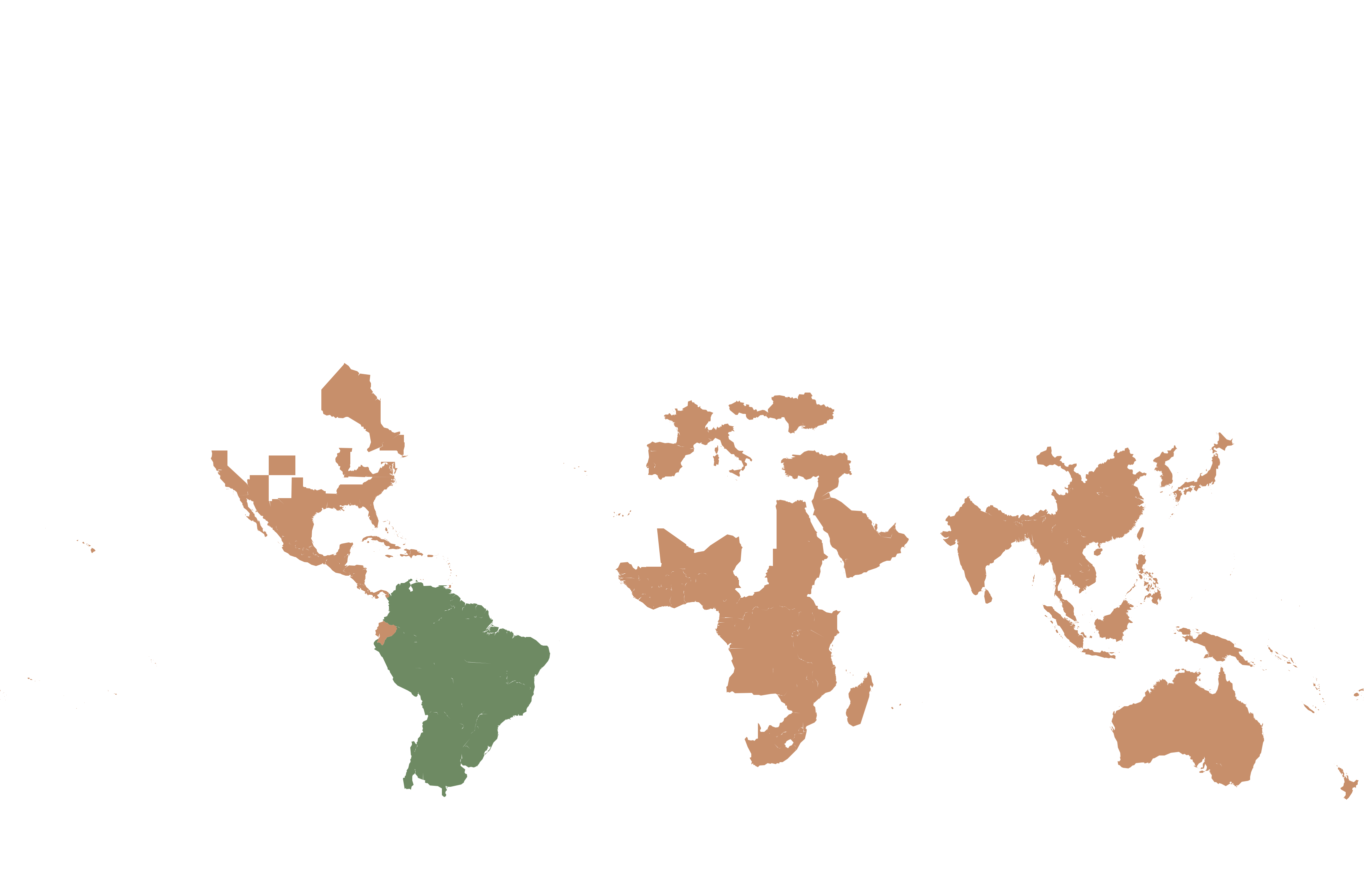
- Native
- Introduced
- South America
History
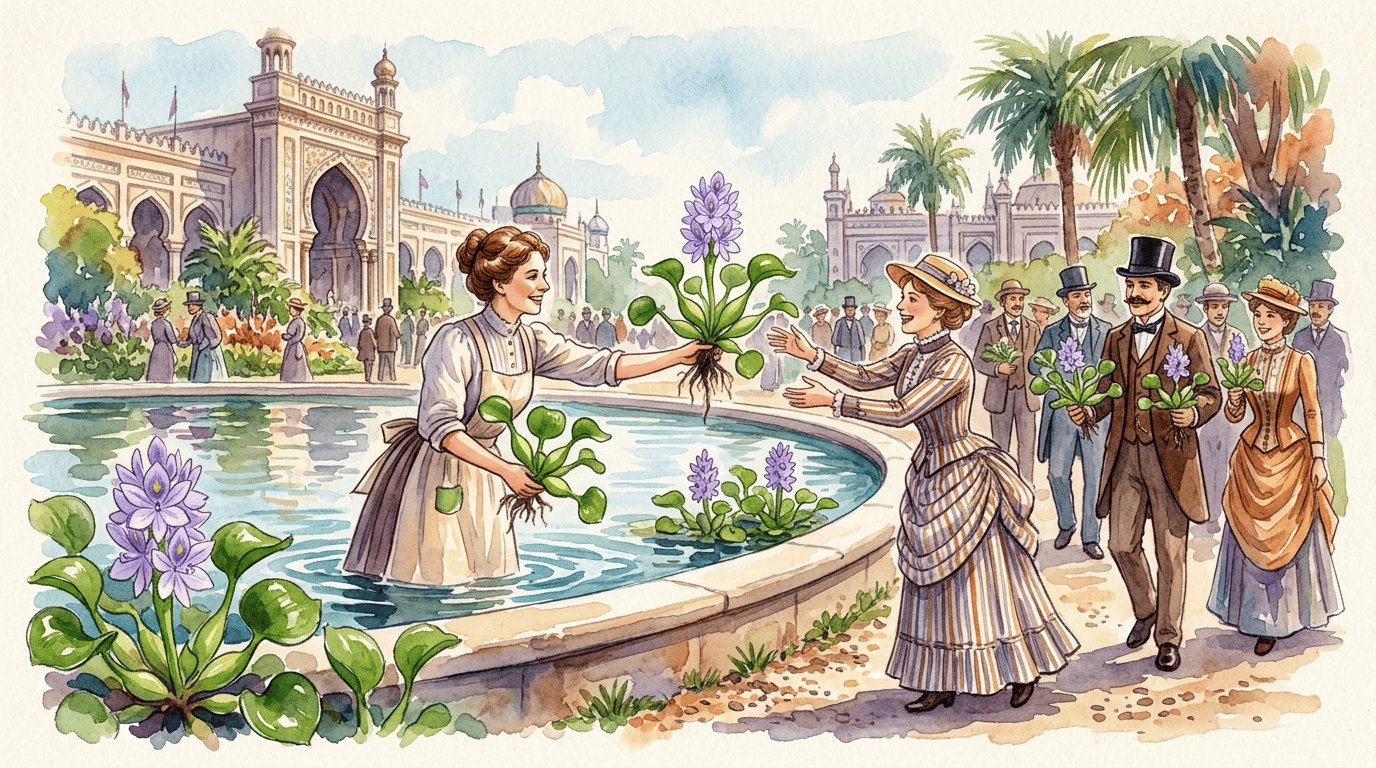
Eichhornia crassipes (recently reclassified by many authorities as Pontederia crassipes) is a free-floating aquatic plant native to the Amazon basin of South America. It has distinctive swollen spongy leaf petioles that contain aerenchyma (air-filled tissue) and keep the plant buoyant, glossy rounded leaves, and beautiful upright spikes of large lavender-blue flowers with a yellow spot on the upper petal. Introduced globally in the 19th century as an ornamental pond plant — its 1884 introduction to the United States at the New Orleans Cotton Exposition is often cited — the species has become what the IUCN lists as one of the world's 100 worst invasive alien species. Under warm eutrophic conditions a single plant can reproduce vegetatively to 140 million plants in one year, forming dense floating mats that: block sunlight from reaching submerged plants, reduce dissolved oxygen and kill fish, prevent boat navigation, clog hydroelectric intakes, support breeding of bilharzia-carrying snails and malaria-vector mosquitoes, and deposit enormous quantities of decaying biomass that further degrades water quality.
Water hyacinth infestation costs billions annually in African, South Asian, and Southeast Asian water management. Biological control using weevils (Neochetina species) and water hyacinth moth (Niphograpta albiguttalis) has had significant success but cannot fully control the species in highly eutrophic waters. Sale is banned in many US states and internationally regulated.
Water hyacinth was introduced as an ornamental at the 1884 World's Industrial and Cotton Centennial Exposition in New Orleans, where visitors were given free plants — a generous gesture that unleashed one of the most devastating biological invasions in history. Within decades, it had choked waterways across the American South. It spread worldwide through the ornamental plant trade and is now invasive in over 50 countries. Lake Victoria in Africa lost significant fishery productivity to water hyacinth mats in the 1990s. Despite its destructive reputation, researchers are finding productive uses — it can be converted to biogas, woven into furniture, and used in constructed wetlands to purify wastewater contaminated with heavy metals.
Symbolism & meaning
What It Symbolizes
The Common Water Hyacinth expresses a hard kind of beauty, its lavender blooms drifting across tropical waters in masses that hide a destructive nature. Where it spreads, it suffocates fisheries, blocks waterways, and starves native life of light. This is the cautionary flower of garden literature — a reminder that loveliness, when introduced beyond its home and left unchecked, can become one of the gravest ecological dangers.
- Beauty — Stunning lavender blooms mask a destructive invasive nature
- Caution — A reminder that beauty can be dangerous when unchecked and uncontained
Where the Name Comes From
Eichhornia honors the 19th-century Prussian minister of education Johann Albrecht Friedrich Eichhorn. Crassipes means 'thick-footed' in Latin, referring to the swollen leaf stalks.
Related plants
Plants with similar care
 Chinese AbeliaAbelia chinensis
 Fragrant AbeliaAbelia mosanensis
 Large-Flowered AbeliaAbelia uniflora
 Glossy AbeliaAbelia x grandiflora
Frequently asked questions
How often should I water Common Water Hyacinth?
In summer, water about every 1 days; in winter, about every 1 days. Adjust for heat, pot size and drainage.
How much light does Common Water Hyacinth need?
Full sun: 6+ hrs direct. Watch the leaves — scorching or stretching means the light needs adjusting.
Is Common Water Hyacinth toxic to cats or dogs?
Pets Safe (Dogs Safe · Cats Safe) Educational information, not medical or veterinary advice. If exposure is suspected, contact a doctor or veterinarian.
Is Common Water Hyacinth easy to grow?
Yes — it is considered an easy, beginner-friendly plant.
When does Common Water Hyacinth bloom?
It typically blooms Jun–Aug in the Northern Hemisphere.
YardMate
Identify any plant in seconds
Snap a photo — YardMate names the plant, diagnoses problems, and reminds you when to water.
Download on the App Store