 YardMate


Giant Hogweed
Heracleum mantegazzianum
Easy · Beginner friendlyAbout Giant Hogweed
Giant Hogweed is a Caucasian perennial herb notorious for its enormous size and dangerously phototoxic sap that causes severe burns and long-lasting scars. Growing 8 to 20 feet tall with massive 5-foot umbels of white flowers and leaves 5 feet across, it has invaded the northeastern US, Pacific Northwest, and Great Lakes region. Federally listed noxious weed; skin contact followed by sun exposure causes severe third-degree burns, blindness if eye contact occurs.
- Architectural
- Fast-growing
- Pollinator-friendly
How to care for Giant Hogweed
Watering
- Springevery 10 days
- Summerevery 7 days
- Fallevery 14 days
- Winterevery 30 days
Soil · Well-draining
- Top dressingPine bark mulch10%
- Main mixPotting soil + perlite 2:170%
- DrainageLECA / gravel20%
Never skip the drainage layer — standing water is the top cause of root rot.
FERTILIZER
This plant needs little to no feeding.
At a Glance
- NativeWestern Asia, Europe
- Height8–15 ft (2.4–4.6 m)
- Spread3–6 ft (0.9–1.8 m)
- Flower colorWhite
- Foliage colorGreen
- SoilLoamy, Moisture-retentive, Rich
- LocationsYard
Bloom time
BLOOM CYCLE
Peak bloom
Jun–Aug
Massive 3-5 foot white umbel flower heads summer
Fragrance
LIGHT FRAGRANCE
The flowers have a light musky scent.
Toxicity
Humans Toxic · Pets Moderate
furanocoumarins, psoralen, 8-methoxypsoralen, and bergapten
Toxic
- Sap
- Leaf
- Stem
- Contact
EXPOSURE Touching sap, leaves, and stems.
EFFECT Phytophotodermatitis, severe blistering, long-term light sensitivity, and eye damage if sap contacts eyes.
NOTE Sap causes severe photodermatitis; wear full protective clothing when handling.
Moderate
- Sap
- Leaf
- Contact
- Ingestion
EXPOSURE Touching sap and leaves. Eating sap and leaves.
EFFECT Skin blistering and gastrointestinal upset.
NOTE Sap causes severe photodermatitis; wear full protective clothing when handling.
Moderate
- Sap
- Leaf
- Contact
- Ingestion
EXPOSURE Touching sap and leaves. Eating sap and leaves.
EFFECT Skin blistering and gastrointestinal upset.
NOTE Sap causes severe photodermatitis; wear full protective clothing when handling.
Educational information, not medical or veterinary advice. If exposure is suspected, contact a doctor or veterinarian.
DISTRIBUTION

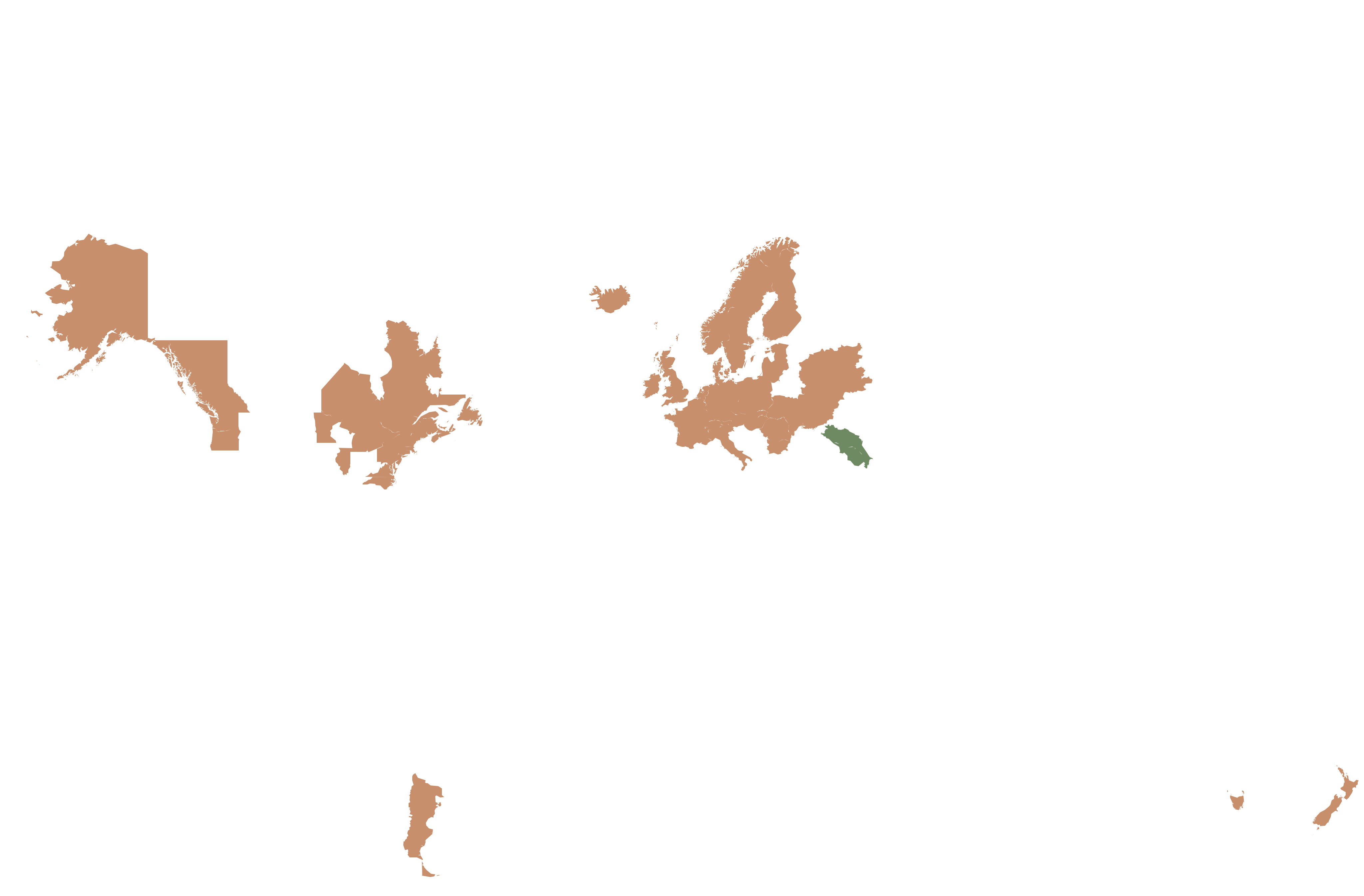
- Native
- Introduced
- Western Asia
- Europe
History
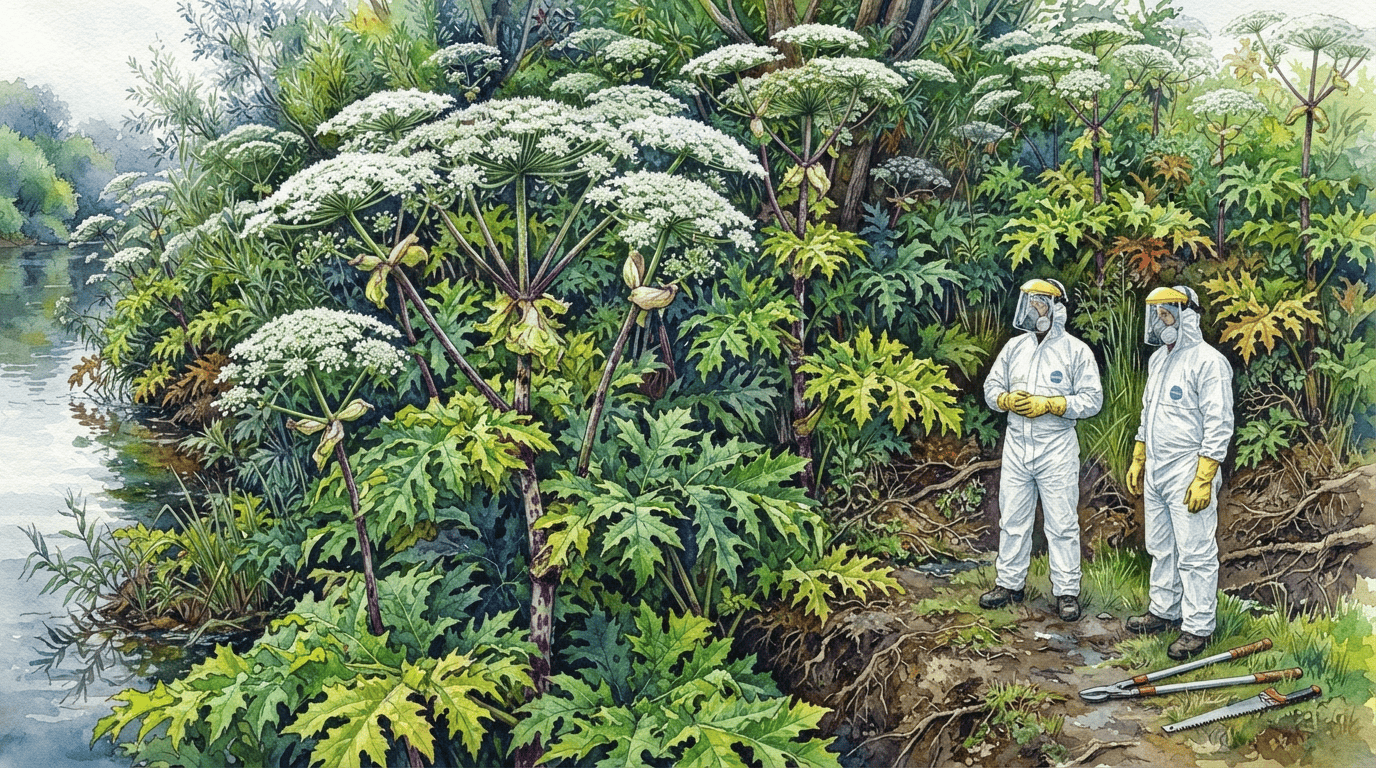
Heracleum mantegazzianum, giant hogweed, is a monocarpic perennial in the carrot family native to the western Caucasus of Georgia and southern Russia, reaching five meters tall at flowering with white umbels fifty centimeters across. British horticulturists began importing seed in 1817 from the Russian imperial gardens at St Petersburg, and Victorian estate gardeners prized the plant for its dramatic scale. By the 1980s it had escaped widely into European and North American riparian corridors.
The sap contains furanocoumarins (psoralens) that photosensitize skin and cause severe blistering, scarring, and long-term light sensitivity when contaminated skin is exposed to ultraviolet light. The species is regulated as a noxious weed in the UK, Canada, and many US states, and removal requires protective clothing and eye protection.
Native to the Caucasus region, Giant Hogweed was introduced to the US as an ornamental curiosity in the early 1900s and has since escaped into the Northeast, Great Lakes, and Pacific Northwest. Federally listed as a noxious weed and regulated for eradication, it causes severe phototoxic burns documented across the invasion range.
Symbolism & meaning
What It Symbolizes
Giant Hogweed is monstrous threat in plant form — fifteen feet tall, with sap that reacts to sunlight to cause severe phototoxic burns and lasting scars on bare skin. Originally imported from the Caucasus as a Victorian botanical curiosity for stately gardens, it has become one of Europe's most feared invasives. It is solar burn given root and stem, a warning that botanical beauty can be genuinely dangerous.
- Monstrous threat — giant plant with burning sap
- Solar burn — sap activates in sunlight to burn skin
Where the Name Comes From
'Heracleum' from Hercules, for the herb's giant stature; 'mantegazzianum' honors Italian anthropologist Paolo Mantegazza (1831-1910).
Related plants
Plants with similar care
 Chinese AbeliaAbelia chinensis
 Fragrant AbeliaAbelia mosanensis
 Large-Flowered AbeliaAbelia uniflora
 Glossy AbeliaAbelia x grandiflora
Frequently asked questions
How often should I water Giant Hogweed?
In summer, water about every 7 days; in winter, about every 30 days. Adjust for heat, pot size and drainage.
How much light does Giant Hogweed need?
Full sun: 6+ hrs direct. Watch the leaves — scorching or stretching means the light needs adjusting.
Is Giant Hogweed toxic to cats or dogs?
Pets Moderate (Dogs Moderate · Cats Moderate) Educational information, not medical or veterinary advice. If exposure is suspected, contact a doctor or veterinarian.
Is Giant Hogweed easy to grow?
Yes — it is considered an easy, beginner-friendly plant.
When does Giant Hogweed bloom?
It typically blooms Jun–Aug in the Northern Hemisphere.
YardMate
Identify any plant in seconds
Snap a photo — YardMate names the plant, diagnoses problems, and reminds you when to water.
Download on the App Store