 YardMate



Common Myrtle
Myrtus communis
Easy · Beginner friendlyAbout Common Myrtle
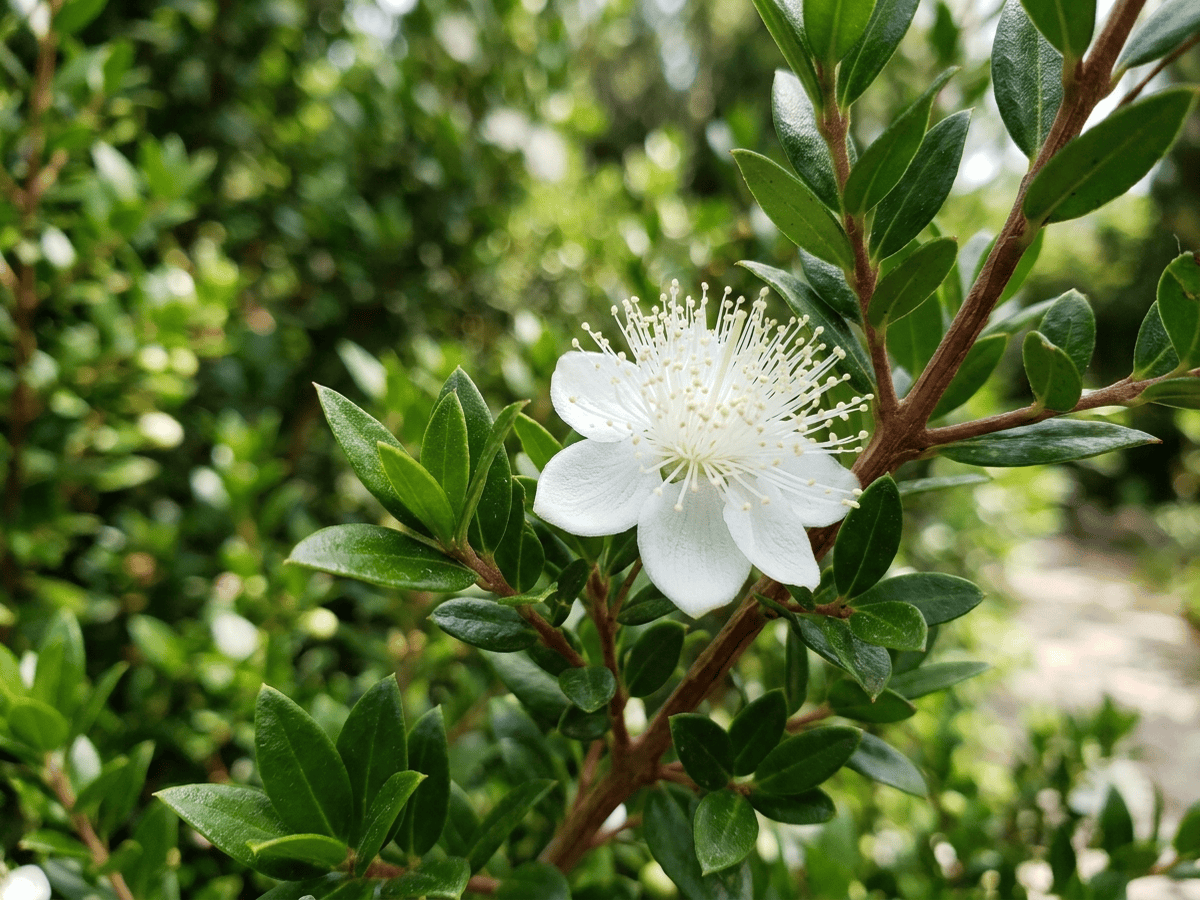
Myrtus communis, common myrtle, is an evergreen shrub native to the Mediterranean basin. It reaches 2-5 m tall with small glossy aromatic dark green leaves, fragrant white five-petaled flowers with prominent golden stamens in summer, and blue-black berries in autumn.
Myrtle has been sacred and symbolic across Mediterranean cultures for over 3000 years. Sacred to Aphrodite/Venus in Greek and Roman tradition, it symbolized love and marriage and was woven into bridal wreaths — a tradition Queen Victoria revived in 1840, since when every British royal bride has carried myrtle from a descendant of Victoria's original plant. Jewish tradition uses myrtle as one of the Four Species of Sukkot. In Muslim tradition myrtle is paradise's garden plant.
Leaves and berries produce the Sardinian and Corsican liqueur 'mirto.' Hardy in USDA zones 8-11. A classic Mediterranean hedge and clipped specimen.
- Edible
- Fragrant
- Drought-tolerant
- Evergreen
How to care for Common Myrtle
Watering
- Springevery 10 days
- Summerevery 7 days
- Fallevery 14 days
- Winterevery 21 days
Soil · Well-draining
- Top dressingPine bark mulch10%
- Main mixPotting soil + perlite 2:170%
- DrainageLECA / gravel20%
Never skip the drainage layer — standing water is the top cause of root rot.
FERTILIZER
Balanced Feed 14-14-14
An even feed covers all three needs at once, keeping leaves, roots and blooms moving together with nothing pushed out of balance.
- Nitrogen · Leaves
- Phosphorus · Roots + Blooms
- Potassium · Strength
- Springevery 30 days
- Summerevery 30 days
- Fallevery 45 days
At a Glance
- NativeMediterranean, Africa, Western Asia
- Height5–15 ft (1.5–4.6 m)
- Spread5–10 ft (1.5–3 m)
- Flower colorWhite
- Foliage colorDark-green, Green
- Fruit colorBlack, Blue
- SoilLoamy, Well-drained
- LocationsYard
Bloom time
BLOOM CYCLE
Peak bloom
Jun–Sep
Small fragrant white flowers with gold stamens in mid-to-late summer; blue-black berries follow.
Fragrance
STRONG FRAGRANCE
Classic aromatic sweet-spicy myrtle scent.
Toxicity
No toxicity has been reported for this plant. Still, it is wise to keep pets from chewing on any houseplant.
Educational information, not medical or veterinary advice. If exposure is suspected, contact a doctor or veterinarian.
DISTRIBUTION


- Native
- Introduced
- Mediterranean
- Africa
- Western Asia
History
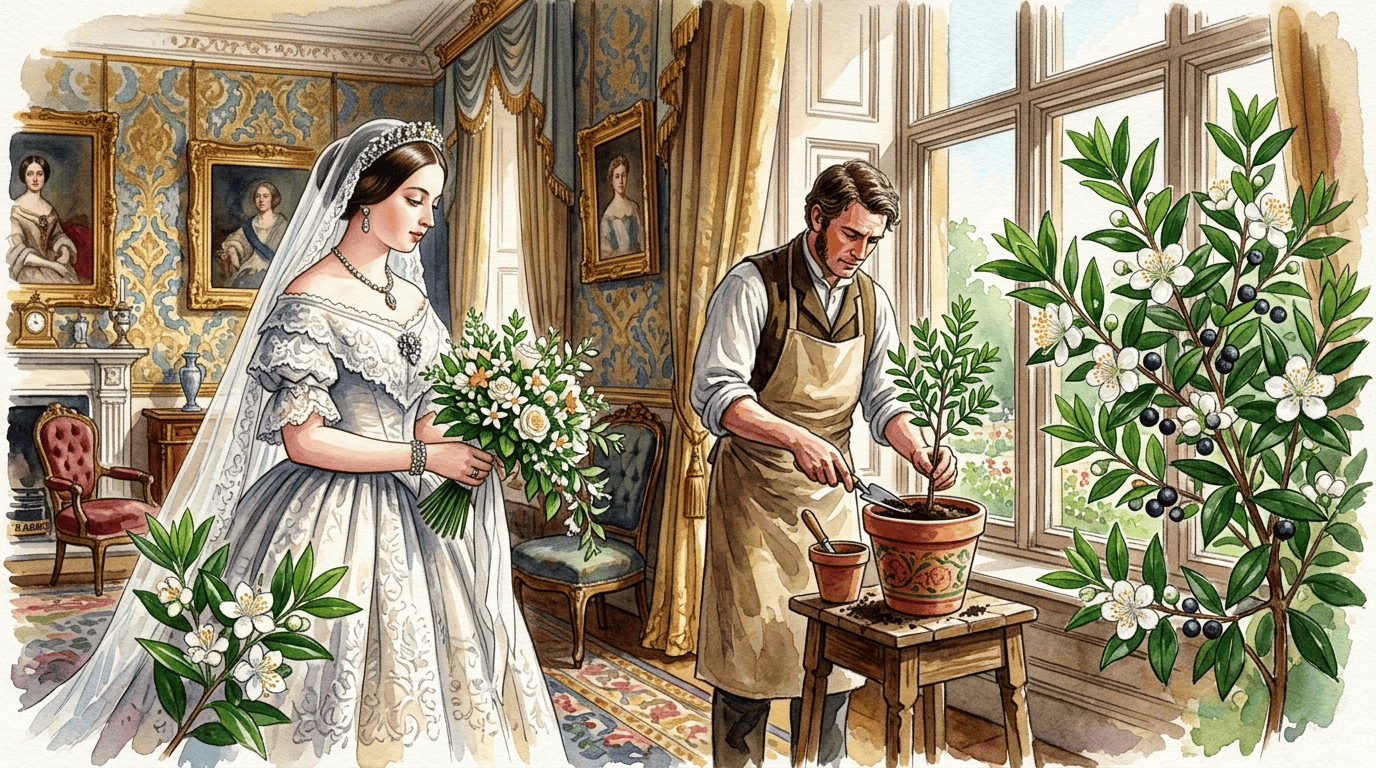
Myrtus communis is native to the entire Mediterranean basin, North Africa, and Western Asia, and has been cultivated continuously for at least 4000 years. In ancient Greek religion it was sacred to Aphrodite — goddess of love — and worn in bridal wreaths. Roman tradition transferred this to Venus, and brides carried myrtle into marriage.
Jewish tradition designates myrtle (hadas) as one of the Four Species (along with citron, palm, and willow) taken on the harvest festival of Sukkot, following Leviticus 23:40. Islamic tradition considers myrtle a plant of Paradise; Muhammad reportedly said he brought three things from Paradise including a branch of myrtle. Queen Victoria of England carried myrtle in her 1840 bridal bouquet and planted a cutting at Osborne House, Isle of Wight; every British royal bride since — Princess Diana (1981), Catherine Middleton (2011), Meghan Markle (2018), Princess Eugenie, and others — has carried myrtle cuttings descended from Victoria's original plant, maintaining an unbroken 180-year tradition.
In Sardinia, Corsica, and parts of southern Italy, myrtle leaves and berries are fermented and distilled into 'mirto' liqueur — the signature digestif of Sardinian cuisine, in both red (berry) and white (leaf) forms. Hardy in USDA zones 8-11; can be grown as a container topiary in colder regions. One of the Four Species of Jewish Sukkot. Source of Sardinian mirto liqueur.
Symbolism & meaning
What It Symbolizes
Common myrtle is the plant of love and marriage and eternity all at once — sacred to Aphrodite in classical Greece, woven into bridal wreaths from antiquity onward, and still used in royal British wedding bouquets today. As an evergreen of remarkable longevity it signals lasting union, the kind of love meant to outlive its season. Few plants accompany human ceremony so faithfully across so many centuries.
- Love — Sacred to Aphrodite; traditional bridal plant since antiquity
- Eternity — Evergreen and long-lived; symbol of lasting union
Where the Name Comes From
Myrtus from Greek 'myrtos'; 'communis' means common.
Uses & Fun Facts
- Aromatic dark berries used to flavor Sardinian mirto liqueur
- Glossy leaves release classic Mediterranean myrtle aroma when crushed
- Dense evergreen growth shaped into Mediterranean garden hedges
- Sacred to Aphrodite and used in Jewish Sukkot ritual bouquets
Related plants
Plants with similar care
 Chinese AbeliaAbelia chinensis
 Fragrant AbeliaAbelia mosanensis
 Large-Flowered AbeliaAbelia uniflora
 Glossy AbeliaAbelia x grandiflora
Frequently asked questions
How often should I water Common Myrtle?
In summer, water about every 7 days; in winter, about every 21 days. Adjust for heat, pot size and drainage.
How much light does Common Myrtle need?
Full sun: 6+ hrs direct. Watch the leaves — scorching or stretching means the light needs adjusting.
Is Common Myrtle toxic to cats or dogs?
No toxicity has been reported for this plant. Still, it is wise to keep pets from chewing on any houseplant. Educational information, not medical or veterinary advice. If exposure is suspected, contact a doctor or veterinarian.
Is Common Myrtle easy to grow?
Yes — it is considered an easy, beginner-friendly plant.
When does Common Myrtle bloom?
It typically blooms Jun–Sep in the Northern Hemisphere.
YardMate
Identify any plant in seconds
Snap a photo — YardMate names the plant, diagnoses problems, and reminds you when to water.
Download on the App Store