 YardMate



Japanese Cheesewood
Pittosporum tobira
Easy · Beginner friendlyAbout Japanese Cheesewood
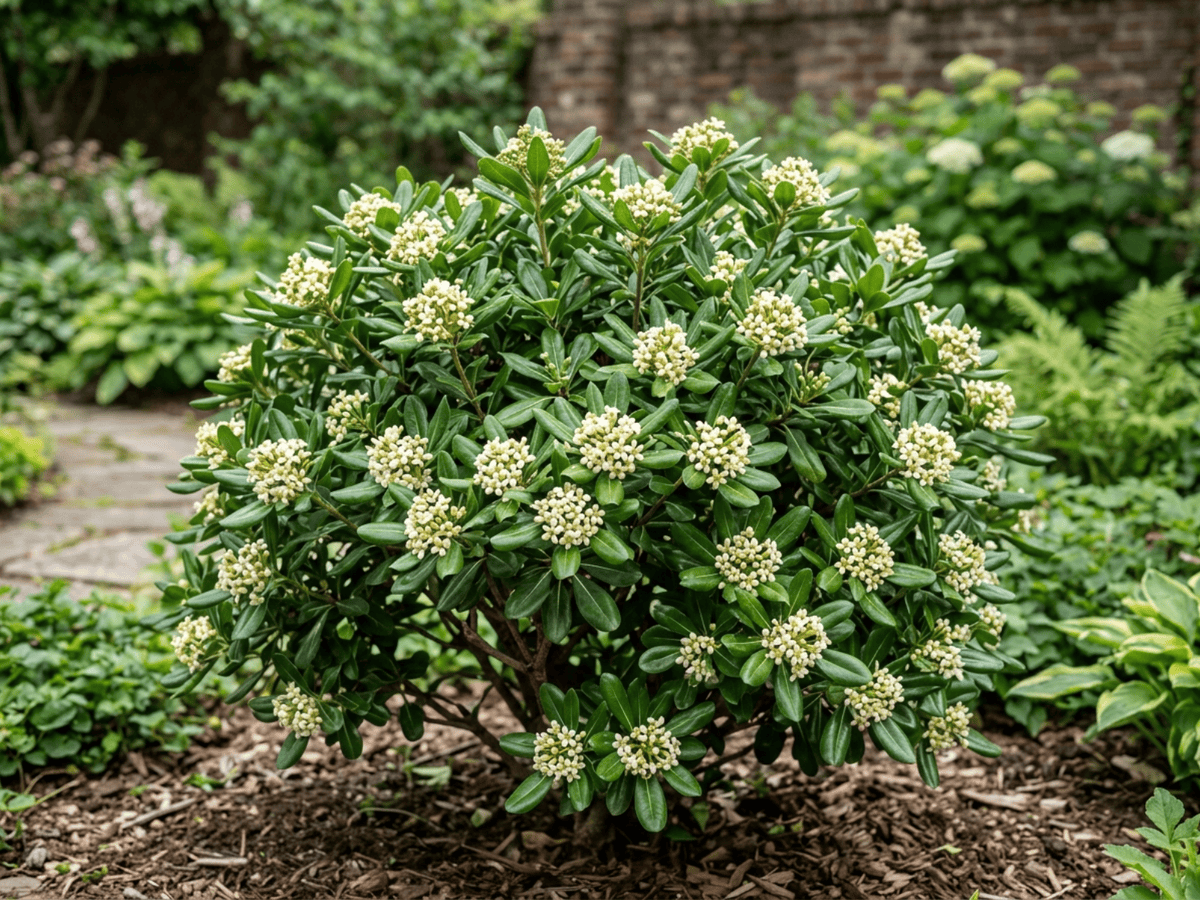
Pittosporum tobira, commonly called Japanese pittosporum or Japanese mock orange, is a dense evergreen shrub native to Japan, China, and Korea. It typically grows two to four meters tall with a naturally rounded form and thick, leathery dark-green leaves arranged in whorls at the branch tips. In late spring to early summer, it produces clusters of small creamy-white flowers with a sweet fragrance reminiscent of orange blossoms, which gradually age to pale yellow. The flowers give way to green seed capsules that split open to reveal sticky orange-red seeds — the genus name literally means 'pitch seed'. Pittosporum tobira is one of the most widely planted ornamental shrubs in warm temperate and subtropical regions worldwide. It excels as a hedge, foundation plant, or specimen shrub, and its salt tolerance makes it invaluable in coastal landscapes. The popular cultivar 'Variegata' features gray-green leaves edged in creamy white. The plant adapts well to pruning and shaping, and once established, it is remarkably drought-tolerant. It is a common element in both formal Western landscapes and naturalistic Asian-style garden designs.
- Fragrant
- Drought-tolerant
- Evergreen
How to care for Japanese Cheesewood
Watering
- Springevery 7 days
- Summerevery 5 days
- Fallevery 14 days
- Winterevery 30 days
Soil · Well-draining
- Top dressingPine bark mulch10%
- Main mixPotting soil + perlite 2:170%
- DrainageLECA / gravel20%
Never skip the drainage layer — standing water is the top cause of root rot.
FERTILIZER
Balanced Feed 14-14-14
An even feed covers all three needs at once, keeping leaves, roots and blooms moving together with nothing pushed out of balance.
- Nitrogen · Leaves
- Phosphorus · Roots + Blooms
- Potassium · Strength
- Springevery 60 days
At a Glance
- NativeEast Asia
- Height8–12 ft (2.4–3.7 m)
- Spread8–12 ft (2.4–3.7 m)
- Flower colorWhite, Cream, Yellow
- Foliage colorGreen, Variegated
- SoilWell-drained, Loamy
- LocationsYard
Bloom time
BLOOM CYCLE
Peak bloom
Mar–May
Fragrant creamy-white flowers in late spring; sweet orange-blossom scent
Fragrance
STRONG FRAGRANCE
Powerful orange-blossom fragrance — carries long distances in warm spring air.
Toxicity
Pets Safe
None reported
Not reported
EXPOSURE No exposure route is reported.
EFFECT No toxic effect is reported.
NOTE No human toxicity is reported in this catalog; avoid eating ornamental plants unless confirmed edible.
Safe
EXPOSURE No exposure route is reported.
EFFECT No toxic effect is reported.
NOTE Listed as non-toxic for dogs; avoid eating ornamental plants unless confirmed edible.
Safe
EXPOSURE No exposure route is reported.
EFFECT No toxic effect is reported.
NOTE Listed as non-toxic for cats; avoid eating ornamental plants unless confirmed edible.
Educational information, not medical or veterinary advice. If exposure is suspected, contact a doctor or veterinarian.
DISTRIBUTION


- Native
- Introduced
- East Asia
History

Pittosporum tobira is native to coastal Japan, southern Korea, and coastal southeastern China, including Taiwan. Its Japanese name tobira means door, a reference to the old custom of placing branches at doorways during New Year celebrations to invite good fortune. The plant forms dense evergreen shrubs with glossy leaves clustered at branch tips, and in late spring it releases cream-white flowers with a powerful orange-blossom fragrance.
Introduced to European horticulture in 1804 through Kew, it became a workhorse of Mediterranean-climate landscaping because it tolerates salt spray, heat, drought, pollution, poor soils, and hard pruning. It has been planted by the millions as hedging, foundation planting, freeway landscape, and coastal windbreak in California, Florida, southern Europe, Australia, and New Zealand. Compact 'Wheeler's Dwarf' and variegated forms keep it common in modern gardens.
Symbolism & meaning
What It Symbolizes
Japanese Cheesewood holds sweet memories in its orange-blossom fragrance, evoking nostalgic recollections of coastal courtyards and summer evenings long past. Welcome is its second meaning — traditionally planted at doorways across East Asia and the Mediterranean, where its glossy mounded form greets visitors and is said to invite good fortune. Its message gathers at the threshold: scent, hospitality, and the soft pull of memory.
- Sweet memories — Its orange-blossom fragrance evokes nostalgic recollections of past moments
- Welcome — Traditionally planted at doorways to greet visitors and invite good fortune
Where the Name Comes From
'Pittosporum' comes from Greek 'pitta' (pitch) and 'sporum' (seed), describing the sticky resin coating the seeds. 'Tobira' is the Japanese word for door.
Uses & Fun Facts
- Creamy flower clusters release strong orange-blossom scent
- Glossy evergreen sheared into coastal privacy hedges
- Mounding form anchors warm-climate foundation plantings
Related plants
More Pittosporum plants
Plants with similar care
 Chinese AbeliaAbelia chinensis
 Fragrant AbeliaAbelia mosanensis
 Large-Flowered AbeliaAbelia uniflora
 Glossy AbeliaAbelia x grandiflora
Frequently asked questions
How often should I water Japanese Cheesewood?
In summer, water about every 5 days; in winter, about every 30 days. Adjust for heat, pot size and drainage.
How much light does Japanese Cheesewood need?
Full sun: 6+ hrs direct. Watch the leaves — scorching or stretching means the light needs adjusting.
Is Japanese Cheesewood toxic to cats or dogs?
Pets Safe (Dogs Safe · Cats Safe) Educational information, not medical or veterinary advice. If exposure is suspected, contact a doctor or veterinarian.
Is Japanese Cheesewood easy to grow?
Yes — it is considered an easy, beginner-friendly plant.
When does Japanese Cheesewood bloom?
It typically blooms Mar–May in the Northern Hemisphere.
YardMate
Identify any plant in seconds
Snap a photo — YardMate names the plant, diagnoses problems, and reminds you when to water.
Download on the App Store