 YardMate


Houseleek
Sempervivum tectorum
Easy · Beginner friendlyAbout Houseleek
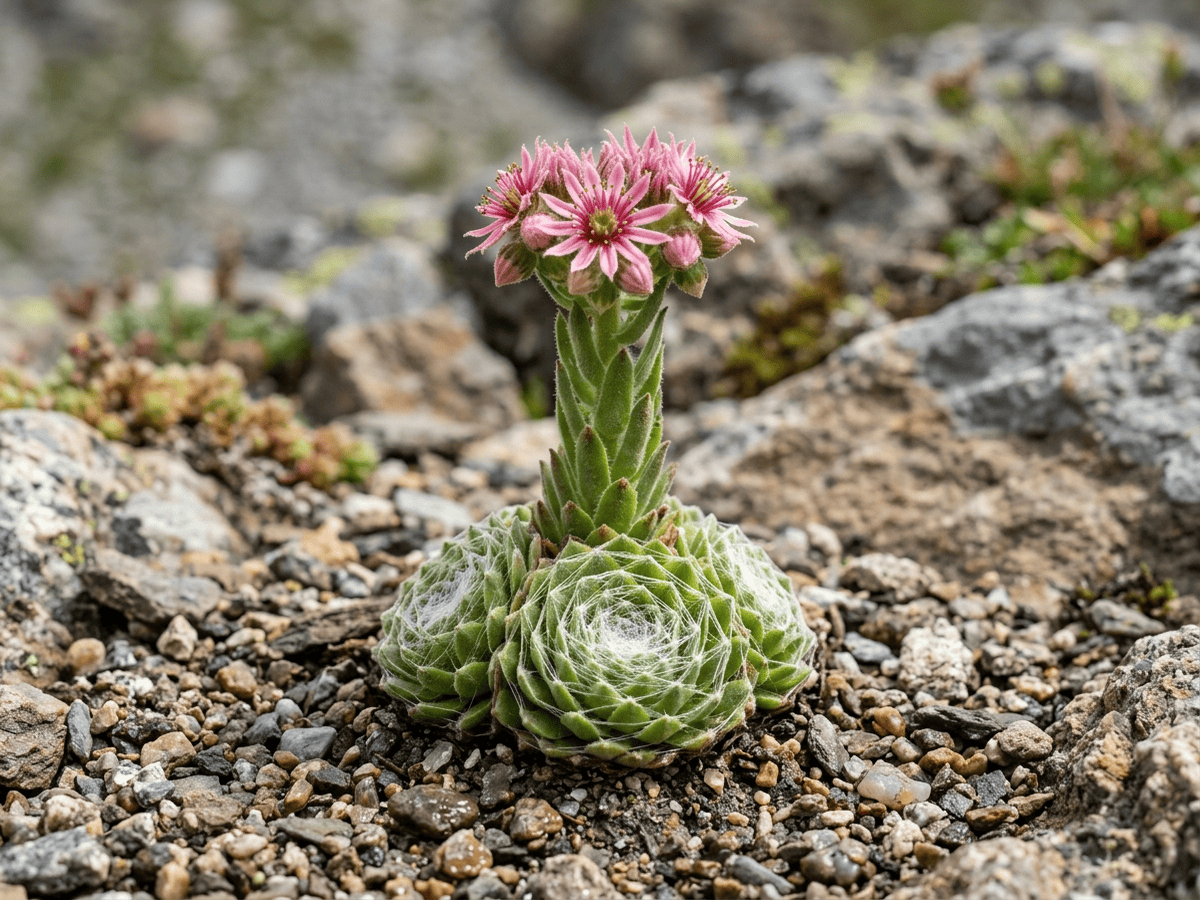
Sempervivum tectorum, the houseleek or hens-and-chicks, forms tight rosettes of succulent leaves that produce rings of smaller 'chick' offsets connected by stolons. Native to European mountains, it is extraordinarily cold-hardy, surviving -30°C and beyond. The rosettes range from green to red, purple, and silver, often changing color seasonally. After flowering (tall star-shaped pink flowers), the mother rosette dies — but is surrounded by dozens of offspring. Medieval Europeans planted it on rooftops, believing it protected against lightning, hence 'tectorum' (of roofs).
- Drought-tolerant
- Cold-hardy
- Groundcover
How to care for Houseleek
Watering
- Springevery 14 days
- Summerevery 10 days
- Fallevery 21 days
- Winterevery 30 days
Soil · Fast-draining
- Main mixSand + pumice + soil 1:1:150%
- DrainagePumice / gravel50%
Keep grit at half the mix or more — this soil is meant to dry out fast.
FERTILIZER
- Springevery 60 days
At a Glance
- NativeEurope
- Height0.3–0.5 ft (0.1–0.2 m)
- Spread0.5–1.5 ft (0.2–0.5 m)
- Flower colorPink, Red, Purple
- Foliage colorGreen, Red, Purple, Silver
- SoilSandy, Well-drained
- LocationsYard · Balcony
Bloom time
BLOOM CYCLE
Peak bloom
Jun–Aug
Pink star flowers on tall stalk; mother rosette dies after flowering but leaves many offsets
Fragrance
NO FRAGRANCE
No notable fragrance.
Toxicity
Humans Safe · Pets Safe
None reported
Safe
EXPOSURE No exposure route is reported.
EFFECT Historically used in folk medicine and leaves topically applied to burns.
NOTE Listed as non-toxic for humans; avoid eating ornamental plants unless confirmed edible.
Safe
EXPOSURE No exposure route is reported.
EFFECT Not listed as toxic.
NOTE Listed as non-toxic for dogs; avoid eating ornamental plants unless confirmed edible.
Safe
EXPOSURE No exposure route is reported.
EFFECT Not listed as toxic.
NOTE Listed as non-toxic for cats; avoid eating ornamental plants unless confirmed edible.
Educational information, not medical or veterinary advice. If exposure is suspected, contact a doctor or veterinarian.
DISTRIBUTION


- Native
- Introduced
- Europe
History

Sempervivum tectorum is native to the mountains of central and southern Europe, from the Pyrenees through the Alps to the Balkans. The genus name means "always alive"; the specific epithet tectorum means "of roofs." Romans planted it on tile roofs in the belief that it warded off lightning strikes from Jupiter and fire; Pliny the Elder records the practice.
Charlemagne's 8th-century Capitulare de villis, an agricultural decree governing imperial estates, mandated that the houseleek (Jovis barba, "Jupiter's beard") be grown on every house roof. Medieval European custom continued the tradition into the modern era, particularly in Alpine and Germanic regions. Folk medicine used the fleshy leaves like aloe, as burn and insect-sting poultices.
Twentieth-century horticulture produced hundreds of colorful cultivars, and sempervivums now populate trough, wall, and green-roof plantings across temperate horticulture. Charlemagne (742–814) decreed that every home in the Holy Roman Empire plant Sempervivum on its roof to protect against lightning — a mandate based on association with Jupiter/Thor. While the lightning protection is myth, the practical benefit was real: the succulent rosettes helped waterproof thatch roofs and prevented fire spread. The tradition continued in Britain, Scandinavia, and Central Europe for a millennium. Modern green roof technology has rediscovered Sempervivum — it is one of the most widely used plants in extensive green roof systems because it survives extreme drought, heat, cold, and poor soil.
Symbolism & meaning
What It Symbolizes
The houseleek is tenacity inscribed in its old name sempervivum — always living. For at least a thousand years European peasants planted it on cottage thatch, where it was said to ward off lightning and where, more practically, it survived summer heat and winter snow alike with no soil but the moss. To watch it persist on bare rooftops is to see a small definition of indomitable life force.
- Tenacity — Surviving on bare rooftops for centuries, it represents indomitable life force
Where the Name Comes From
Sempervivum from Latin 'semper' (always) and 'vivum' (alive). Tectorum means 'of roofs.'
Uses & Fun Facts
- Tight evergreen rosettes carpet sunny rock gardens and walls
- Hardy succulent ideal for trough gardens and shallow pots
- Traditionally planted on European roofs to ward off lightning
Related plants
More Sempervivum plants
Plants with similar care
 Chinese AbeliaAbelia chinensis
 Fragrant AbeliaAbelia mosanensis
 Large-Flowered AbeliaAbelia uniflora
 Glossy AbeliaAbelia x grandiflora
Frequently asked questions
How often should I water Houseleek?
In summer, water about every 10 days; in winter, about every 30 days. Adjust for heat, pot size and drainage.
How much light does Houseleek need?
Full sun: 6+ hrs direct. Watch the leaves — scorching or stretching means the light needs adjusting.
Is Houseleek toxic to cats or dogs?
Pets Safe (Dogs Safe · Cats Safe) Educational information, not medical or veterinary advice. If exposure is suspected, contact a doctor or veterinarian.
Is Houseleek easy to grow?
Yes — it is considered an easy, beginner-friendly plant.
When does Houseleek bloom?
It typically blooms Jun–Aug in the Northern Hemisphere.
YardMate
Identify any plant in seconds
Snap a photo — YardMate names the plant, diagnoses problems, and reminds you when to water.
Download on the App Store