 YardMate


Black-Eyed Susan Vine
Thunbergia alata
Easy · Beginner friendlyAbout Black-Eyed Susan Vine
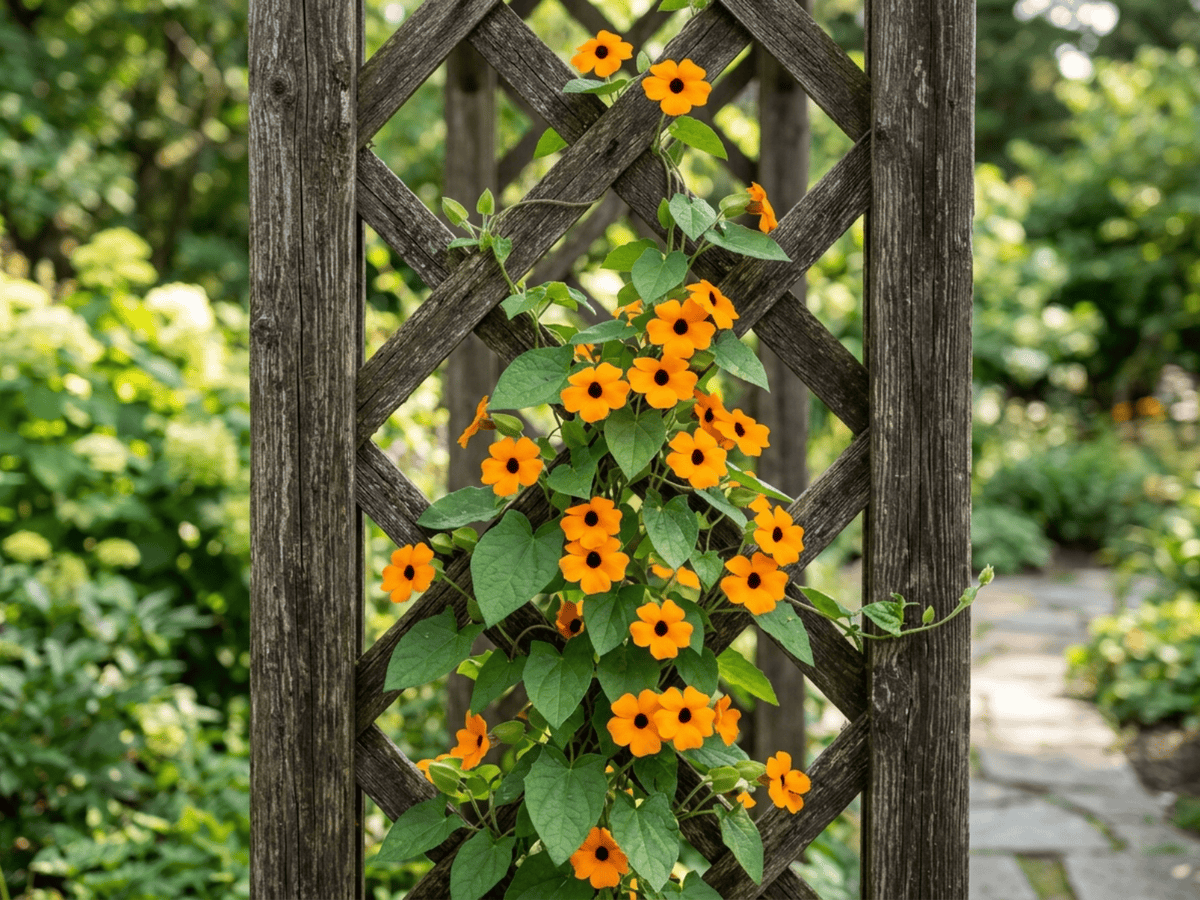
Black-eyed Susan Vine is a tender perennial from East Africa grown as an annual vine in most US zones, reaching 6–8 feet in a season. Heart-shaped leaves and flat five-petaled flowers in orange, yellow, or white with a distinctive dark 'eye'. Blooms continuously from early summer to frost in full sun. Excellent for trellises, hanging baskets, and mailbox posts across American gardens. Newer Sunny Susy and A-Peel series extend the color range to apricot, salmon, and cream.
- Climbing
- Fast-growing
- Container-friendly
- Long-blooming
How to care for Black-Eyed Susan Vine
Watering
- Springevery 3 days
- Summerevery 2 days
- Fallevery 5 days
- Winterevery 10 days
Soil · Well-draining
- Top dressingPine bark mulch10%
- Main mixPotting soil + perlite 2:170%
- DrainageLECA / gravel20%
Never skip the drainage layer — standing water is the top cause of root rot.
FERTILIZER
Balanced Feed 14-14-14
An even feed covers all three needs at once, keeping leaves, roots and blooms moving together with nothing pushed out of balance.
- Nitrogen · Leaves
- Phosphorus · Roots + Blooms
- Potassium · Strength
- Springevery 14 days
- Summerevery 14 days
- Fallevery 21 days
At a Glance
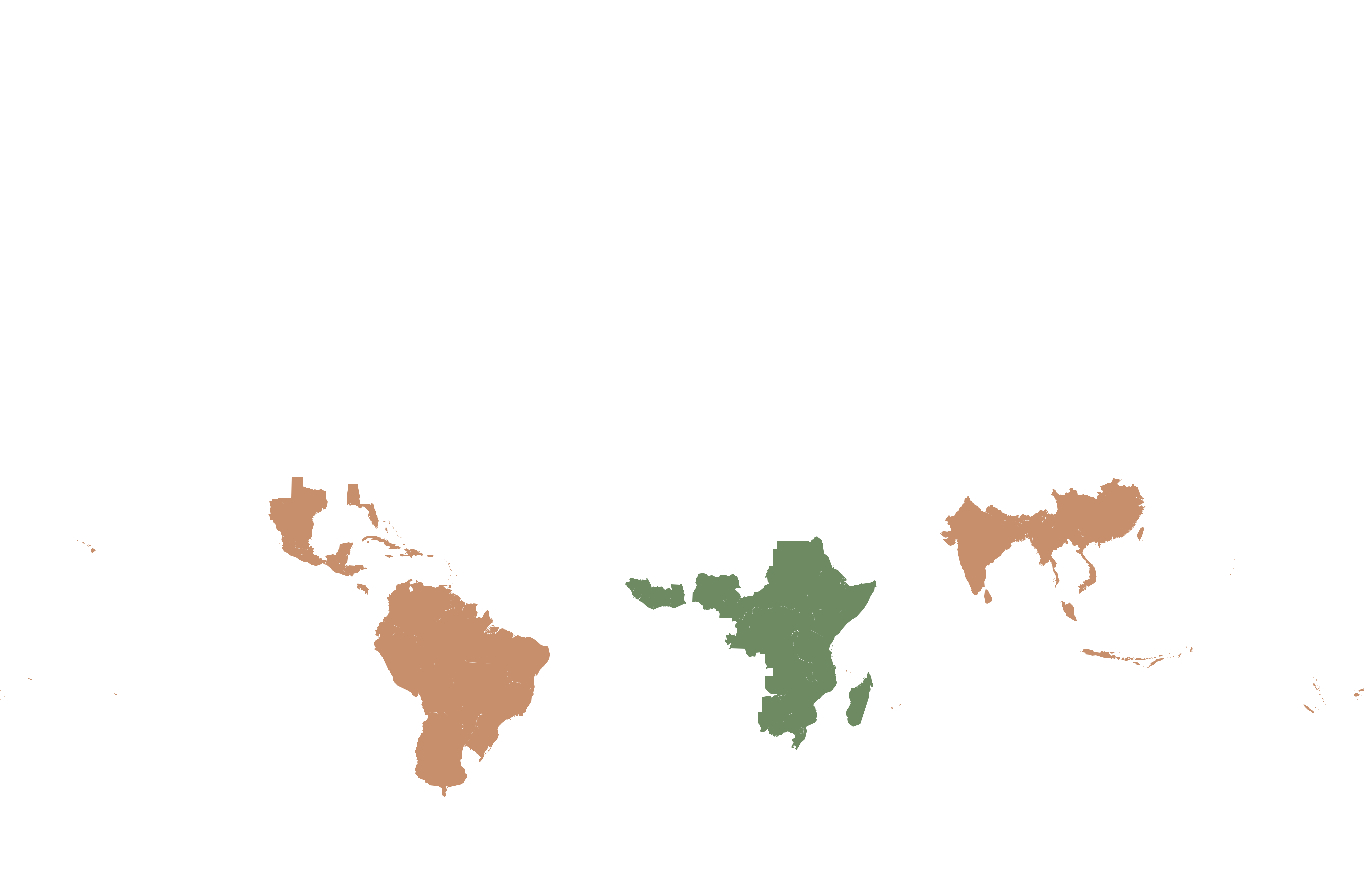
- NativeAfrica
- Height6–10 ft (1.8–3 m)
- Spread3–6 ft (0.9–1.8 m)
- Flower colorOrange, Yellow, White
- Foliage colorGreen
- SoilWell-drained, Loamy
- LocationsYard · Balcony
Bloom time
BLOOM CYCLE
Peak bloom
Jun–Nov
Dark-eyed flowers early summer to frost
Fragrance
NO FRAGRANCE
No notable fragrance.
Toxicity
No toxicity has been reported for this plant. Still, it is wise to keep pets from chewing on any houseplant.
Educational information, not medical or veterinary advice. If exposure is suspected, contact a doctor or veterinarian.
DISTRIBUTION

- Native
- Introduced
- Africa
History
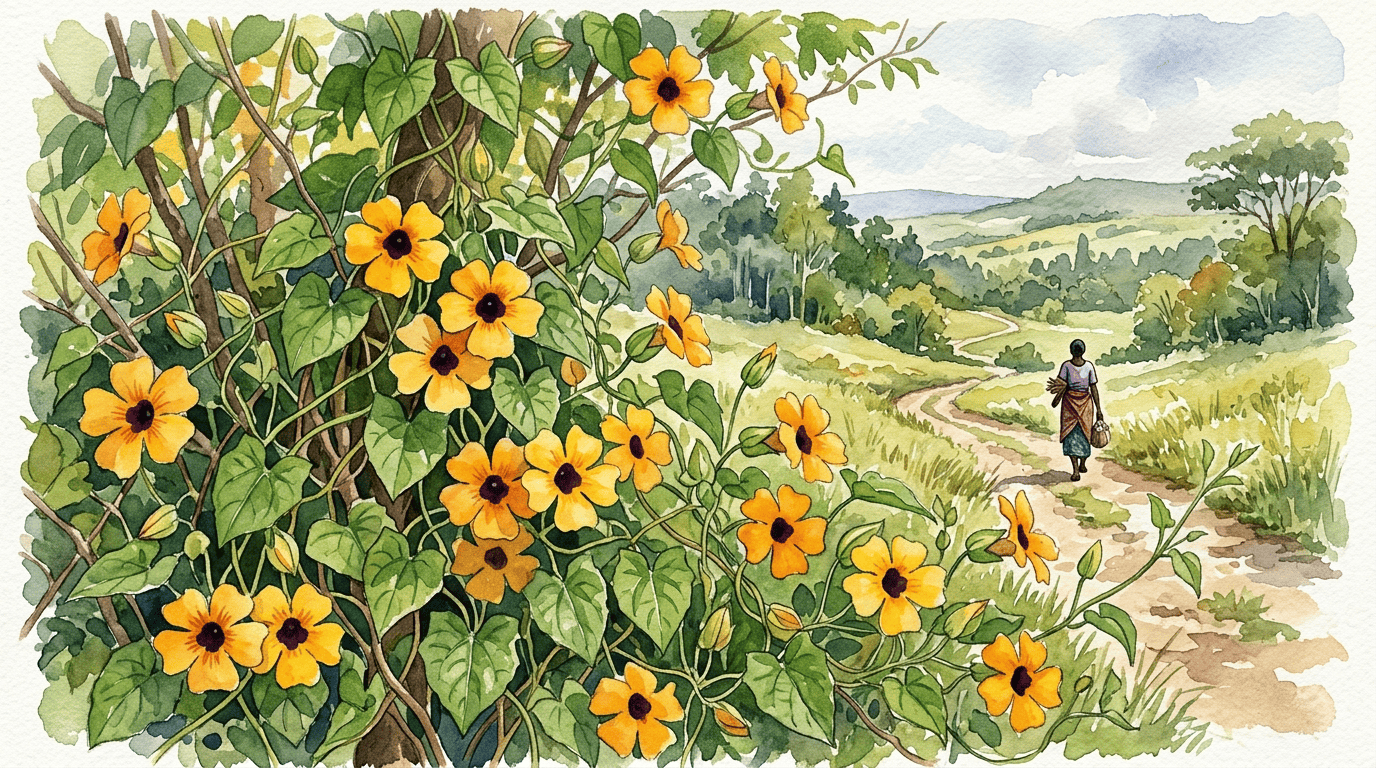
Thunbergia alata is native to the tropical and subtropical highlands of eastern Africa — primarily Kenya, Tanzania, Ethiopia, Uganda, and parts of adjacent countries — growing in montane forest edges, savanna margins, and disturbed open ground at 500-2000 meters elevation. The genus name honors Carl Peter Thunberg (1743-1828), the "Japanese Linnaeus" — a Swedish botanist who traveled with the Dutch East India Company and made collections in southern Africa, Japan, and Southeast Asia. The plant is a compact twining vine 1.5-2.5 meters tall per growing season, with heart-shaped medium-green leaves and, through summer and autumn, produces continuous 3-4 cm flat-faced five-petaled tubular flowers. The distinctive ornamental signature is a bright yellow-orange petal with a dramatic dark purple-black throat at the center, giving the common name "black-eyed Susan vine" (not to be confused with Rudbeckia, the true daisy-form black-eyed Susan).
Modern cultivars extend the color palette: "Susie" series includes pure yellow, white, and orange selections with and without the dark eye, "Lemon-Eye Superstar" has a pale-yellow background with black center, "African Sunset" offers unusual salmon-orange tones, and "Blushing Susie" has soft apricot-pink. In tropical and frost-free climates the vine is a fast-growing semi-evergreen perennial; in temperate gardens it is grown as a container and trellis annual. Widely used in hanging baskets and mixed summer containers.
Hardy to approximately USDA zone 10. Introduced from East Africa to European horticulture in the early 1800s and reached American gardens by the late 1800s. The compact Susy series, introduced in the 1990s, made Thunbergia alata a staple 'climber' in mixed American garden-center containers.
Symbolism & meaning
What It Symbolizes
Black-Eyed Susan Vine offers daily encouragement, its cheerful yellow-and-black blooms appearing reliably along trellises and hanging baskets through the long summer. Vitality runs through every twining stem — vigorous growth and continuous bloom keep it generous well into autumn. Its meaning is the small, repeated lift of a flower that simply keeps showing up, asking little and reminding the gardener each morning that brightness is still on the schedule.
- Encouragement — cheerful daily blooms uplift
- Vitality — vigorous growth and continuous bloom
Where the Name Comes From
The name Black-Eyed Susan Vine describes dark flower centers. Genus honors Swedish botanist Carl Peter Thunberg (1743–1828); 'alata' means 'winged' for the flower stalks.
Uses & Fun Facts
- Twining annual vine spills from hanging baskets and pots
- Light vine trained on small trellises and obelisks
- Cheerful orange flowers with dark eye through summer
Related plants
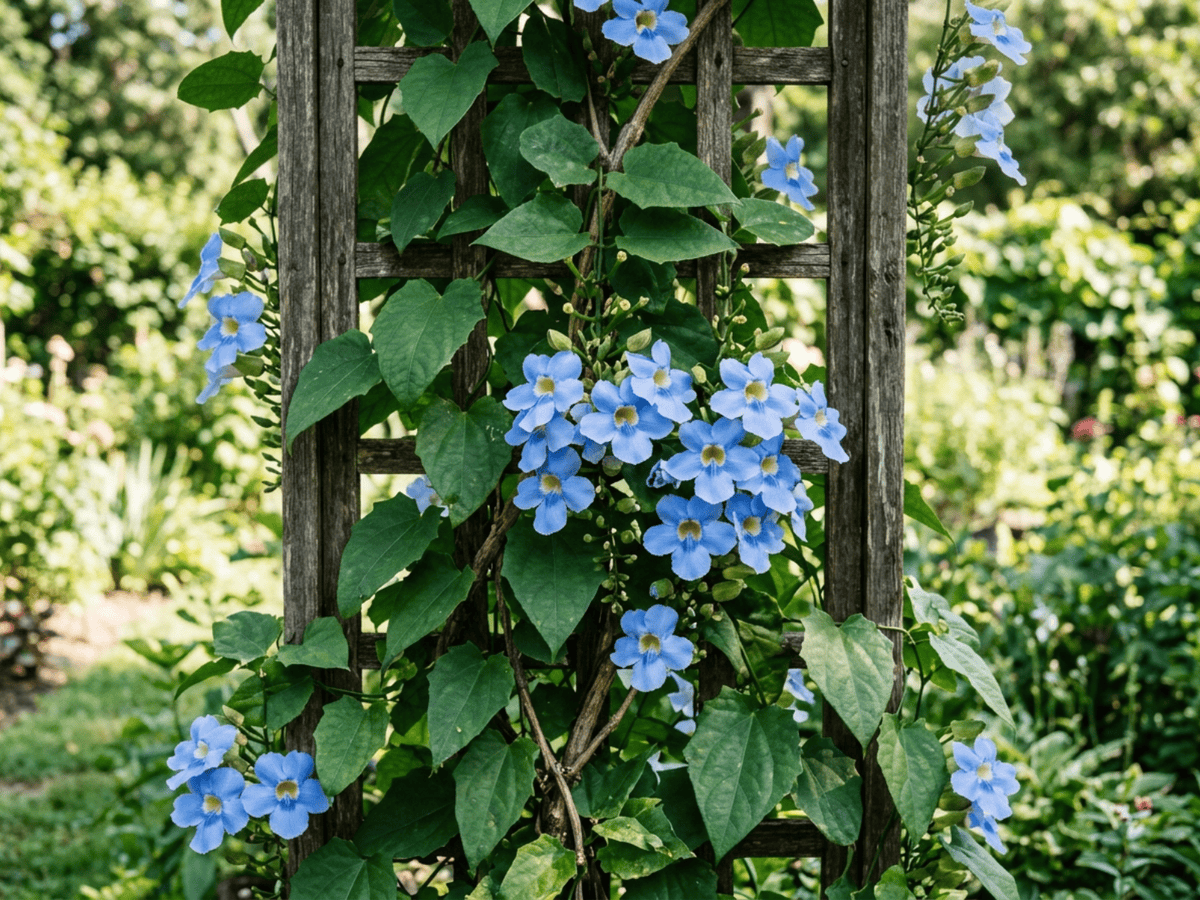
More Thunbergia plants
Plants with similar care
 Chinese AbeliaAbelia chinensis
 Fragrant AbeliaAbelia mosanensis
 Large-Flowered AbeliaAbelia uniflora
 Glossy AbeliaAbelia x grandiflora
Frequently asked questions
How often should I water Black-Eyed Susan Vine?
In summer, water about every 2 days; in winter, about every 10 days. Adjust for heat, pot size and drainage.
How much light does Black-Eyed Susan Vine need?
Full sun: 6+ hrs direct. Watch the leaves — scorching or stretching means the light needs adjusting.
Is Black-Eyed Susan Vine toxic to cats or dogs?
No toxicity has been reported for this plant. Still, it is wise to keep pets from chewing on any houseplant. Educational information, not medical or veterinary advice. If exposure is suspected, contact a doctor or veterinarian.
Is Black-Eyed Susan Vine easy to grow?
Yes — it is considered an easy, beginner-friendly plant.
When does Black-Eyed Susan Vine bloom?
It typically blooms Jun–Nov in the Northern Hemisphere.
YardMate
Identify any plant in seconds
Snap a photo — YardMate names the plant, diagnoses problems, and reminds you when to water.
Download on the App Store