 YardMate


Bengal Trumpet
Thunbergia grandiflora
Medium · Some experienceAbout Bengal Trumpet
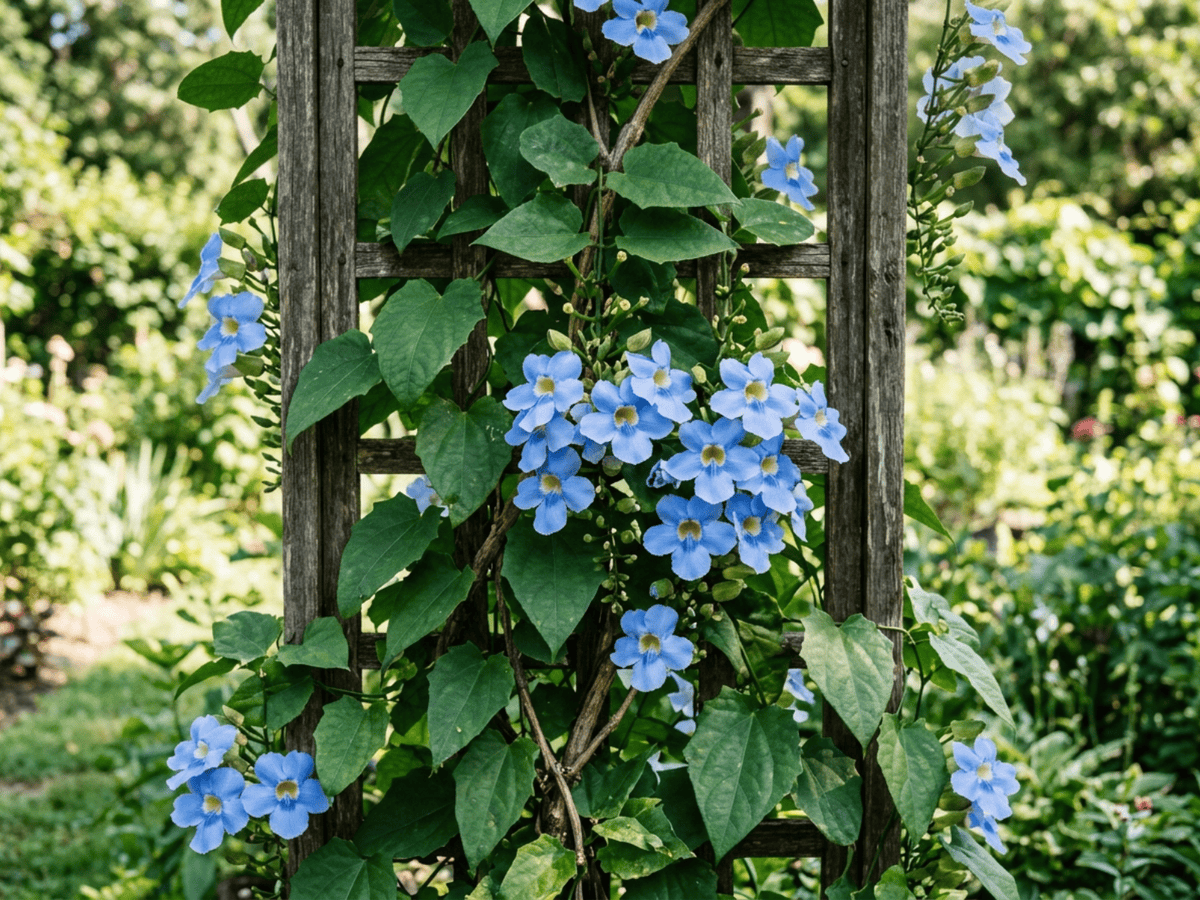
Thunbergia grandiflora, the Bengal clock vine or blue sky vine, is a vigorous evergreen climber native to India, Bangladesh, and Southeast Asia. It produces stunning trumpet-shaped flowers in lavender-blue that hang in cascading racemes, blooming almost year-round in tropical climates. Each flower measures 7–8 cm across with a pale yellow or white throat, creating a striking two-tone effect. The vine can scramble over 10 meters if given support, using twining stems rather than tendrils. Its heart-shaped, rough-textured leaves form a dense green curtain ideal for covering fences, pergolas, and arbors. In frost-free regions it is one of the most spectacular flowering vines available. It thrives in rich, moist soil with full sun and appreciates regular feeding during the growing season. In cooler zones it can be grown as a conservatory specimen or large container plant brought indoors for winter. The vine attracts bees, butterflies, and hummingbirds, making it a valuable addition to pollinator gardens.
- Climbing
- Fast-growing
- Evergreen
- Pollinator-friendly
How to care for Bengal Trumpet
Watering
- Springevery 3 days
- Summerevery 2 days
- Fallevery 5 days
- Winterevery 14 days
Soil · Well-draining
- Top dressingPine bark mulch10%
- Main mixPotting soil + perlite 2:170%
- DrainageLECA / gravel20%
Never skip the drainage layer — standing water is the top cause of root rot.
FERTILIZER
Balanced Feed 14-14-14
An even feed covers all three needs at once, keeping leaves, roots and blooms moving together with nothing pushed out of balance.
- Nitrogen · Leaves
- Phosphorus · Roots + Blooms
- Potassium · Strength
- Springevery 30 days
- Summerevery 30 days
- Fallevery 30 days
At a Glance
- NativeSouth Asia, East Asia
- Height15–30 ft (4.6–9.1 m)
- Spread6–15 ft (1.8–4.6 m)
- Flower colorBlue, Purple, White
- Foliage colorGreen
- SoilLoamy, Well-drained, Rich
- LocationsYard
Bloom time
BLOOM CYCLE
Peak bloom
Jan–Dec
Lavender-blue trumpets in cascading racemes; blooms year-round in tropics
Fragrance
NO FRAGRANCE
No notable fragrance.
Toxicity
No toxicity has been reported for this plant. Still, it is wise to keep pets from chewing on any houseplant.
Educational information, not medical or veterinary advice. If exposure is suspected, contact a doctor or veterinarian.
DISTRIBUTION


- Native
- Introduced
- South Asia
- East Asia
History

Thunbergia grandiflora is native to a wide arc of South and mainland Southeast Asia — India, Nepal, Bangladesh, Myanmar, southern China, Thailand, Laos, Vietnam, and the Malay Peninsula — where it grows as a robust vigorous woody climbing vine of tropical forest edges and river margins. The genus Thunbergia honors Carl Peter Thunberg, 18th-century Swedish botanist and student of Linnaeus. The species produces clear pale sky-blue (rarely white) trumpet- or funnel-shaped flowers 5-8 cm across, borne in hanging clusters from long pendent racemes, blooming almost year-round in tropical climates and seasonally in subtropical ones. It is one of the most visually striking flowering vines of the tropics and has been cultivated throughout tropical and subtropical gardens worldwide since at least the 19th century.
However, in tropical Australia — particularly northern Queensland — it has become one of the most serious vine invasives, smothering native tropical rainforest, pulling down understory trees, and forming impenetrable curtains over roadsides and remnant forest fragments. Queensland classifies it as a Class 3 restricted invasive plant, and it is widely managed under weed-control programs. Also listed as invasive in parts of the Pacific, South Africa, and Central America.
Seeds are explosively dispersed by the dehiscing fruits and can launch several meters. Named after Carl Peter Thunberg, the 18th-century Swedish naturalist known as the 'father of South African botany.' The species was first described from specimens collected in India and quickly became a prized ornamental throughout the colonial tropics. In Hawaii and parts of Australia it has naturalized so aggressively that it is considered invasive, smothering native vegetation with its dense growth. In its native range, traditional Ayurvedic practitioners used leaf extracts for anti-inflammatory preparations.
Symbolism & meaning
What It Symbolizes
Bengal Trumpet is admiration in cascading sky-blue trumpets — breathtaking flowers dripping from pergolas in tropical gardens, inspiring the kind of awe that makes passersby stop. Its vigorous climbing habit is freedom, an exuberant reach toward open skies that few vines match. It is the climber for those who want a wall to feel like a waterfall of lavender-blue flower.
- Admiration — Its breathtaking cascading blooms inspire awe and deep admiration
- Freedom — The vigorous climbing habit symbolizes reaching toward open skies
Where the Name Comes From
The name Bengal Trumpet describes its trumpet-shaped flowers. Thunbergia honors Carl Peter Thunberg (1743–1828), Swedish botanist and student of Linnaeus. Grandiflora means 'large-flowered' in Latin.
Uses & Fun Facts
- Vigorous evergreen vine cloaks pergolas and tall fences
- Cascading lavender-blue trumpets bloom nearly year-round in tropics
- Large open flowers attract carpenter bees and sunbirds
Related plants
More Thunbergia plants
Plants with similar care
 Mexican AbeliaAbelia floribunda
 Fraser FirAbies fraseri
 Paperbark MapleAcer griseum
 Sugar MapleAcer saccharum
Frequently asked questions
How often should I water Bengal Trumpet?
In summer, water about every 2 days; in winter, about every 14 days. Adjust for heat, pot size and drainage.
How much light does Bengal Trumpet need?
Full sun: 6+ hrs direct. Watch the leaves — scorching or stretching means the light needs adjusting.
Is Bengal Trumpet toxic to cats or dogs?
No toxicity has been reported for this plant. Still, it is wise to keep pets from chewing on any houseplant. Educational information, not medical or veterinary advice. If exposure is suspected, contact a doctor or veterinarian.
Is Bengal Trumpet easy to grow?
It is moderately demanding: a good choice once you have a little experience.
When does Bengal Trumpet bloom?
It typically blooms Jan–Dec in the Northern Hemisphere.
YardMate
Identify any plant in seconds
Snap a photo — YardMate names the plant, diagnoses problems, and reminds you when to water.
Download on the App Store