 YardMate
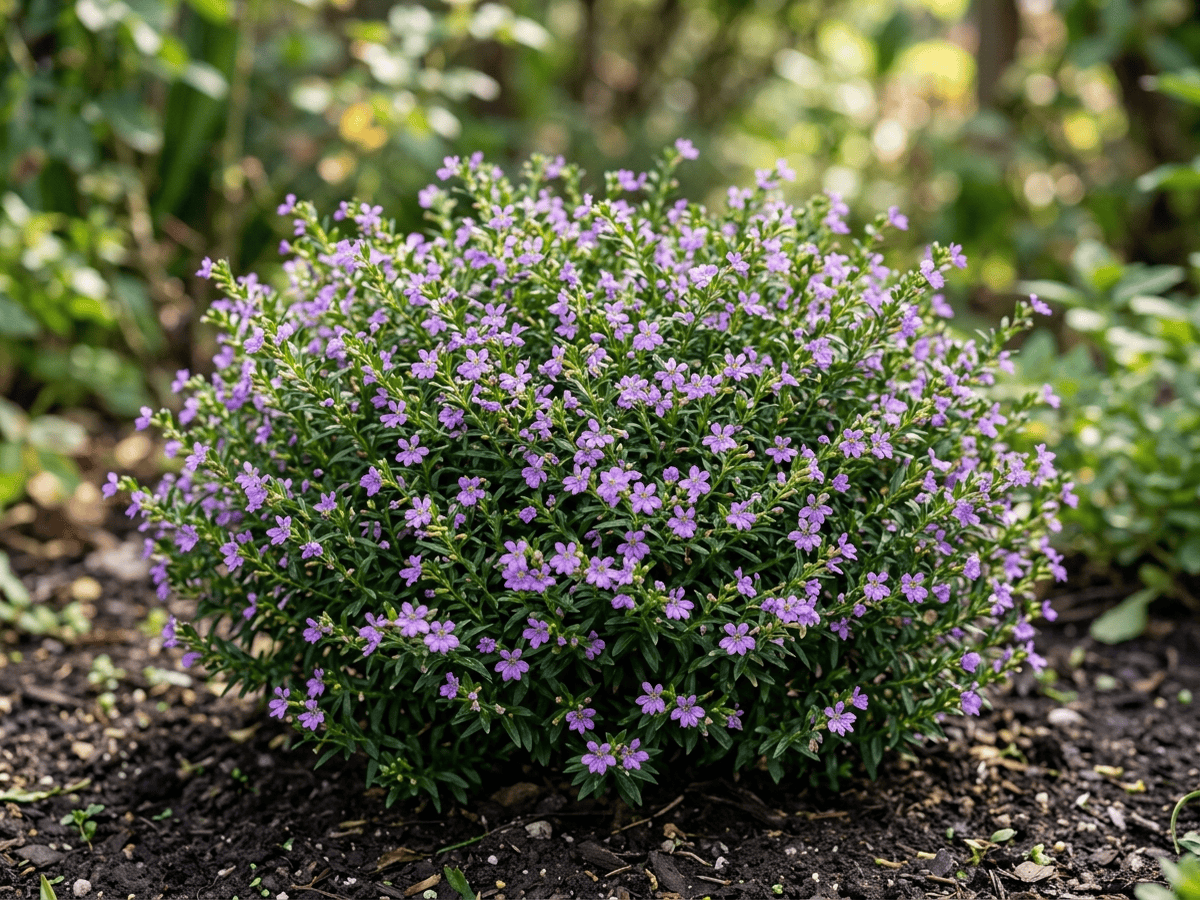


False Heather
Cuphea hyssopifolia
Easy · Beginner friendlyAbout False Heather
Mexican Heather or False Heather is a Mexican and Central American tender evergreen shrub grown as an annual across most of the US and as a low perennial in Florida and coastal California. Forming dense mounded plants 10 to 24 inches tall with fine hyssop-like foliage, it produces countless tiny six-petal lavender, pink, or white flowers from spring through frost. A popular border and container filler for its fine texture and constant bloom.
- Heat-tolerant
- Deer-resistant
- Container-friendly
- Long-blooming
How to care for False Heather
Watering
- Springevery 5 days
- Summerevery 4 days
- Fallevery 7 days
- Winterevery 10 days
Soil · Well-draining
- Top dressingPine bark mulch10%
- Main mixPotting soil + perlite 2:170%
- DrainageLECA / gravel20%
Never skip the drainage layer — standing water is the top cause of root rot.
FERTILIZER
Balanced Feed 14-14-14
An even feed covers all three needs at once, keeping leaves, roots and blooms moving together with nothing pushed out of balance.
- Nitrogen · Leaves
- Phosphorus · Roots + Blooms
- Potassium · Strength
- Springevery 30 days
- Summerevery 30 days
At a Glance
- NativeNorth America, Central America
- Height1–2 ft (0.3–0.6 m)
- Spread2–3 ft (0.6–0.9 m)
- Flower colorPurple, Pink, White
- Foliage colorGreen
- SoilLoamy, Well-drained, Rich
- LocationsYard · Balcony
Bloom time
BLOOM CYCLE
Peak bloom
Mar–Nov
Countless tiny flowers cover plant spring to frost
Toxicity
Toxicity unknown
None reported
Unknown
EXPOSURE Unspecified plant material.
EFFECT Toxic effects are not specified.
NOTE Toxicity for humans is not well documented; use caution until verified.
Unknown
EXPOSURE Unspecified plant material.
EFFECT Toxic effects are not specified.
NOTE Toxicity for dogs is not well documented; use caution until verified.
Unknown
EXPOSURE Unspecified plant material.
EFFECT Toxic effects are not specified.
NOTE Toxicity for cats is not well documented; use caution until verified.
Educational information, not medical or veterinary advice. If exposure is suspected, contact a doctor or veterinarian.
DISTRIBUTION


- Native
- Introduced
- North America
- Central America
History

Cuphea hyssopifolia, commonly called Mexican heather, false heather, or Hawaiian heather, is an evergreen subshrub native to Mexico and Guatemala. Spanish botanist Mariano Lagasca described the species in 1821, the epithet hyssopifolia alluding to its foliage resembling hyssop. The plant forms a dense 30 to 45 centimeter mound covered continuously in tiny six-petaled lavender, purple, pink, or white flowers from spring through frost.
Although hardy only to USDA zone 8 or 9, it handles heat, drought, and humidity excellently, making it a mainstay of Gulf Coast, California, and Hawaii landscape and container plantings as either a perennial or annual. Proven Winners and Monrovia release popular selections such as Allyson and FloriGlory, and the plant is naturalized in Hawaii and parts of Florida.
Native to Mexico and Guatemala, introduced to American horticulture in the 1800s and popular in Victorian bedding schemes. Remains a standard Florida and Southern California landscape plant, beloved for the constant stream of small flowers that feed butterflies and tiny native bees all season.
Symbolism & meaning
What It Symbolizes
False Heather is quiet constancy, scattered with hundreds of tiny lavender flowers month after month without fanfare. Its fine grace softens bolder plantings, weaving delicate texture between architectural neighbors. It is the kind of subtle backbone every good garden needs — never demanding attention, always rewarding it when it comes.
- Quiet constancy — never-ending tiny flowers
- Fine grace — delicate texture softens bold plantings
Where the Name Comes From
'Cuphea' from Greek 'kyphos' meaning curved, for the curved seed capsule; 'hyssopifolia' means hyssop-leaved, for fine narrow leaves.
Uses & Fun Facts
- Mounded fine foliage fills patio pots and poolside planters
- Low evergreen mounds form knot-garden borders in warm climates
- Tiny six-petaled flowers attract butterflies and small bees
Related plants
More Cuphea plants

Plants with similar care
 Chinese AbeliaAbelia chinensis
 Fragrant AbeliaAbelia mosanensis
 Large-Flowered AbeliaAbelia uniflora
 Glossy AbeliaAbelia x grandiflora
Frequently asked questions
How often should I water False Heather?
In summer, water about every 4 days; in winter, about every 10 days. Adjust for heat, pot size and drainage.
How much light does False Heather need?
Full sun: 6+ hrs direct. Watch the leaves — scorching or stretching means the light needs adjusting.
Is False Heather toxic to cats or dogs?
Pets Unknown (Dogs Unknown · Cats Unknown) Educational information, not medical or veterinary advice. If exposure is suspected, contact a doctor or veterinarian.
Is False Heather easy to grow?
Yes — it is considered an easy, beginner-friendly plant.
When does False Heather bloom?
It typically blooms Mar–Nov in the Northern Hemisphere.
YardMate
Identify any plant in seconds
Snap a photo — YardMate names the plant, diagnoses problems, and reminds you when to water.
Download on the App Store