 YardMate



Trifoliate Orange
Poncirus trifoliata
Easy · Beginner friendlyAbout Trifoliate Orange
Poncirus trifoliata (syn. Citrus trifoliata), the trifoliate orange or hardy orange, is the most cold-hardy member of the citrus family, surviving to USDA zone 5 (-25°C). A deciduous 3-6 m shrub native to northern China and Korea, it bears viciously thorny green stems, trifoliate leaves, fragrant white spring flowers, and small downy yellow-orange fruits in autumn.
The fruit is extremely bitter and inedible raw but is used in Asian traditional medicine (called 'zhishi' in Chinese, 'kitrefs' in Korean). Commercially it is the world's leading citrus rootstock — grafted beneath orange, grapefruit, and lemon trees to impart cold-hardiness, disease resistance, and dwarfing.
The terrifying thorns (3-5 cm, needle-sharp) make it a formidable security hedge. 'Flying Dragon' is a contorted-stem cultivar grown ornamentally. The most hardy citrus relative in the world.
- Cold-hardy
How to care for Trifoliate Orange
Watering
- Springevery 10 days
- Summerevery 7 days
- Fallevery 14 days
- Winterpause watering
Soil · Well-draining
- Top dressingPine bark mulch10%
- Main mixPotting soil + perlite 2:170%
- DrainageLECA / gravel20%
Never skip the drainage layer — standing water is the top cause of root rot.
FERTILIZER
- Springevery 30 days
- Summerevery 30 days
At a Glance
- NativeEast Asia
- Height8–20 ft (2.4–6.1 m)
- Spread6–15 ft (1.8–4.6 m)
- Flower colorWhite
- Foliage colorGreen, Yellow
- Fruit colorYellow, Orange
- SoilLoamy, Well-drained, Acidic
- LocationsYard
Bloom time
BLOOM CYCLE
Peak bloom
Apr–May
Fragrant white spring flowers precede leaves; small bitter yellow fruits in autumn.
Fragrance
MODERATE FRAGRANCE
The flowers and ripe fruit have a sweet citrus-orange fragrance.
Toxicity
Humans Slight · Pets Slight
citrus essential oils
Slight
- Fruit
- Thorn
- Contact
- Ingestion
EXPOSURE Touching fruit and thorns. Eating fruit and thorns.
EFFECT Thorns cause painful punctures, fruit is inedibly bitter, and essential oils may irritate skin.
NOTE Documented concern for humans: Thorns cause painful punctures, fruit is inedibly bitter, and essential oils may irritate skin.
Slight
- Fruit
- Ingestion
EXPOSURE Eating fruit.
EFFECT GI upset and citrus oils can irritate.
NOTE Thorns physically dangerous. Citrus plants listed as mildly toxic to pets by ASPCA.
Slight
- Fruit
- Ingestion
EXPOSURE Eating fruit.
EFFECT GI upset and citrus oils can irritate.
NOTE Thorns physically dangerous. Citrus plants listed as mildly toxic to pets by ASPCA.
Educational information, not medical or veterinary advice. If exposure is suspected, contact a doctor or veterinarian.
DISTRIBUTION


- Native
- Introduced
- East Asia
History
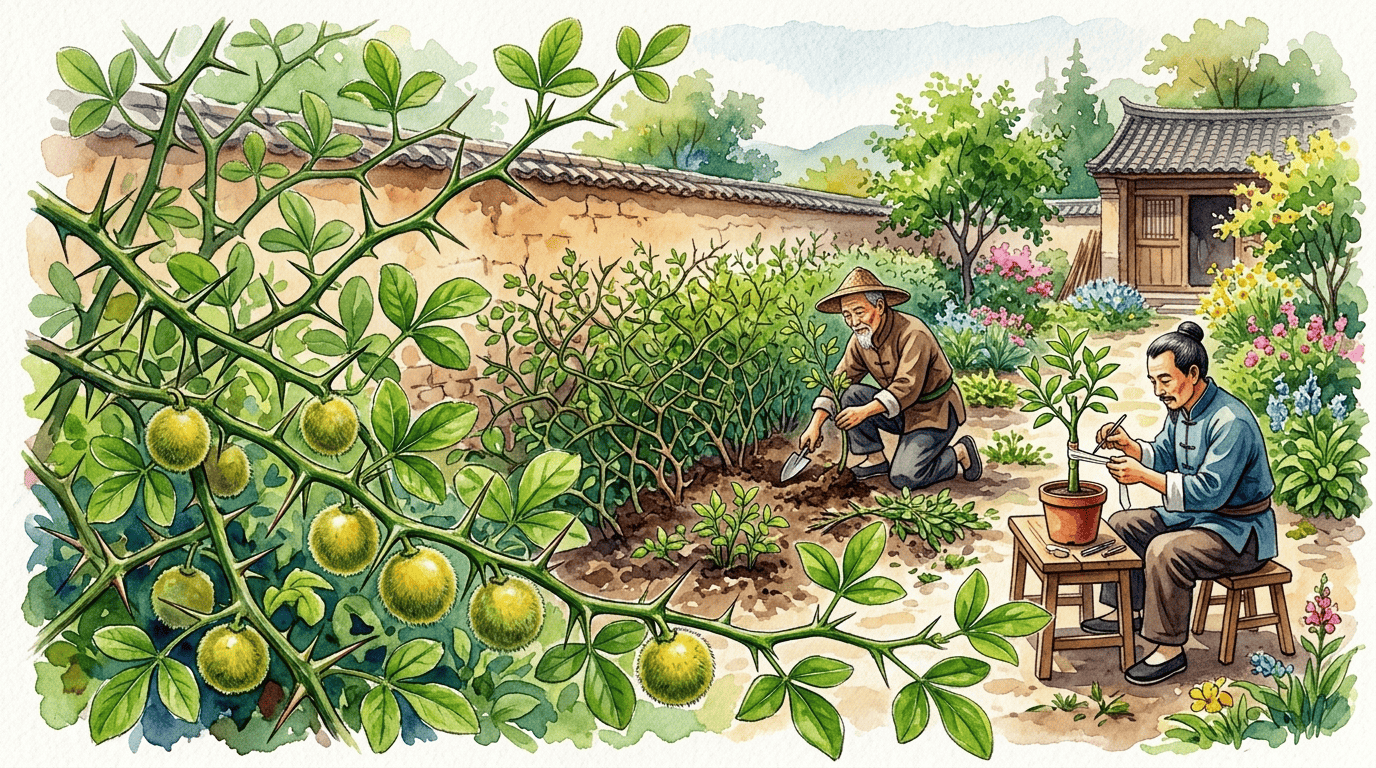
Poncirus trifoliata is native to northern China and Korea, where it has been cultivated for more than a thousand years as a thorny hedge and medicinal plant. Its old medicinal name zhishi refers to immature bitter citrus fruit used in digestive formulas. European gardens received it in 1850, and the USDA introduced it to the United States in 1869.
Its greatest impact came through citrus breeding: grafting oranges, lemons, and grapefruits onto Poncirus rootstock improved cold hardiness, resistance to Phytophthora root rot and tristeza virus, and reduced tree size. It became one of the world's dominant citrus rootstocks.
The contorted form 'Flying Dragon' is grown both as an ornamental and as an extreme dwarfing rootstock. Recent genetic work folds it into Citrus as Citrus trifoliata, but growers still often use the old name. The fruit is bitter raw, and the thorns are fierce enough for security hedging.
Symbolism & meaning
What It Symbolizes
Trifoliate Orange carries protection through its formidable green thorns, planted historically as living fences to deter intruders and grazing animals. Its resilience matches its armor, surviving down to minus twenty-five Celsius where no true citrus could possibly persist. It is often read as a flower of guarded hardiness, a fierce cousin of the orange tree whose meaning is that the ability to defend oneself and the ability to endure cold often grow on the same branch.
- Protection — Fearsome thorns deter intruders and grazing animals
- Resilience — Handles -25°C when no true citrus can survive
Where the Name Comes From
The common name highlights its orange coloring. Poncirus from the French 'poncire' (a citron); 'trifoliata' means three-leaved.
Uses & Fun Facts
- Dried fruit (zhi shi) used in traditional Chinese medicine
- Viciously thorny stems form impenetrable security barriers
- Cold-hardy rootstock for grafted citrus orchards
- 'Flying Dragon' twisted form is collector specimen
Related plants
Plants with similar care
 Chinese AbeliaAbelia chinensis
 Fragrant AbeliaAbelia mosanensis
 Large-Flowered AbeliaAbelia uniflora
 Glossy AbeliaAbelia x grandiflora
Frequently asked questions
How often should I water Trifoliate Orange?
Water about every 10 days during the growing season, and always let excess water drain away.
How much light does Trifoliate Orange need?
Full sun: 6+ hrs direct. Watch the leaves — scorching or stretching means the light needs adjusting.
Is Trifoliate Orange toxic to cats or dogs?
Pets Slight (Dogs Slight · Cats Slight) Educational information, not medical or veterinary advice. If exposure is suspected, contact a doctor or veterinarian.
Is Trifoliate Orange easy to grow?
Yes — it is considered an easy, beginner-friendly plant.
When does Trifoliate Orange bloom?
It typically blooms Apr–May in the Northern Hemisphere.
YardMate
Identify any plant in seconds
Snap a photo — YardMate names the plant, diagnoses problems, and reminds you when to water.
Download on the App Store