 YardMate
Welwitschia
Welwitschia mirabilis
Hard · Experienced growersAbout Welwitschia
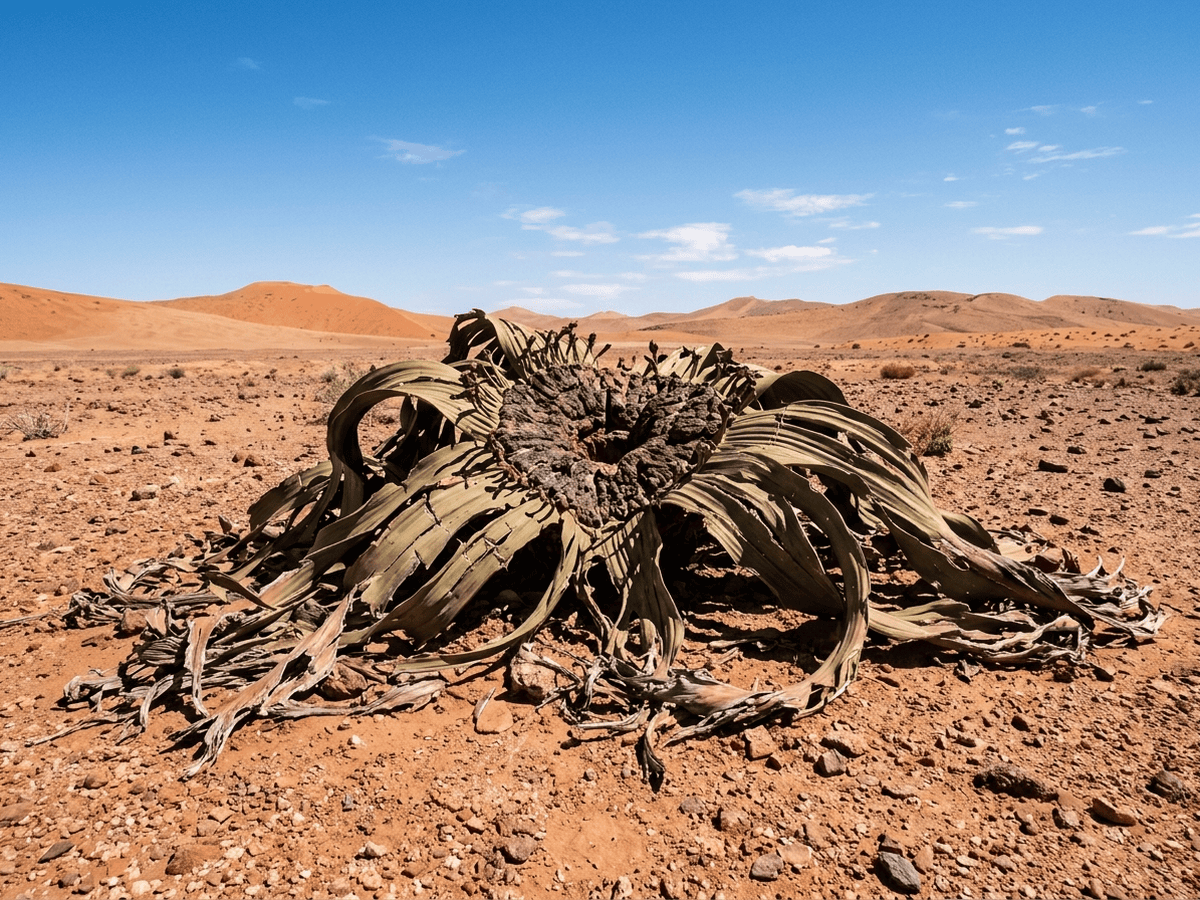
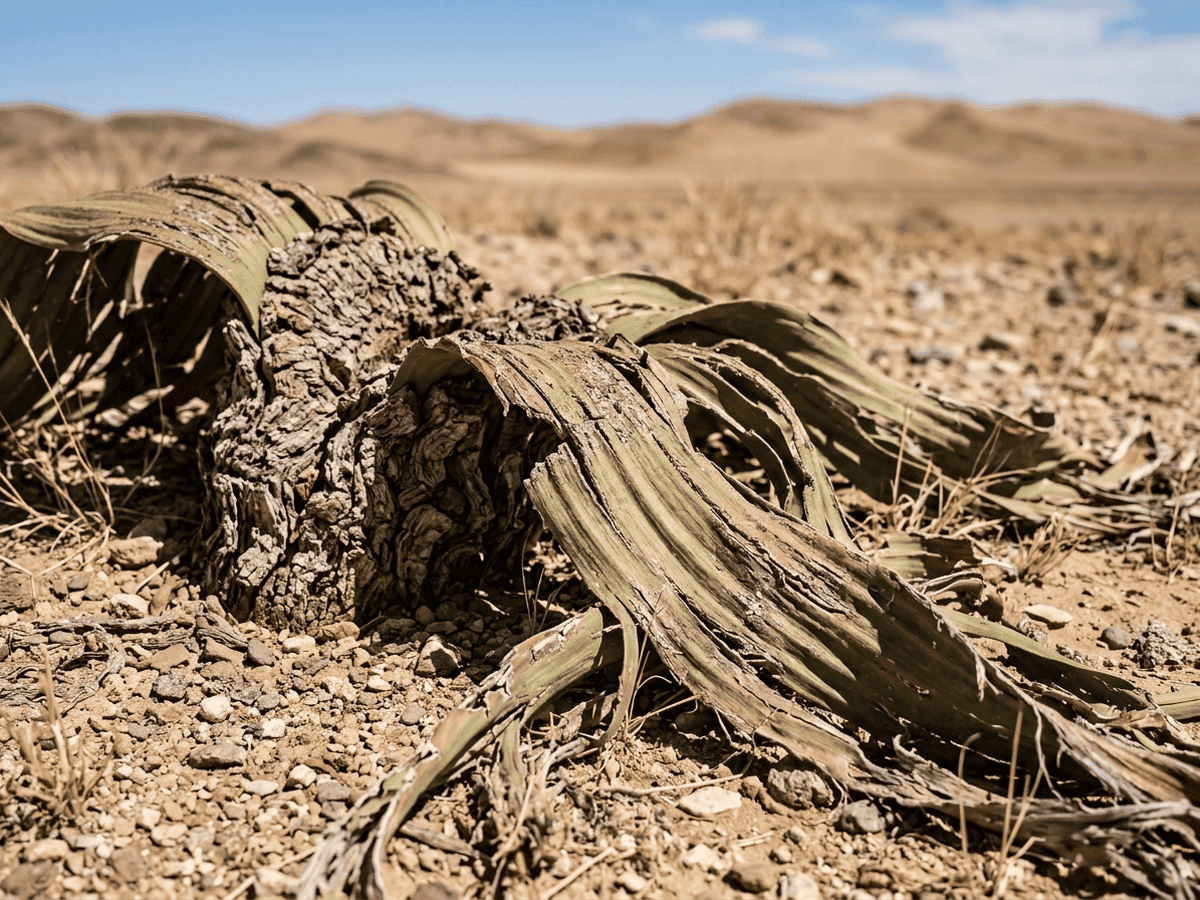
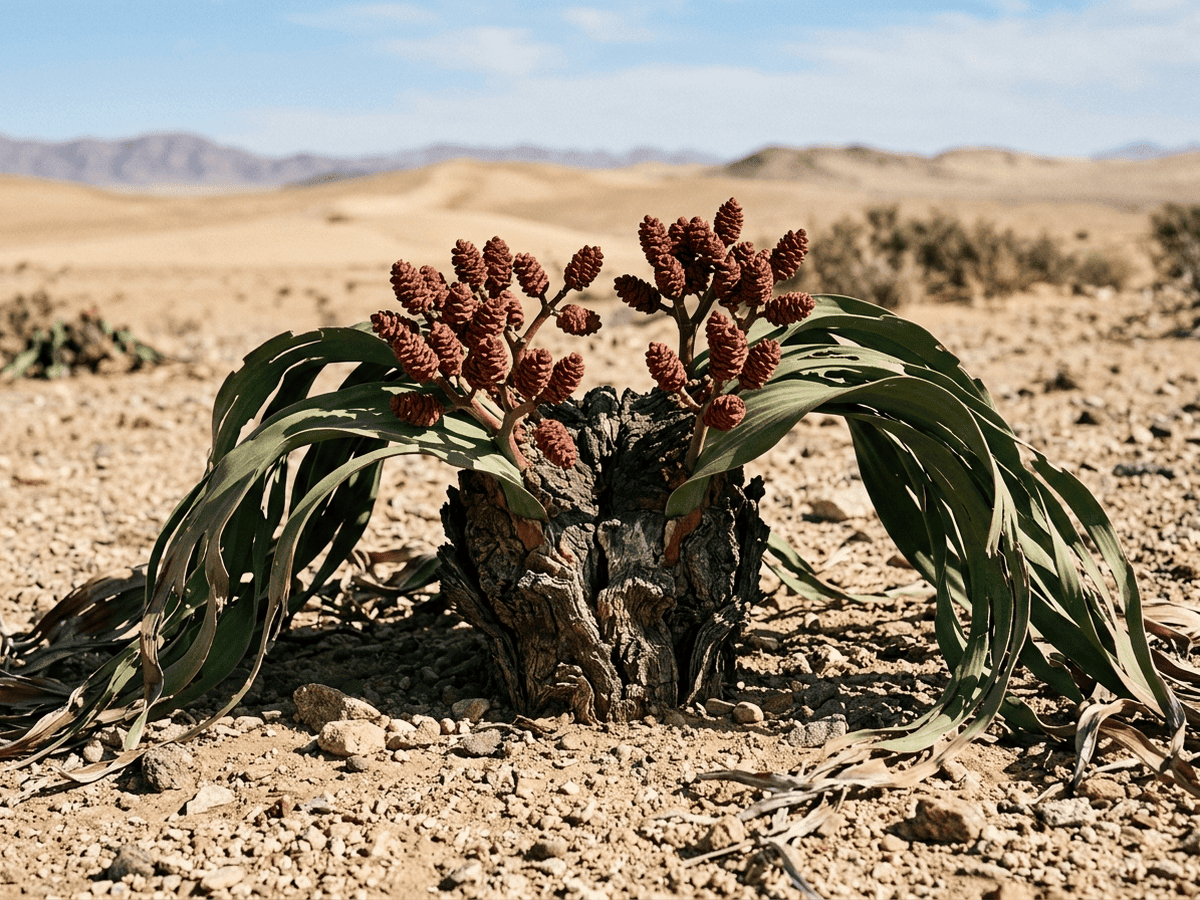
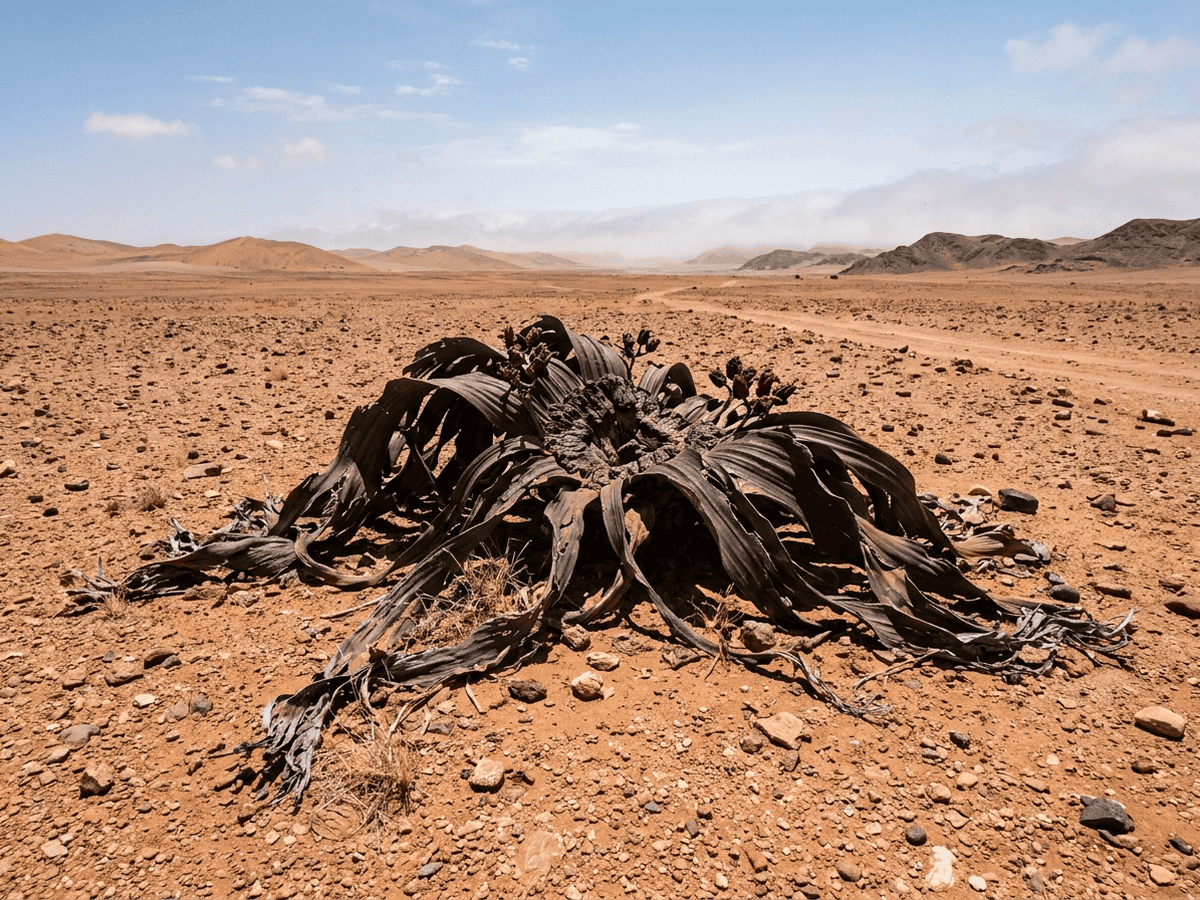
Welwitschia mirabilis is one of the most extraordinary plants on Earth—a gymnosperm living fossil found only in the Namib Desert of Namibia and southern Angola, the sole species in its own family, order, and genus. It produces exactly two leaves in its entire lifetime, which grow continuously from the base and split into ribbon-like strips over centuries of Namib wind; ancient specimens are 1,000–2,000 years old, the most elderly reportedly over 3,000. The woody stem crown is disk-like, low to the ground, bearing male or female cone clusters. Charles Darwin called it 'the platypus of the plant kingdom.' Extraordinarily drought-tolerant, it absorbs coastal fog moisture and thrives on minimal annual rainfall. Nearly impossible to cultivate outside its habitat, it is grown in specialist collections as a living monument to the strangeness of plant evolution.
- Drought-tolerant
- Slow-growing
- Evergreen
- Container-friendly
How to care for Welwitschia
Watering
- Springevery 15 days
- Summerevery 10 days
- Fallevery 30 days
- Winterevery 30 days
Soil · Fast-draining
- Main mixSand + pumice + soil 1:1:150%
- DrainagePumice / gravel50%
Keep grit at half the mix or more — this soil is meant to dry out fast.
FERTILIZER
Cactus & Succulent Feed 2-7-7
Hold the nitrogen back and growth stays compact instead of soft and stretched. Phosphorus and potassium carry the roots and the flowering.
- Nitrogen · Leaves
- Phosphorus · Roots + Blooms
- Potassium · Strength
This plant needs little to no feeding.
At a Glance
- NativeSouthern Africa
- Height1–2 ft (0.3–0.6 m)
- Spread2–5 ft (0.6–1.5 m)
- Foliage colorGreen
- SoilWell-drained, Sandy
- LocationsYard · Balcony
Fragrance
NO FRAGRANCE
No fragrance; reproductive structures are cones, not flowers.
Toxicity
No toxicity has been reported for this plant. Still, it is wise to keep pets from chewing on any houseplant.
Educational information, not medical or veterinary advice. If exposure is suspected, contact a doctor or veterinarian.
DISTRIBUTION


- Native
- Southern Africa
History
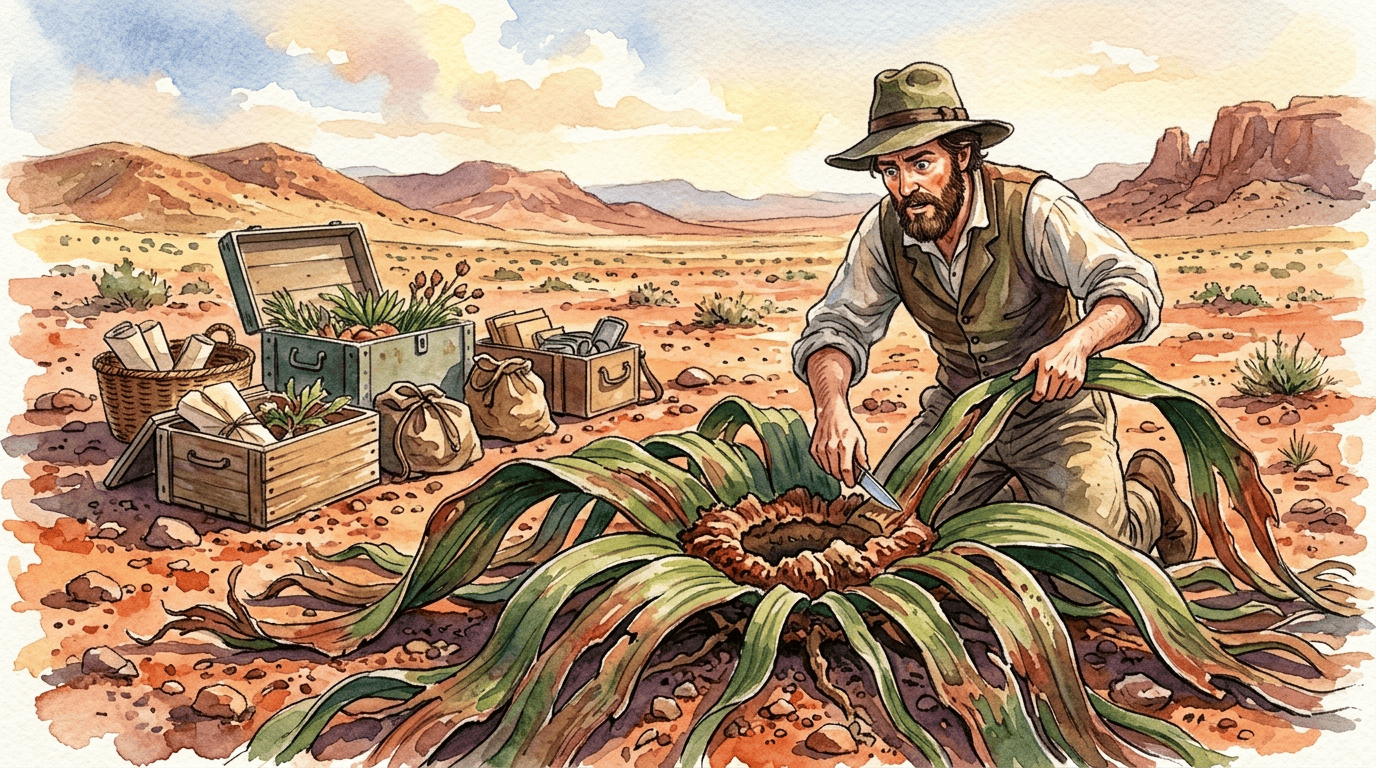
On September 3, 1859, Austrian physician and botanical collector Friedrich Welwitsch was traversing the coastal desert of Angola near Benguela when he encountered something that stopped him in his tracks. Growing on the red gravel plain, low and spreading, with two enormous tattered strap-like leaves splaying outward from a woody central crown, was a plant he could not classify into anything he knew. He had spent decades collecting in Africa and Portugal, had described hundreds of new species—but this was unlike anything in his experience. By his own account, he could only kneel beside it and stare.
Welwitsch collected specimens and sent them to Joseph Dalton Hooker at the Royal Botanic Gardens, Kew. Hooker, one of the great Victorian botanists, described it in 1862 and named it in Welwitsch's honor. His assessment: 'I look upon it as the most wonderful plant that has ever been brought to this country, and no description of it will convey to you any idea of it, unless you look upon it as an extraordinary freak of nature.' Charles Darwin, in correspondence with Hooker, called it 'the platypus of the plant kingdom'—an organism so taxonomically isolated that it seemed to have arrived from a different evolutionary line entirely.
Welwitschia's relationships took a century of botanical debate to settle. It is a gymnosperm—a cone-bearing plant related to conifers and cycads, not to flowering plants—occupying its own order, Welwitschiales. The two leaves it produces at germination grow continuously from meristematic tissue at their bases for the plant's entire lifespan: a single Namib specimen can carry leaf tissue two thousand years old, split and frayed by Namib winds but still photosynthesizing at the growing base. Radiocarbon dating of Namib specimens has confirmed lifespans exceeding 1,500 years, with estimates of some crowns reaching 3,000 years.
Symbolism & meaning
What It Symbolizes
A Welwitschia growing today in the Namib was a seedling during the Roman Empire. The leaves it is photosynthesizing with right now began growing before the Mongol Empire. It has outlasted every empire, religion, language, and civilization that developed since its germination. It does this with two leaves.
- radical persistence — Two leaves from germination to death, growing for two thousand years through one of Earth's harshest environments—Welwitschia is the definition of enduring by the most minimal possible means.
- surviving the unchanged — While the world around it transformed over millions of years, Welwitschia barely changed at all—a living argument that the simplest viable form can outlast everything more complex.
Where the Name Comes From
Welwitschia honors Friedrich Welwitsch (1806–1872), the Austrian physician and botanical collector who discovered the plant in Angola in 1859 and sent specimens to Kew Gardens. The species name mirabilis is Latin for 'wonderful' or 'marvelous'—chosen by botanist Joseph Dalton Hooker when he described it in 1862, reflecting his astonishment at the plant. Tree Tumbo is the traditional name from the Herero people of Namibia.
Uses & Fun Facts
- Living fossil grown as a specimen plant in succulent collections and botanical gardens; essentially impossible to cultivate outside its Namib Desert habitat but valued as a botanical curiosity
- In the Namib Desert, cone clusters are visited by specialist insects; the plant provides structure in an otherwise nearly barren desert ecosystem
Related plants
Plants with similar care
Frequently asked questions
How often should I water Welwitschia?
In summer, water about every 10 days; in winter, about every 30 days. Adjust for heat, pot size and drainage.
How much light does Welwitschia need?
Indirect: Filtered light. Watch the leaves — scorching or stretching means the light needs adjusting.
Is Welwitschia toxic to cats or dogs?
No toxicity has been reported for this plant. Still, it is wise to keep pets from chewing on any houseplant. Educational information, not medical or veterinary advice. If exposure is suspected, contact a doctor or veterinarian.
Is Welwitschia easy to grow?
It is considered challenging and rewards experienced growers.
YardMate
Identify any plant in seconds
Snap a photo — YardMate names the plant, diagnoses problems, and reminds you when to water.
Download on the App Store