 YardMate

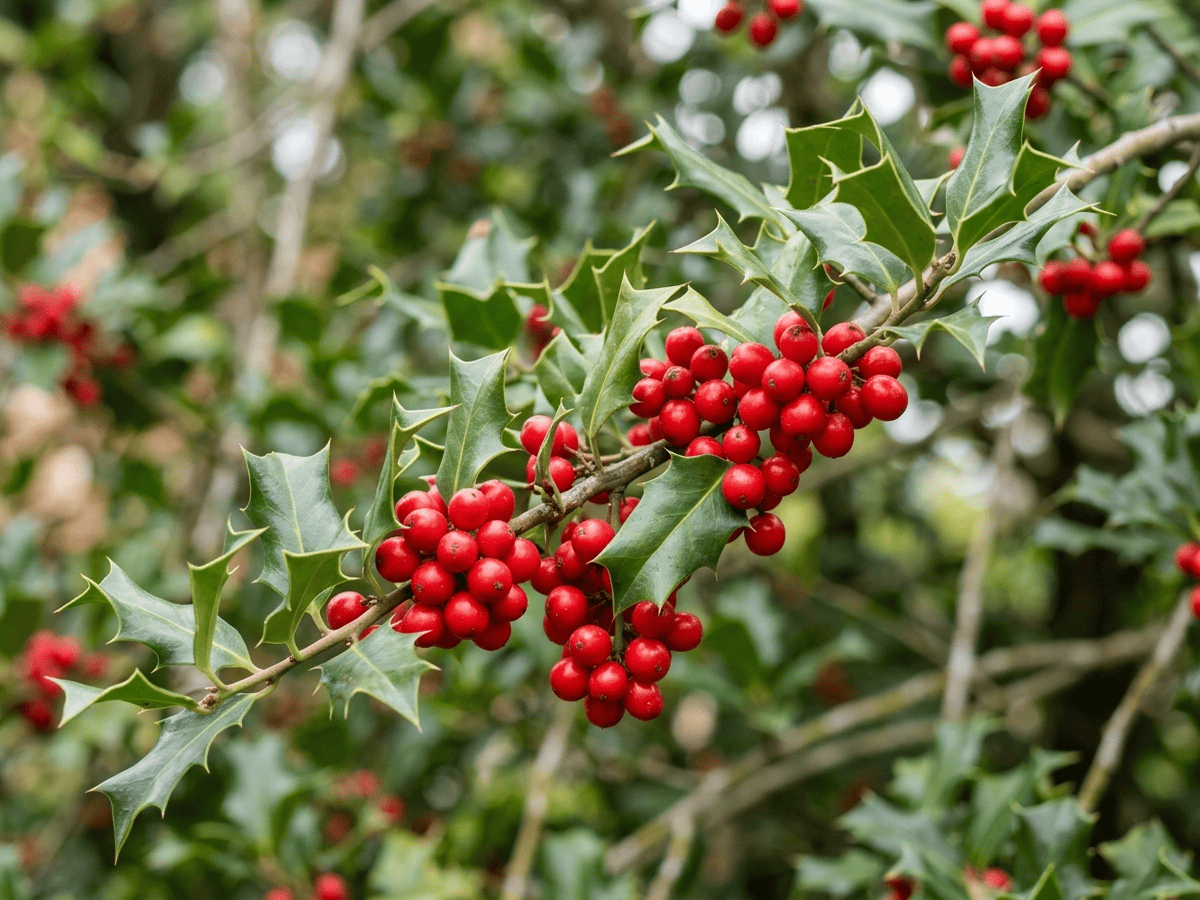


Chinese Holly
Ilex cornuta
Easy · Beginner friendlyAbout Chinese Holly
Chinese Holly is a dense evergreen shrub from China and Korea, growing 8-15 feet tall with distinctive rectangular spiny leaves bearing sharp points at the corners. It is notable for producing abundant bright red berries without needing cross-pollination—a major advantage over most hollies. Extremely heat and drought tolerant, it thrives in the challenging conditions of the American South. The cultivar 'Burfordii' with its simpler single-spined leaves is one of the most widely planted landscape shrubs in the southeastern United States.
- Drought-tolerant
- Heat-tolerant
- Evergreen
- Wildlife-friendly
How to care for Chinese Holly
Watering
- Springevery 7 days
- Summerevery 5 days
- Fallevery 10 days
- Winterevery 21 days
Soil · Acidic · pH 4.5–6
- Top dressingPine needle mulch10%
- Main mixAcid-lover mix + peat 3:175%
- DrainageGravel15%
Never add lime or wood ash — it cancels out the acidity.
FERTILIZER
Balanced Feed 14-14-14
An even feed covers all three needs at once, keeping leaves, roots and blooms moving together with nothing pushed out of balance.
- Nitrogen · Leaves
- Phosphorus · Roots + Blooms
- Potassium · Strength
- Springevery 30 days
At a Glance
- NativeEast Asia
- Height8–15 ft (2.4–4.6 m)
- Spread6–10 ft (1.8–3 m)
- Flower colorWhite
- Foliage colorDark-green, Green
- Fruit colorRed
- SoilLoamy, Well-drained, Acidic
- LocationsYard
Bloom time
BLOOM CYCLE
Peak bloom
Mar–May
Inconspicuous spring flowers; self-fertile—no pollinator needed for berries
Fragrance
LIGHT FRAGRANCE
Mild sweet scent from flowers.
Toxicity
Humans Moderate · Pets Moderate
saponins and theobromine
Moderate
- Fruit
- Leaf
- Ingestion
EXPOSURE Eating fruit and leaves.
EFFECT Nausea, vomiting, diarrhea from saponins.
NOTE Documented concern for humans: Nausea, vomiting, diarrhea from saponins.
Moderate
- Fruit
- Leaf
- Ingestion
EXPOSURE Eating fruit and leaves.
EFFECT Vomiting, diarrhea, lethargy.
NOTE ASPCA toxic. Leaves sharp-spined—physical injury possible.
Moderate
- Fruit
- Leaf
- Ingestion
EXPOSURE Eating fruit and leaves.
EFFECT Vomiting, diarrhea, lethargy.
NOTE ASPCA toxic. Leaves sharp-spined—physical injury possible.
Educational information, not medical or veterinary advice. If exposure is suspected, contact a doctor or veterinarian.
DISTRIBUTION


- Native
- Introduced
- East Asia
History

Ilex cornuta is native to eastern China (Jiangsu, Anhui, Zhejiang, Jiangxi, Hubei, Henan, Hebei) and Korea. English botanist John Lindley described the species in 1846 from a cultivated Chinese plant imported to England, the epithet cornuta meaning horned for the characteristic rectangular 4-5 spined leaves. Robert Fortune introduced the species to the Horticultural Society of London around 1844.
The classic wild-type leaf has spines at each corner plus the tip—an unmistakable identification feature. Female plants produce heavy crops of bright red berries held well into winter. In the southern United States, particularly Texas and the Gulf states, Chinese holly cultivars are among the most widely planted evergreen shrubs.
The most famous is 'Burford', selected around 1900 by T.W. Burford at Westview Cemetery in Atlanta, Georgia—remarkably it is parthenocarpic (producing berries without pollination) and nearly spineless, with only a single leaf-tip spine. 'Dwarf Burford' is a compact sport. 'Carissa' (also nearly spineless) and 'Needlepoint' are other common cultivars. Introduced from China by Robert Fortune in the 1840s. The Burford holly ('Burfordii'), selected in the 1930s at Westview Cemetery in Atlanta, Georgia, transformed Southern landscaping with its heavy berry production, heat tolerance, and simpler leaf shape. Its spiny nature makes it an effective natural security barrier. Chinese holly hedges are a defining feature of traditional Southern landscapes from Virginia to Texas.
Symbolism & meaning
What It Symbolizes
Chinese Holly carries foresight in its very biology — self-fertile fruiting means it produces brilliant red berries even without a pollinator partner nearby, planning ahead for solitary winters. Its formidable spiny leaves also speak of defense, creating natural barriers that hedge homes and gardens with armored grace. Beauty and strategy bundled into a single evergreen shrub.
- Foresight — self-fertile fruiting ensures berries without a pollinator
- Defense — formidable spiny leaves create natural barriers
Where the Name Comes From
The name Chinese Holly points to China. 'Ilex' is the classical Latin name for holm oak (similar leaves); 'cornuta' means 'horned' in Latin, referring to the distinctive horn-like leaf spines.
Uses & Fun Facts
- Spiny evergreen foliage trimmed into impenetrable security hedges
- Red berries persist into winter for songbirds and waxwings
- Glossy holly foliage and red berries for winter interest
Related plants
More Ilex plants
 European HollyIlex aquifolium
 Japanese HollyIlex crenata
 Myrtle DahoonIlex myrtifolia
 American HollyIlex opaca
Plants with similar care
 Chinese AbeliaAbelia chinensis
 Fragrant AbeliaAbelia mosanensis
 Large-Flowered AbeliaAbelia uniflora
 Glossy AbeliaAbelia x grandiflora
Frequently asked questions
How often should I water Chinese Holly?
In summer, water about every 5 days; in winter, about every 21 days. Adjust for heat, pot size and drainage.
How much light does Chinese Holly need?
Full sun: 6+ hrs direct. Watch the leaves — scorching or stretching means the light needs adjusting.
Is Chinese Holly toxic to cats or dogs?
Pets Moderate (Dogs Moderate · Cats Moderate) Educational information, not medical or veterinary advice. If exposure is suspected, contact a doctor or veterinarian.
Is Chinese Holly easy to grow?
Yes — it is considered an easy, beginner-friendly plant.
When does Chinese Holly bloom?
It typically blooms Mar–May in the Northern Hemisphere.
YardMate
Identify any plant in seconds
Snap a photo — YardMate names the plant, diagnoses problems, and reminds you when to water.
Download on the App Store