 YardMate


Pontic Rhododendron
Rhododendron ponticum
Medium · Some experienceAbout Pontic Rhododendron
Rhododendron ponticum is a large evergreen shrub native to the western and eastern Mediterranean, the Caucasus, and parts of the Iberian Peninsula. Growing 6 to 15 feet tall or more, it produces spectacular trusses of funnel-shaped purple-lavender flowers in late spring to early summer. Its large, glossy, dark evergreen leaves provide year-round structure and density. The plant thrives in acidic, moist, well-drained soil in partial shade, typical of woodland conditions. While ornamentally impressive, R. ponticum has become one of the most problematic invasive species in the British Isles, Ireland, and parts of western Europe, where it forms impenetrable thickets that shade out native plants and alter soil chemistry. Each flower head can produce millions of tiny seeds, and the plant also spreads by layering. Its leaves and nectar contain grayanotoxins that are toxic to most animals. Despite its invasive reputation in some regions, it remains popular in cultivation where it can be managed, and it serves as the primary rootstock for grafting hybrid rhododendrons.
- Shade-tolerant
- Evergreen
How to care for Pontic Rhododendron
Watering
- Springevery 3 days
- Summerevery 2 days
- Fallevery 7 days
- Winterevery 21 days
Soil · Acidic · pH 4.5–6
- Top dressingPine needle mulch10%
- Main mixAcid-lover mix + peat 3:175%
- DrainageGravel15%
Never add lime or wood ash — it cancels out the acidity.
FERTILIZER
Acid-Loving Feed 4-3-4
One bag does both jobs. An acid feed carries the usual nitrogen, phosphorus and potassium, plus the sulfur and iron that keep the soil sour enough for the roots to take them up at all.
- Nitrogen · Leaves
- Phosphorus · Roots + Blooms
- Potassium · Strength
- Springevery 45 days
At a Glance
- NativeMediterranean
- Height8–15 ft (2.4–4.6 m)
- Spread8–15 ft (2.4–4.6 m)
- Flower colorPurple, Pink
- Foliage colorGreen
- SoilAcidic, Moisture-retentive, Well-drained
- LocationsYard
Bloom time
BLOOM CYCLE
Peak bloom
Mar–May
Purple-lavender trusses in late spring; deadhead spent flowers carefully without damaging the growth buds directly beneath
Fragrance
LIGHT FRAGRANCE
The flowers have a light scent.
Toxicity
Humans Toxic · Pets Toxic
grayanotoxins
Toxic
- Leaf
- Flower
- Nectar
- Ingestion
EXPOSURE Eating leaves, flowers, and nectar.
EFFECT Grayanotoxin poisoning: dizziness, low blood pressure, bradycardia, vomiting, seizures and "mad honey" effect well documented.
NOTE Documented concern for humans: Grayanotoxin poisoning: dizziness, low blood pressure, bradycardia, vomiting, seizures and "mad honey" effect well documented.
Toxic
- Leaf
- Flower
- Ingestion
EXPOSURE Eating leaves and flowers.
EFFECT Vomiting, drooling, weakness, bradycardia, cardiac arrhythmias, potentially fatal.
NOTE ASPCA lists Rhododendron as toxic to dogs, cats, and horses. All plant parts — including nectar and honey made from its nectar — contain grayanotoxins.
Toxic
- Leaf
- Flower
- Ingestion
EXPOSURE Eating leaves and flowers.
EFFECT Same grayanotoxin toxicity as dogs.
NOTE ASPCA lists Rhododendron as toxic to dogs, cats, and horses. All plant parts — including nectar and honey made from its nectar — contain grayanotoxins.
Educational information, not medical or veterinary advice. If exposure is suspected, contact a doctor or veterinarian.
DISTRIBUTION


- Native
- Introduced
- Mediterranean
History
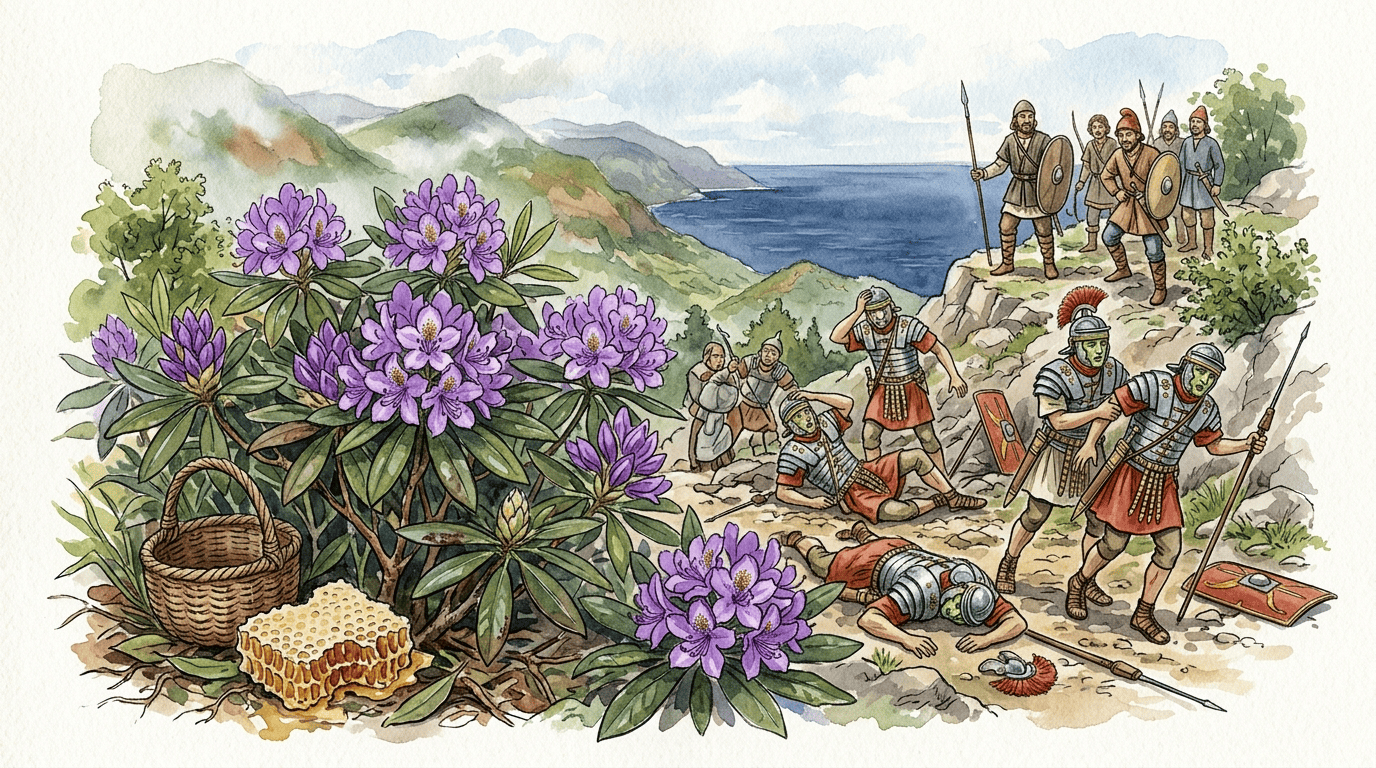
Rhododendron ponticum is native to the Pontic region around the southern and eastern Black Sea — northern Turkey, Georgia, and Bulgaria — with disjunct relict populations in Iberia (Portugal and southwestern Spain) that survived the last Ice Age. It was introduced to British horticulture in 1763 by Conrad Loddiges's nursery from Gibraltar seed, and through the 19th century was extensively planted as game cover on British and Irish estates and as rootstock for grafted rhododendron hybrids. It proved spectacularly successful — too successful.
In the 20th and 21st centuries it has become one of the most serious invasive non-native plants in the British Isles, forming impenetrable thickets that shade out native woodland understory and produce an allelopathic leaf litter that prevents regeneration. Massive, expensive eradication programs run in Snowdonia National Park, Killarney National Park, and across UK National Trust properties.
The plant's nectar contains grayanotoxins — toxins historically responsible for the ancient "mad honey" (deli bal) of the Pontic region, famously used by Mithridates VI of Pontus in 67 BCE to incapacitate Roman soldiers under Pompey (recorded by the geographer Strabo). Turkish mad honey is still produced in small quantities today. Rhododendron ponticum was introduced to Britain in 1763 as an ornamental and game-cover plant for shooting estates.
Symbolism & meaning
What It Symbolizes
Pontic rhododendron is a vivid lesson in caution — across the British Isles its purple flowers have escaped Victorian estates and now smother native woodlands, choking out everything beneath. The danger is older still: bees feeding on it produce mad honey, which has poisoned soldiers since the time of Xenophon. Beautiful, invasive, and chemically perilous, it is a reminder that hidden peril can wear a glamorous coat.
- Caution — Its toxicity and invasive nature serve as a warning to treat beauty with respect
- Danger — Associated with 'mad honey' and hidden peril behind beautiful appearances
Where the Name Comes From
'Rhododendron' from Greek 'rhodon' (rose) and 'dendron' (tree), meaning 'rose tree.' 'Ponticum' means 'of Pontus', the ancient kingdom on the Black Sea coast of Turkey where it was first described.
Uses & Fun Facts
- Massive purple flower trusses smother evergreen shrubs in late spring
- Dense evergreen growth pruned into large estate-scale screens
- Bell-shaped blooms attract bumblebees and early-season butterflies
Related plants
More Rhododendron plants
 Smooth AzaleaRhododendron arborescens
 Augustine's RhododendronRhododendron augustinii
 Orange AzaleaRhododendron austrinum
 Mountain AzaleaRhododendron canescens
Plants with similar care
 Japanese MapleAcer palmatum
 Azure MonkshoodAconitum carmichaelii
 Florida HobblebushAgarista populifolia
 Shell GingerAlpinia zerumbet
Frequently asked questions
How often should I water Pontic Rhododendron?
In summer, water about every 2 days; in winter, about every 21 days. Adjust for heat, pot size and drainage.
How much light does Pontic Rhododendron need?
Part shade: 2–4 hrs direct. Watch the leaves — scorching or stretching means the light needs adjusting.
Is Pontic Rhododendron toxic to cats or dogs?
Pets Toxic (Dogs Toxic · Cats Toxic) Educational information, not medical or veterinary advice. If exposure is suspected, contact a doctor or veterinarian.
Is Pontic Rhododendron easy to grow?
It is moderately demanding: a good choice once you have a little experience.
When does Pontic Rhododendron bloom?
It typically blooms Mar–May in the Northern Hemisphere.
YardMate
Identify any plant in seconds
Snap a photo — YardMate names the plant, diagnoses problems, and reminds you when to water.
Download on the App Store