 YardMate



Borage
Borago officinalis
Easy · Beginner friendlyAbout Borage
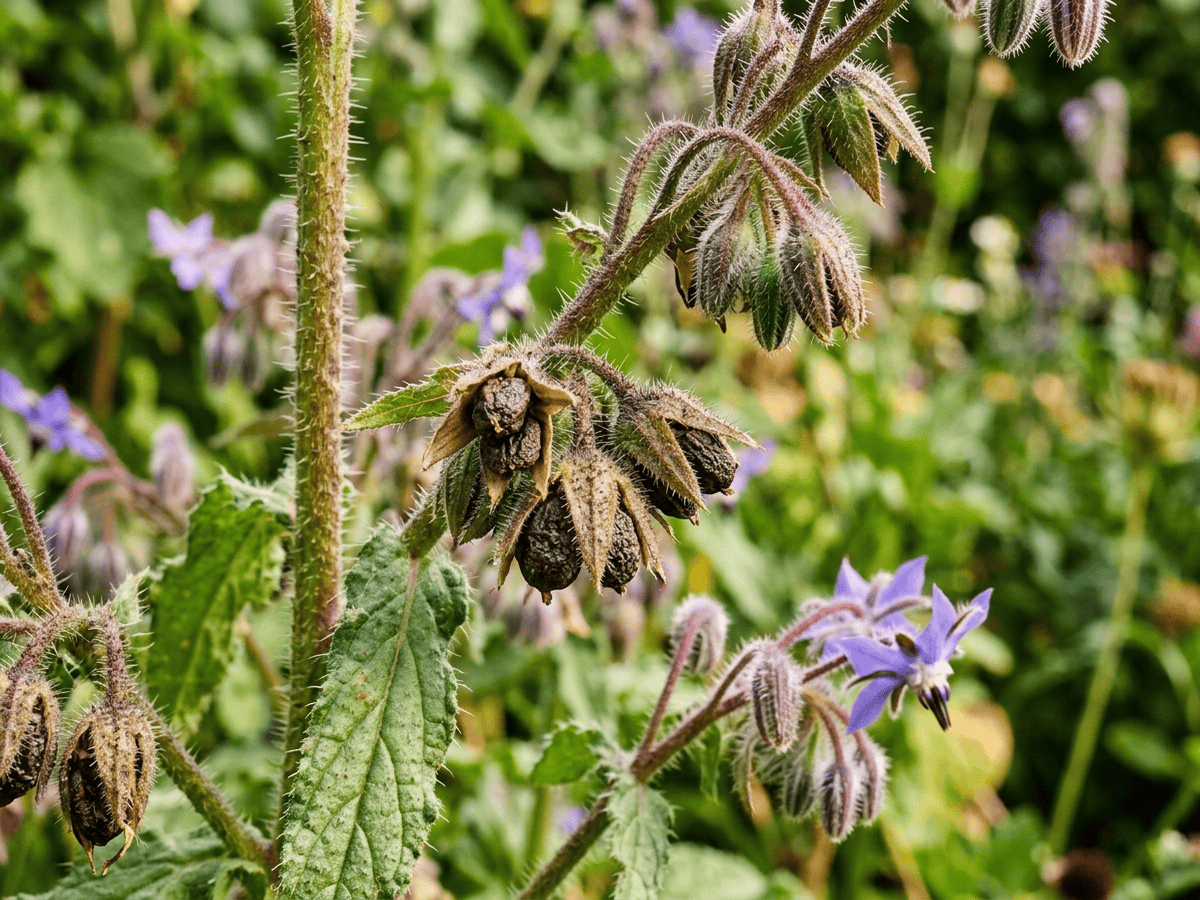
Borago officinalis, or borage, is an annual herb in the Boraginaceae family native to the western Mediterranean region. Growing 60–90 cm tall, it produces large, rough-textured leaves and clusters of star-shaped, vivid blue flowers that hang in graceful drooping cymes. The entire plant is covered in stiff white hairs, giving it a distinctive bristly texture.
Borage is exceptionally easy to grow, self-sowing readily in any well-drained soil in full sun to partial shade. It germinates quickly and flowers within eight weeks of sowing, making it a rewarding annual even for beginners. The plant is one of the finest bee magnets in the garden—studies show honeybees preferentially visit borage over many other flower sources, and the blossoms refill with nectar every few minutes.
Culinary uses include adding the cucumber-flavoured flowers to salads, cocktails, and frozen in ice cubes. Young leaves are edible cooked like spinach. Borage seed oil is commercially important, containing gamma-linolenic acid (GLA) used in skincare and supplements. In companion planting, borage is a classic tomato and strawberry companion, thought to deter certain pests and improve flavour. The plant's taproot also helps break compacted soil.
- Edible
- Pollinator-friendly
How to care for Borage
Watering
- Springevery 3 days
- Summerevery 2 days
- Fallevery 4 days
- Winterevery 7 days
Soil · Rich & well-draining
- Top dressingCompost10%
- Main mixPotting soil + compost 3:180%
- DrainageGravel10%
Top up the compost layer each season.
FERTILIZER
- Springevery 21 days
- Summerevery 21 days
- Fallevery 30 days
At a Glance
- NativeMediterranean
- Height1.5–3 ft (0.5–0.9 m)
- Spread1–1.5 ft (0.3–0.5 m)
- Flower colorBlue, Pink, White
- Foliage colorGreen
- SoilWell-drained, Loamy, Sandy
- LocationsYard
Bloom time
BLOOM CYCLE
Peak bloom
Mar–Nov
Succession-sow every 3 weeks for continuous blue blooms from spring to frost.
Fragrance
LIGHT FRAGRANCE
The foliage has a mild cucumber-saline aroma.
Toxicity
Humans Slight · Pets Slight
pyrrolizidine alkaloids (trace) and gamma-linolenic acid (in seed oil)
Slight
- Leaf
- Seed
- Ingestion
EXPOSURE Eating leaves and seeds.
EFFECT Contains trace pyrrolizidine alkaloids and occasional use safe but chronic high-dose intake not recommended.
NOTE Culinary amounts generally safe; some sources advise against daily long-term consumption due to pyrrolizidine alkaloid content.
Slight
- All
- Ingestion
EXPOSURE Eating any part of the plant.
EFFECT Trace pyrrolizidine alkaloids — chronic intake could cause liver issues.
NOTE Culinary amounts generally safe; some sources advise against daily long-term consumption due to pyrrolizidine alkaloid content.
Slight
- All
- Ingestion
EXPOSURE Eating any part of the plant.
EFFECT Trace pyrrolizidine alkaloids — chronic intake could cause liver issues.
NOTE Culinary amounts generally safe; some sources advise against daily long-term consumption due to pyrrolizidine alkaloid content.
Educational information, not medical or veterinary advice. If exposure is suspected, contact a doctor or veterinarian.
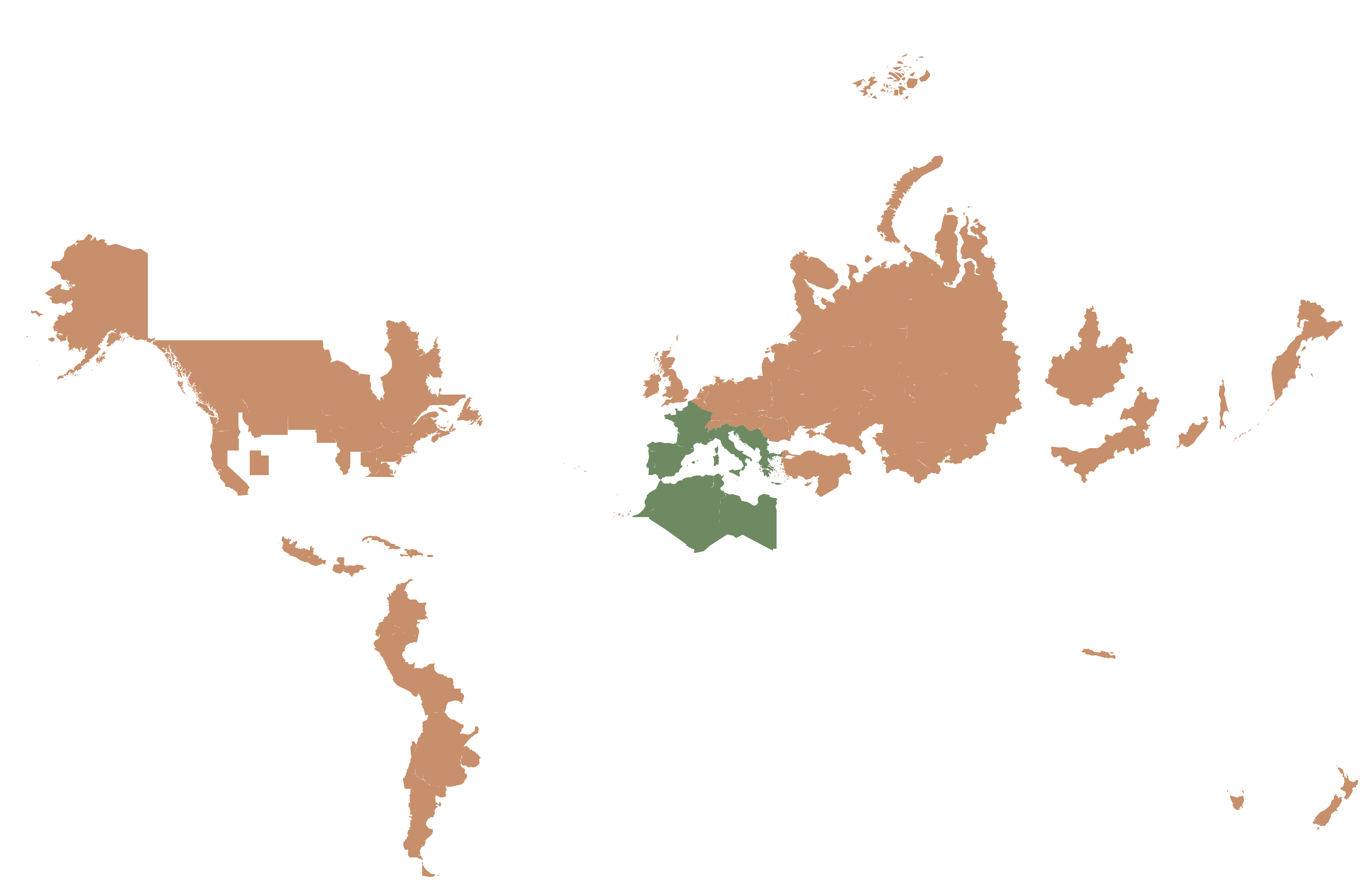
DISTRIBUTION

- Native
- Introduced
- Mediterranean
History
Borago officinalis is probably native to the Mediterranean, though its long cultivation history has obscured exact origins. The name may derive from Latin "burra" (rough hair, referring to the plant's bristles) or Arabic "abu 'araq" (father of sweat, for a diaphoretic effect). Classical and medieval herbalists including Dioscorides, Pliny, and Gerard all recorded the saying "I, borage, bring courage" (Ego borago gaudia semper ago) and the practice of floating the blue star-shaped flowers in wine to cheer drinkers.
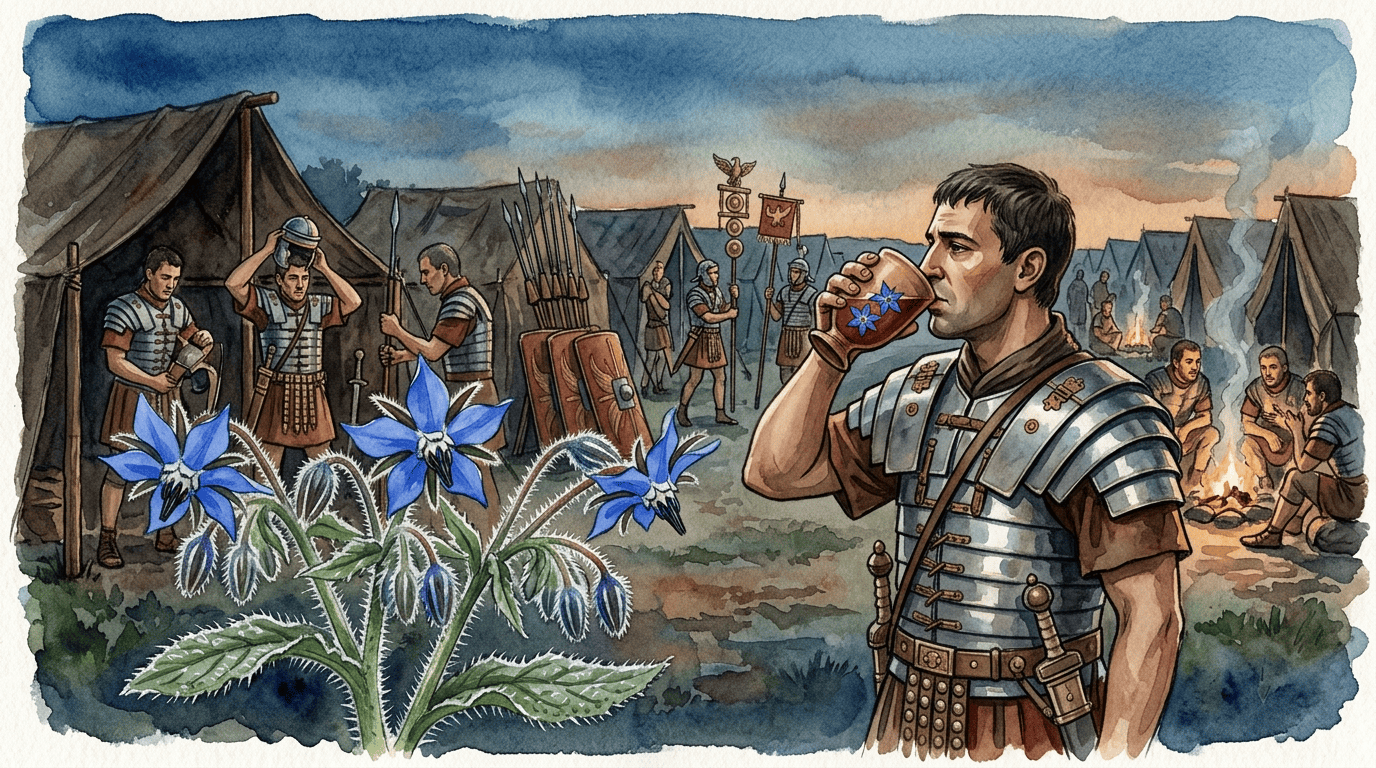
It was carried by Roman soldiers across Europe. The flowers, with their sapphire-blue color and clear honey flavor, are traditional garnishes for Pimm's Cup and summer fruit drinks in Britain. Young leaves have a distinct cucumber-saline flavor used in Italian Ligurian cuisine (ravioli di borragine, pansoti).
Borage seed oil is a commercial source of gamma-linolenic acid (GLA), marketed as a dietary supplement. The plant is also one of the best bee-forage annuals. Roman soldiers ate borage before battle to bolster bravery, and the herb's Latin motto 'Ego borago gaudia semper ago' (I, borage, always bring courage) was repeated through the Middle Ages. Celtic warriors drank borage wine for the same purpose. It was a key ingredient in the original Pimm's Cup.
Symbolism & meaning
What It Symbolizes
Borage has carried courage since antiquity, when its starry blue flowers were linked with cheer before battle and boldness at the table. Bees crowd the blooms, and the cucumber-scented leaves bring a rough, generous freshness. Its symbolism is morale: the garden's blue encouragement when spirits need lifting.
- Courage — Since antiquity borage has been the herb of bravery, believed to lift spirits and embolden the heart
- Joy — Medieval herbalists prescribed borage to dispel melancholy and bring cheerfulness
Where the Name Comes From
Possibly from Arabic 'abu araq' (father of sweat), referencing its use as a diaphoretic; or from Latin 'borra' (rough hair), describing the bristly stems.
Uses & Fun Facts
- Cucumber-flavored leaves and blue flowers garnish drinks and salads
- Star-shaped blooms heavily favored by honeybees
- Seeds yield gamma-linolenic acid used in supplements
Related plants
Plants with similar care
 Chinese AbeliaAbelia chinensis
 Fragrant AbeliaAbelia mosanensis
 Large-Flowered AbeliaAbelia uniflora
 Glossy AbeliaAbelia x grandiflora
Frequently asked questions
How often should I water Borage?
In summer, water about every 2 days; in winter, about every 7 days. Adjust for heat, pot size and drainage.
How much light does Borage need?
Full sun: 6+ hrs direct. Watch the leaves — scorching or stretching means the light needs adjusting.
Is Borage toxic to cats or dogs?
Pets Slight (Dogs Slight · Cats Slight) Educational information, not medical or veterinary advice. If exposure is suspected, contact a doctor or veterinarian.
Is Borage easy to grow?
Yes — it is considered an easy, beginner-friendly plant.
When does Borage bloom?
It typically blooms Mar–Nov in the Northern Hemisphere.
YardMate
Identify any plant in seconds
Snap a photo — YardMate names the plant, diagnoses problems, and reminds you when to water.
Download on the App Store